
 Worksheets
Mol Bio
Total questions: 116
Worksheet time: 2hrs 59mins
Organelle in eukaryotic cells that is the site of cellular respiration that burns sugar with oxygen to produce energy, carbon dioxide, and water.
Chloroplasts
Vacuoles
Mitochondria
Golgi Apparatus
Which of the following are basic needs for plants to make food, but not for animals.
Water and oxygen
Acid rain
Sunlight, CO2, and soil
Glucose
Which best describes how organisms obtain energy from food?
Food (Glucose) reacts with water to release energy during photosynthesis.
Food (Glucose) reacts with oxygen to release energy (ATP) during cellular respiration.
Food (Glucose) reacts with sunlight to release energy during photosynthesis.
Food (Glucose) reacts with carbon dioxide to release energy during cellular respiration.
How are plant cells and human cells the same?
They can produce their own oxygen.
They can receive nutrients through the cell wall.
They make their own glucose from sunlight during photosynthesis.
They use mitochondria to release energy from glucose during cellular respiration.
Which best describes the nutrients that are sources of energy for the body?
fats and proteins
fats and carbohydrates
water and carbohydrates
Calcium and fiber
Which choice describes a chromosome in a prokaryotic cell?
linear in the nucleus
circular in the nucleus
linear in the cytoplasm
circular in the cytoplasm
What is the correct description of eukaryotic chromosomes?
many linear pieces of DNA in the cytoplasm
many linear pieces of DNA in the nucleus
one circular piece of DNA in the cytoplasm
many circular pieces of DNA in the nucleus
Which choices describe DNA replication?
semiconservative
produces two pieces of DNA identical to the original
products are half original and half new
all of the above
What is the process for making another DNA copy of a chromosome?
replication
transcription
translation
chromatin
Where in the cell does DNA replication occur?
always the cytoplasm
always the nucleus
in the cytoplasm in eukaryotes and the nucleus in prokaryotes
in the cytoplasm in prokaryotes and the nucleus in eukaryotes
What is the enzyme responsible for DNA replication?
DNA polymerase
RNA polymerase
ribosome
nucleolus
What does DNA polymerase do?
connects sugars and phosphates with weak hydrogen bonds
connects sugars and phosphates with strong covalent bonds
connects bases with strong hydrogen bonds
connects bases with strong covalent bonds
What are the 2 functions of DNA polymerase?
makes DNA and RNA
makes DNA and protein
makes DNA and fixes its mistakes
makes RNA and protein
What is the structure of the DNA during DNA replication?
wrapped around histones in chromatin form
tightly coiled into chromosomes
just as it appears in a karyotype
DNA has no structure during replication
When in the cell cycle is DNA replication?
S phase of interphase
Go of interphase
mitosis
meiosis
Where does transcription take place in a cell?
always in the nucleus
always in the cytoplasm
in the nucleus in eukaryotes and the cytoplasm in prokaryotes
in the cytoplasm in eukaryotes and the nucleus in prokaryotes
Which of the following describes the product of transcription?
contains ribose and U''s
contains deoxyribose and T's
contains ribose and T's
contains deoxyribose and U's
What is the first step in both replication and transcription?
DNA is unzipped
weak hydrogen bonds are broken
DNA strands separate
all of the above
Which of the following describes the products of transcription?
long, double stranded RNA
short, double stranded DNA
long, single stranded RNA
short, single stranded RNA
Following transcription in eukaryotes, the RNA
stays in the nucleus
is made into mRNA and goes to the cytoplasm
goes directly to the cytoplasm without changes
goes back to the nucleus for changes
In replication, ______________ DNA strands are copied and in transcription ____________________ DNA strands are copied.
only one of the, both
both, only one of the
both, both
only one of the, only one of the
rRNA is
used as a template to make protein
part of a ribosome
a small molecule used by the ribosome and is not made into protein
all of the above
mRNA is
used as a template to make protein
part of a ribosme
a small molecule used by the ribosome and is not made into protein
all of the above
What happens to an mRNA when the protein it is used to make is no longer needed?
it is broken down into amino acids and they are reused
it is broken down into nucleotides and they are reused
it is broken down into glucose and reused
it goes back to the nucleus
Where are rRNA and tRNA made in the cell?
the nucleolus in the cytoplasm
the nucleolus in the mitochondria
the nucleolus in the nucleus
always in the cytoplasm
tRNA is
used as a template to make protein
part of a ribosome
a small molecule used by the ribosome and is not made into protein
all of the above
CAT TCA CTG


Eukaryotes differ from prokaryote in mechanism of DNA replication due to ____________
Use of DNA primer rather than RNA primer
Different enzyme for synthesis of lagging and leading strand
Discontinuous rather than semi-discontinuous replication
Unidirectional rather than semi-discontinuous replication

Which enzyme is responsible for adding nucleotides to the free three prime end
Helicase
Topoisomerase
DNA Polymersase 3
DNA Polymersase 1
What are three parts of a DNA nucleotide?
Phosphate group
Sugar
Hydrogen
Nitrogenous base
What is RNA?
A nucleic acid that processes all steps of protein synthesis in all living cells.
A molecule that contains the genetic code of organisms.
The process in which cells make proteins.
A gene that is damaged or changed in a way to alter the genetic message carried by that gene.
What is transcription?
A molecule that contains the genetic code for organisms.
The RNA → Protein part of the central dogma
The DNA → RNA part of the central dogma of molecular biology
The process in which cells make proteins
What is translation?
The RNA → Protein part of the central dogma
The DNA → RNA part of the central dogma of molecular biology
The process in which cells make proteins
A molecule that contains the genetic code of organisms.
How many cells at least does your genes have?
50,000
30,000
20,000
40,000

Operons are found in the cells of which of the following types of organisms?
prokaryotes
eukaryotes
animals only
viruses
What is the name of the stretch of DNA where RNA polymerase binds?
operator
promoter
enhancer
regulatory gene
A key advantage of grouping genes with related functions is that a single "on-off" switch can control the whole cluster.
True
False
The "on/off" switch for an operon is called the
promoter
enhancer
operator
gene

What is a gene?
A segment of RNA that encodes for a protein
The portion of the chromosome that does not get transcribed
A segment of DNA that encodes for a protein
The collection of your chromosomes
A protein that binds to the operator and blocks the RNA polymerase
inducer
repressor
activator
corepressor
The tryptophan operon is
permanently turned on.
turned on when tryptophan is present in the growth medium.
turned off only when glucose is present in the growth medium.
turned off when tryptophan is added to the growth medium.
In the lac operon model, the genes within the operon will be expressed if
lactose is absent in the cell
glucose is present in the cell
lactose is present in the cell
tryptophan is present
The purpose of the lac operon is to produce enzymes that
synthesize lactose
use lactose
synthesize tryptophan
use tryptophan
The lac operon is referred to as a(n) __________ operon.
inducible
repressible
audible
inaudible
ATG GGA ACT CCA

This point is translated 3 right and 2 down. Which diagram shows the new position of the point?


Why must transcription occur where DNA can be found?
because DNA can't leave
because ribosomes are in the nucleus
because DNA polymerase is found there
because helicase unzips the DNA
TRANSCRIBE this DNA sequence: TACGTTACT
AUGCAAUGA
ATGCAATGA
AUGGATUGA
TACGTTACT

A polypeptide is a sequence of ____________________ held together by a ______________ bond.
amino acids; peptide
fatty acids; ionic
proteins; hydrogen
fatty acids; covalent
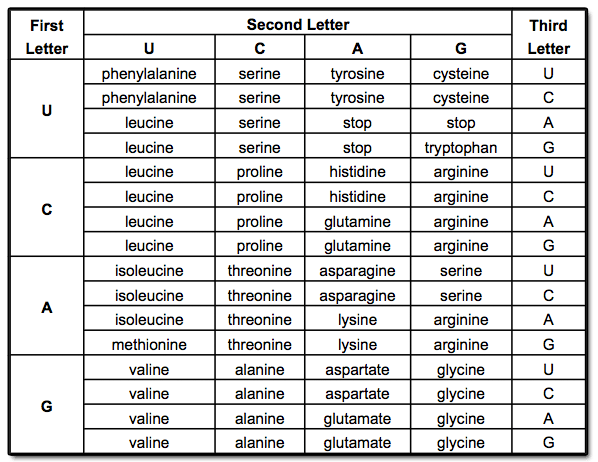
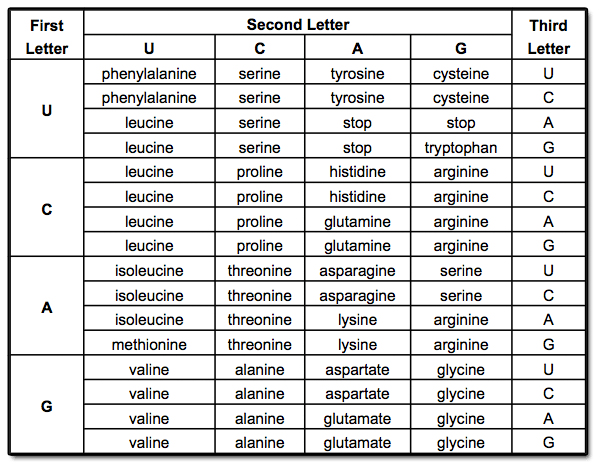
TRANSLATE this RNA sequence: AUGCAAUGA
Met-Glu-Stop
Met-His-Stop
Thr-Glu-Stop
Thr-Pro-Stop
True or False: The sugar in a nucleotide of DNA is called deoxyribose.
True
False
True or False: RNA is double stranded.
True
False
What type of RNA moves to the ribosome to start protein synthesis?
tRNA
mRNA
rRNA
nRNA
Which macromolecule is made up of amino acids?
carbohydrate
lipid
nucleic acid
protein
mRNA is read into amino acids during what process?
transcription
transfer
translation
transition
RNA polymerase reads the mRNA strand in which direction?
3' to 5' direction
5' to 3' direction
mRNA is made in which direction?
5' to 3' direction
3' to 5' direction
Where would you find the anti-codon?
tRNA
mRNA
ribosome
rRNA
What do tRNA bring to the ribosome?
glucose
fatty acids
nucleotides
amino acids

