wayground logo

Free Printable Worksheets

Font size

S
M
L
XL
Worksheets

Biology PMA3 Review

Total questions: 121

Worksheet time: 2hrs 52mins

Name
Class
Date
1.
What will most likely happen if the human population continues to grow at current rates?
a)
There will be fewer natural resources available for future generations.
b)
There will be an increase in nitrogen levels in the atmosphere. 
c)
There will be a decrease in water pollution. 
d)
There will be an increase in the number of strong hurricanes. 
2.
A strand of DNA has these bases:
 AGC CAT GTA TAC What is the complementary DNA strand?
a)
ACG GAT CTA TAG
b)
TCG GTA CAT ATG
c)
TGC CTA GAT ATC
d)
UCG CUA CAU AUG
3.
Which statement best describes the relationship that exists among proteins, DNA, and cells?
a)
Proteins combine to produce cells, which produce DNA
b)
Proteins are made up of DNA, which determines the cells that are produced. 
c)
DNA is made up of proteins, which tell a cell how to function. 
d)
Cells contain DNA, which controls the production of proteins.
4.
Which process produces the most variation within a species? 
a)
Asexual reproduction
b)
Sexual reproduction
c)
mitosis
d)
cloning
5.
What are the subunits of DNA and their function? 
a)
nucleotides that store information 
b)
monosaccharides that provide quick energy for the cell
c)
lipids that store energy and provide insulation 
d)
proteins that provide the building blocks for the structural components of organisms 
6.
The use of pesticides on crops has been a common farming practice for decades. What has been the greatest effect of natural selection through the use of pesticides on certain insect populations? 
a)
Natural selection has been altered because the insects and their predators are killed. 
b)
The rate of selection is increased because the pesticides do not kill the insects that are naturally resistant to it. 
c)
The rate of selection has decreased because the pesticides kill only young insects. 
d)
The pesticides have altered natural selection by causing the insect DNA to spontaneously mutate.
7.
What type of organic molecules are enzymes? 
a)
carbohydrates
b)
lipids 
c)
nucleic acids
d)
proteins
8.
A freshwater plant is placed in a container of saltwater. What will most likely happen to the cells of the plant?
a)
They will swell because water will move into them.
b)
They will swell because salt will move into them
c)
They will shrink because water will move out of them.
d)
They will shrink because salt will move out of them.
9.
How does the amount of energy resulting from fermentation compare with that of aerobic respiration? 
a)
Aerobic respiration results in less energy.
b)
Aerobic respiration results in more energy.
c)
Each process results in equal amounts of energy.
d)
Each process results in variable amounts of energy.
10.
This diagram shows a plant cell. Which structure is found in a plant cell but is absent in an animal cell? 
a)
1
b)
2
c)
3
d)
4
11.
What will most likely be the result if all of the mitochondria are removed from a plant cell? 
a)
It will be unable to carry out respiration. 
b)
It will lose water through osmosis.  
c)
It will break down ribosomes in the cell
d)
It will be unable to photosynthesize.
12.
A compound is analyzed and found to have the chemical formula C6H12O6. What type of macro molecule is this substance?
a)
protein
b)
lipid
c)
carbohydrate
d)
nucleic acid
13.
What disease is likely to result if a cell begins to reproduce abnormally?
a)
HIV
b)
influenza
c)
cancer
d)
Tay-Sachs disease
14.
Which of the following best describes cellular respiration?
a)
external breathing
b)
the breakdown of sugar to release energy in cells
c)
the movement of water from outside a cell to inside the cell
d)
the removal of water from a cell
15.
Which of the following correctly describes the reactants involved in cellular respiration?
a)
oxygen and carbon dioxide
b)
carbon dioxide and glucose
c)
glucose and water
d)
oxygen and glucose
16.
Which is the only structure you would expect to see when examining a prokaryotic cell with a compound microscope?
a)
nucleus
b)
chloroplast
c)
cell membrane
d)
mitochondria
17.
Cell have several mechanisms for regulating their internal environments.  Which of these mechanisms involved in maintaining homeostasis requires energy?
a)
osmosis
b)
diffusion
c)
active transport
d)
passive transport
18.
What does the peak of the dotted line represent?
a)
energy of the products
b)
reaction progress
c)
activation energy without a catalyst
d)
activation energy with a catalyst
19.
Which organic macromolecules are composed of chains of amino acids that join to form the structural components of organisms?
a)
carbohydrates
b)
nucleic acids
c)
proteins
d)
lipids
20.
Which of the following is a possible result of a disruption in the cell cycle?
a)
cancer
b)
photosynthesis
c)
cellular respiration
d)
protein synthesis
21.
Which cell part is present in eukaryotic cells, but not in prokaryotic cells?
a)
cell membrane
b)
cell wall
c)
cytoplasm
d)
nucleus
22.
What does the fossil record show about the history of species of Earth?
a)
Species stay the same over time.
b)
Species evolve from one form to another.
c)
Modern species have no relationship to ancient species.
d)
No species have become extinct in the last 2 million years.
23.
The standardized system for naming organism is known as binomial nomenclature.  What two pieces of information are used to name and identify organisms using this system?
a)
genus and species
b)
class and genus
c)
class and species
d)
domain and kingdom
24.
The genetic variation that leads to evolution can occur when genes from one population are introduced into the gene pool of a different population.  This process is known as
a)
mutation
b)
crossing over
c)
natural selection
d)
gene flow
25.
A strand of DNA with the sequence A-C-T-T-G serves as a template to form a strand of mRNA with the sequence U-G-A-A-C.  During which process would this happen?
a)
replication
b)
transcription
c)
translation
d)
meiosis
26.
Below is a food web diagram. Based on the diagram, it is reasonable to conclude that energy could follow which of the following paths as it cycles through this ecosystem?
a)
Sun ---> plant seeds ---> deer
b)
Plant seeds ---> field mouse ---> robin
c)
Eagle ---> deer ---> plant seeds
d)
Grass ---> deer ---> mountain lion
27.
An organism has a nucleus, is multicellular but has no cell wall and no chloroplast?
a)
Fungi
b)
Plantae
c)
Animalia
d)
Eubacteria
28.
This picture represents what type of cell transport?
a)
endocytosis
b)
exocytosis
c)
osmosis
d)
passive transport
29.
This picture represents which type of cellular transport?
a)
passive transport
b)
endocytosis
c)
exocytosis
d)
osmosis
30.
  A membrane that keeps out some molecules but allows others to pass:
a)
semi-permeable
b)
permeable
c)
diffusion
d)
concentration gradient
31.
Cells that have a true nucleus are called....
a)
eukaryotes
b)
prokaryotes
c)
unicellular
d)
multicellular
32.
In which organelle does photosynthesis occur?
a)
mitochondria
b)
ribosome
c)
xylem
d)
chloroplast
33.
A reduction in which of these would lead to a decrease in all other populations?
a)
Coyote
b)
Grass
c)
Grasshoppers 
d)
Squirrel 
34.

The molecule that transports the amino acid to the ribosome during protein synthesis is called the

a)

DNA

b)

mRNA

c)

tRNA

d)

rRNA

35.
What you see, or the physical appearance in a person:
a)
Genotype
b)
Phenotype
c)
Homozygous
d)
Heterozygous
36.

In a food web, grass is eaten by a rabbit. The rabbit becomes food for a hawk. What trophic level applies to the hawk?

a)

Primary producer

b)

Primary consumer

c)

Secondary consumer

d)

Tertiary consumer

37.

Doug is in a car accident and has an injury to the back of his head that results in his vision being affected even though his eyes are fine. What part of the brain was likely injured?

a)

The occipital lobe

b)

The cerebellum

c)

The frontal lobe

d)

The parietal lobe

38.

Human impact on the environment includes the addition of carbon dioxide to the atmosphere that contributes to global warming. Which of the following does is a major cause of global warming?

a)

Burning of fossil fuels

b)

Use of solar energy

c)

Use of hydroelectric power

d)

Use of nuclear energy

39.

An organism has the following characteristics:

multicellular, cells have a nucleus and a cell wall made of chitin, heterotrophic, and can reproduce sexually or asexually.

Which Domain and Kingdom does this organism belong to?

a)

Domain Archaea, Kingdom Archaea

b)

Domain Eukarya, Kingdom Animalia

c)

Domain Eukarya, Kingdom Fungi

d)

Bacteria, Kingdom Eubacteria

40.

The origins of life on earth are thought to have occurred from the formation of organic molecules in the early environment. Which of the following molecules are thought to have produced the first proteins?

a)

RNA

b)

DNA

c)

amino acids

d)

None of these

41.

The theory that states that early prokaryotic cells were engulfed by larger host cells and over millions of years the relationship evolved into the membrane-bound organelles we see today in eukaryotic cells.

a)

Natural selection

b)

Primordial soup theory

c)

Vestigial structures

d)

Endosymbiotic theory

42.

The atmosphere of early Earth consisted mostly of hydrogen, water vapor, methane and ammonia. How did oxygen become part of the atmosphere?

a)

Oxygen was produced from lightning passing through water vapor.

b)

The first eukaryotes were aerobic and produced carbon dioxide

c)

Spontaneous formation

d)

The first prokaryotes were anaerobic and produced oxygen.

43.

Which of the following is true about organisms in the Domain Eubacteria?

a)

They are not motile.

b)

They have a cell wall.

c)

They reproduce sexually.

d)

Some have a nucleus.

44.
Which of the following is an example of a homozygous dominant genotype?
a)
BB
b)
Bb
c)
bB
d)
bb
45.
What part of DNA holds the genetic information?
a)
the nitrogenous base
b)
the ribose sugar
c)
the phosphodiester bond
d)
the phosphate
46.
If a homozygous dominant (AA) individual is crossed to a homozygous recessive (aa) individual, what will the genotypes be of the offspring?
a)
50% AA, 50% aa
b)
25% AA, 50% Aa, 25% aa
c)
100% Aa
d)
50% AA, 50% Aa
47.
What is meant by the term "genetic variation?"
a)
Some individuals have the same genes as others
b)
Some genes are multiplied in tetraploid organisms
c)
Some chromosomes are longer than others
d)
Some individuals have different genes than others
48.
How do molecules move during facilitated diffusion?
a)
With the concentration gradient, using energy
b)
Against the concentration gradient, without using energy
c)
With the concentration gradient, without using energy
d)
Against the concentration gradient, using energy
49.

The efficiency of energy transfer from a lower trophic level to the next highest level is roughly

a)

1

b)

10

c)

50

d)

100

50.

In the energy pyramid here, how much of the energy in each level gets lost as heat or used by the organism for survival?

a)

80

b)

90

c)

10

d)

20

51.
Building blocks of proteins are
a)
Simple sugars
b)
Amino acids
c)
Monosaccharides
d)
Polysaccharides
52.
Two structures present in plant cells but NOT animal cells are:
a)
Chloroplasts and centrioles
b)
Chloroplasts and cell wall
c)
Chloroplasts and cell membrane
d)
Chloroplasts and ribosomes
53.
Controls what goes in and out of the cell
a)
Cell membrane
b)
Cell wall
c)
Chloroplasts
d)
Nucleus
54.
If a toxic chemical destroys the ribosomes, which cellular activity would be affected first?
a)
Energy storage
b)
Movement
c)
Protein production
d)
DNA synthesis
55.
What organelle is used to store food?
a)
Chloroplast
b)
Mitochondrion
c)
Vacuole
d)
Nucleus
56.

The organelle that is the site of cellular respiration which provides energy for the cell is the

a)

Nucleus

b)

Lysosome

c)

Golgi bodies

d)

Mitochondria

57.

Some insects are able to move across the surface of water because water _____ .

a)

has a high specific heat

b)

is a good evaporative coolant

c)

is cohesive and adhesive

d)

has a high boiling point

58.
Sugar, starch and cellulose are examples of
a)
Lipids
b)
Carbohydrates
c)
Proteins
d)
Nucleic Acids
59.
Fats, oils and waxes are examples of 
a)
Nucleic Acids
b)
Carbohydrates
c)
Lipids
d)
Proteins
60.
Diffusion is the movement of molecules from____
a)
an area of low concentration to an area of high concentration
b)
an area of high concentration to an area of low concentration
c)
an area of equilibrium to an area of high concentration
d)
no movement at all
61.
Most cellular activities are processes regulated by the action of ____
a)
Polysaccharides
b)
Lipids 
c)
Enzymes
d)
Carbohydrates
62.
Name the process in the picture.
a)
transcription
b)
mitosis
c)
translation
d)
replication
63.
What process is occurring in the picture?
a)
DNA replication
b)
mitosis
c)
protein synthesis
d)
meiosis
64.

What pattern of inheritance is shown in the Punnett square?

a)

codominance

b)

incomplete dominance

c)

complete dominance

d)

sex linked recessive

65.
This cell is undergoing mitosis.  What stage of mitosis is shown?
a)
prophase
b)
metaphase
c)
anaphase
d)
telophase
66.
The ability to taste a bitter chemical called PTC is a dominant trait in humans.  The Punnett square below shows a cross between two parents who are heterozygous for the ability to taste this chemical.  What is the probability, expressed as a percentage, that these parents will produce an offspring who is homozygous recessive for the tasting trait?
a)
0%
b)
25%
c)
50%
d)
75%
67.
The diagram summarizes two stages in the production of the specialized cells used for sexual reproduction.
What happens in the stage labeled "process 2"?
a)
The chromosomes cross over.
b)
Th chromosomes number is reduced by half.
c)
The chromosomes move to opposite end of the cell.
d)
Four identical gametes form.
68.
Proteins are formed in the cytoplasm of cell using genetic instructions from DNA, which is located in the cells nucleus.  Which of the following best explains how the genetic information gets to the site of protein synthesis?
a)
DNA is divided during mitosis, and one strand travels outside the nucleus to bind with RNA and form a protein
b)
DNA is copied to make mRNA. The mRNA leaves the nucleus and goes to the ribosomes, where the information is used to guide protein synthesis.
c)
Genetic information travels from DNA in the nucleus along a strand of mRNA that is connected to ribosomes in the cytoplasm where proteins are made.
d)
The genetic code is transferred to ribosomes on tRNA molecules, which can pass through the nuclear membrane.
69.

There are three tenets of the Cell Theory. Which of the following is NOT a tenet?

a)

Cells are the basic structure and function of life.

b)

All living things are made of one or more cells.

c)

The cell is the basic unit of matter.

d)

All cells come from preexisting cells.

70.

Select the best answer to the question: Explain why a scientist might choose to use an electron microscope rather than a light microscope.

a)

The light microscope won't show as much and it doesn't make the picture as bigger as the electron microscope.

b)

Electron microscope is better for a scientist to choose than a light microscope it uses electrons and not light.

c)

An electron microscope gives a greater magnification and better resolution than a light microscope.

d)

Scientists might need to choose the electron microscope because it is cheaper and easier than the light microscope.
71.
Xylem and Phloem are both __.
a)
Transpiration
b)
Absorption
c)
Photosynthesis
d)
Vascular tissue
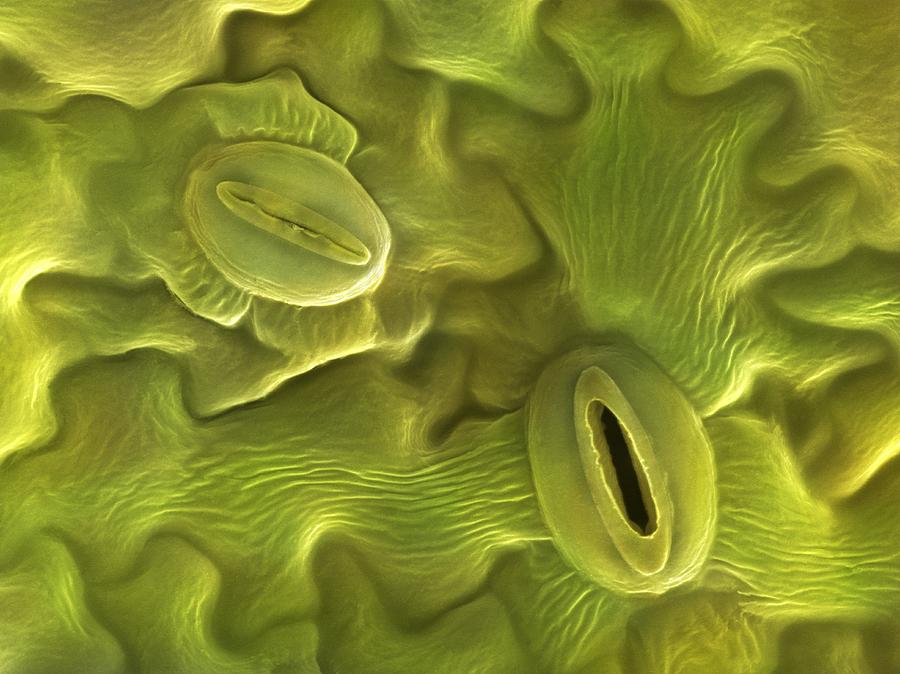
72.
Opening that allows gas exchange
a)
Stomata
b)
Leaves
c)
Roots
d)
Vascular tissue
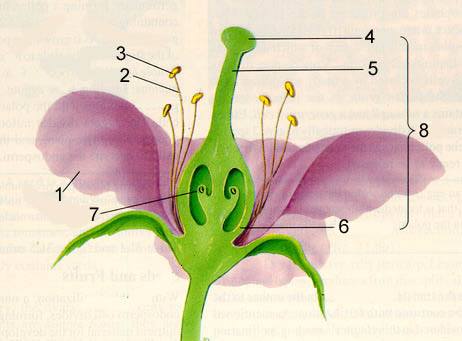
73.
What is #3 pointing to?
a)
stigma
b)
filament
c)
ovary
d)
anther
74.
What is #4 pointing to?
a)
anther
b)
style
c)
stigma
d)
ovary
75.
Moves sugar from leaves to roots
a)
Xylem
b)
Phloem
76.

The rate of transpiration decreases with

a)

high temperature

b)

high water content of leaf

c)

closure of stomata

d)

intensity of sunlight

77.

The rate at which blood flows through the human body changes in response to many factors. Which statement describes one of these factors and its effect on blood flow?

a)

The narrowing of blood vessels increases pressure and leads to faster blood flow.

b)

High blood viscosity (thicker consistency) increases the resistance in the blood vessels and leads to slower blood flow.

c)

Low blood pH decreases the rate of diffusion through the blood vessels and leads to slower blood flow.

d)

The changing shape of red blood cells to a crescent shape decreases resistance and leads to faster blood flow.

78.
What is this?
a)
Cerebrum
b)
Cerebellum
c)
Brain Stem
d)
Diencephalon
79.

What happens after the second time you are exposed to a pathogen?

a)

The body will not be able to fight off the pathogen quickly, because it knows how to get into the body easier.

b)

The body's immune system will react the same was as it did during the first exposure.

c)

The body can only be exposed to a pathogen a second time if you do not have a vaccine.

d)

The body will know how to fight off the pathogen quickly, because memory cells have been created after the first encounter.
80.

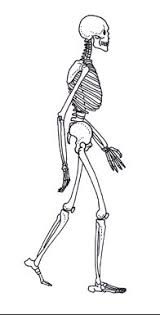
The ability to walk upright on two legs is called:

a)

bipedalism

b)

quadropedalism

c)

bicyclepedalism

d)

tripedalism

81.

This feature allowed hominins to work in groups, communicate, solve problems, and create new things.

a)

large brain

b)

color vision

c)

smaller teeth

d)

bipedalism

82.

What type of inheritance do two alleles have if their traits blend together?

a)

Incomplete Dominance

b)

Codominance

c)

Complete dominance

d)

Sex-Linked

83.

Both traits expressed TOGETHER (not blended)

a)

Codominance

b)

Incomplete Dominance

c)

Mendelian trait

d)

Sex-linked

84.

Many genes determine 1 trait (ex: skin color)

a)

Incomplete Dominance

b)

Polygenic

c)

Codominance

d)

Multiple alleles

85.
How are Incomplete Dominance and Co Dominance different than a normal Mendelian cross?
a)
There is no difference
b)
The heterozygous genotype has a unique phenotype
c)
There is no heterozygous genotype
d)
There is only one phenotype regardless of genotype.
86.

Three or more alternative forms of a gene that can occupy the same locus.

a)

multiple alleles

b)

codominant

c)

polygenic

d)

incomplete dominance

87.

For a male to express a recessive x-linked trait, he must have....

a)

two recessive alleles

b)

a Y chromosome

c)

one recessive allele

d)

two dominant alleles

88.
The enzyme that unwinds the DNA to prepare for replication
a)
helicase
b)
replicase
c)
polymerase
d)
synthase
89.
Why does DNA replicate?
a)
To create another copy for the new cell
b)
To create a duplicate copy in case the original gets damaged
c)
To create a new copy to replace the damaged original
90.
Choose the nucleotide sequence of the RNA strand that would be complementary to the following strand: 
GTAGTCA
a)
UATUAGA
b)
ACGACTG
c)
CAUCAGU
d)
CATCAGT
91.
What is the term for a three-nucleotide sequence that codes for an amino acid?
a)
base
b)
codon
c)
amine
d)
serine
92.
Which phrase best describes translation?
a)
converts mRNA into a polypeptide
b)
catalyzes bonds between amino acids
c)
produces RNA from DNA molecules
d)
recycles tRNA molecules for reuse
93.
The codon CCU codes for what amino acid?
a)
Isoleucine
b)
Stop
c)
Methionine
d)
Proline
94.
What do helpful mutations do? 
a)
Increases chances of survival 
b)
Decreases changes of survival 
c)
Increases chances of developing cancer
d)
Decreases skills
95.

What is the mRNA codon for the amino acid threonine (Thr)?

a)

AAG

b)

AGG

c)

ACU

d)

CUG

e)

UAG

96.

While genetic engineering has positive benefits, there are also concerns associated with its widespread use in agriculture. If many farmers begin to plant more genetically modified crops that have an increased tolerance to insects, which of the following may result?

a)

an increase in the use of pesticides

b)

a decrease in genetic diversity of the crops

c)

an increase in the contamination of the water supply

d)

a decrease in crop productivity on these treated fields
97.

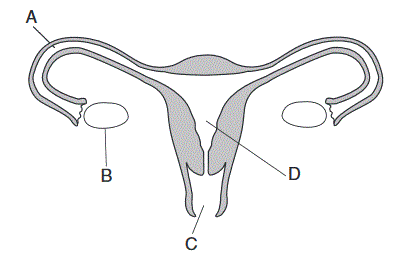
The diagram below represents structures found in the female reproductive system. If the areas labeled A were completely blocked on both sides, the most likely result would be that

a)

egg production would stop

b)

sperm production would stop

c)

fertilization would not occur

d)

an embryo would develop

98.

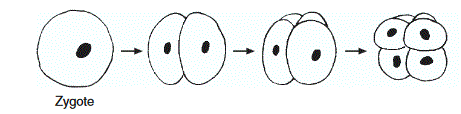
The diagram below represents some stages of early embryonic development. Which process is represented by the arrows in the diagram?

a)

meiosis

b)

Mitosis

c)

Fertilization

d)

Evolution

99.
What is ovulation?
a)
The release of an egg into an oviduct.
b)
The joining of an egg cell and a sperm cell.
c)
The period of time when the female is having her period.
d)
The act of mating.
100.
Where are egg cells stored and released from?
a)
The uterus.
b)
The testes.
c)
The ovaries.
d)
The cervix.
101.

Where do the egg and sperm meet?

a)

The ovary

b)

The fallopian tube / oviduct

c)

The vas deferens

d)

The uterus

102.
Which organ produces sperm cells?
a)
testes
b)
epididymis
c)
ovary
d)
prostate gland
103.
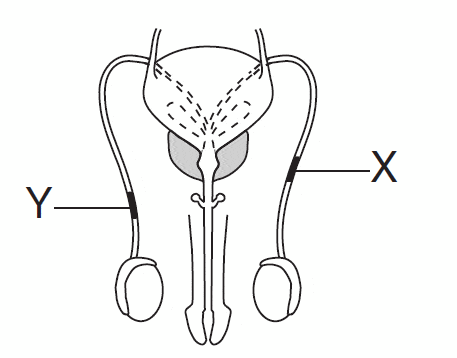
The diagram below represents the human male reproductive system. Which activity would be prevented by blockages at X and Y?
a)
transport of urine out of the body
b)
passage of testosterone to the female to stimulate egg production
c)
movement of sperm out of the body
d)
movement of testosterone to the testes to stimulate sperm production
104.

Reproducing asexually will produce offspring ...

a)

genetically different from each other

b)

genetically identical to the parent

105.

Which of the following describes the main advantages of sexual reproduction?

a)

requires lots of time/energy

b)

no new gene combos can arise

c)

diversity within a population of organisms

d)

looks identical to the parent

106.

Aquatic life is abundant, diverse, and full of sunlight at which zone?

a)

littoral zone

b)

benthic zone

c)

limnetic zone

107.
Two factors that determine where an organism lives in aquatic ecosystem are 
a)
Temperature and sunlight
b)
Neighbors and housing prices
c)
Fish and wildlife
d)
Darkness and tree height
108.

What are wetlands?

a)

areas of land that are flooded at least part of the year

b)

the ocean

c)

lakes

d)

estuaries

109.

Salinity refers to

a)

how many plants are in the water

b)

how many organisms live in the water

c)

how much salt in is water

110.
Glucose is a ...
a)
sugar
b)
carbohydrate
c)
source of quick energy
d)
all are correct
111.
A leaf is the broadest part of the plant and this is good for photosynthesis because, the broad leaf....
a)
curls up when touched
b)
increases surface area
c)
catches rain water
d)
stores lipids for the plants
112.
The vascular tissue of the plant that transports water is the...
a)
roots
b)
phloem
c)
xylem
d)
stem
113.
The formula for glucose is...
a)
C12 H22 O11
b)
NaCl
c)
NaOH
d)
C6 H12 O6
114.
The chloroplast has stacked membranes, what is the purpose of the stacked membranes in doing photosynthesis?
a)
water absorption for photosynthesis
b)
increased COabsorption
c)
increase surface area
d)
support of the plant
115.
The reactant of photosynthesis are...
a)
sunlight and chlorophyll
b)
glucose and oxygen
c)
carbon dioxide and water
d)
sunlight and water
116.
What are the products of anaerobic respiration?
a)
Glucose and oxygen
b)
Carbon dioxide and water
c)
Lactic acid
d)
Carbon monoxide
117.
What type of respiration requires oxygen?
a)
Aerobic
b)
Anaerobic
118.
Which type of respiration is most efficient?
a)
Aerobic
b)
Anaerobic
119.
What is the molecule called that mitochondria produce when they respire glucose?
a)
ATP
b)
ADP
c)
DNA
d)
80p
120.
What is the function of ATP in living things?
a)
provides energy for cells
b)
stores genetic information
c)
provides structure in the nucleus
121.
Where is the energy stored in ATP molecules
a)
In the Ribose Sugar
b)
In the Adenine group
c)
In the Phosphate bonds
d)
In the Bank