
 Worksheets
Semester 2 Final Review
Total questions: 121
Worksheet time: 1hrs 1mins
Name
Class
Date
1.

What are the biotic factors of the pond ecosystem pictured below?
a)
Trees, reeds, algae, lily pads
b)
pond water and the rain that falls in the pond
c)
air above the pond, and the pond water
d)
Sunlight that shines on the pond water
2.
Scientists generally use three approaches to study ecology. Which is an example of experimentation?
a)
counting the number of migrating geese that visit a pond
b)
using a computer program to predict the growth of a forest
c)
raising ants in terrariums, each identical except for the clay content of the soil
d)
observing frogs as they swim across a pond
3.
A population of raccoons is living in a landfill. Scraps of food are brought in on the garbage trucks, so the raccoons thrive and reproduce, increasing the population in the landfill. Unfortunately, several raccoons pick up a contagious disease and transmit it to other raccoons. The population of raccoons soon drops as many die from the disease. After this, a tornado rips through the landfill and the rest of the racoon population is killed.
The contagious disease is an example of a
a)
climax community
b)
density-dependent factor
c)
density-independent factor
d)
range of tolerance
4.
A population of raccoons is living in a landfill. Scraps of food are brought in on the garbage trucks, so the raccoons thrive and reproduce, increasing the population in the landfill. Unfortunately, several raccoons pick up a contagious disease and transmit it to other raccoons. The population of raccoons soon drops as many die from the disease. After this, a tornado rips through the landfill and the rest of the racoon population is killed.
The tornado is an example of a
a)
climax community
b)
density-dependent factor
c)
density-independent factor
d)
range of tolerance
5.
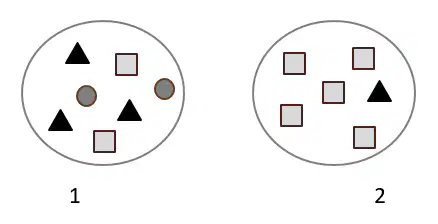
In the two communities below, each shape represents one species. Which of the following is true about species richness and evenness?
a)
same species richness, but different species evenness
b)
different species richness, but the same species evenness
c)
different species richness and different species evenness
d)
same species richness and the same species evenness
6.
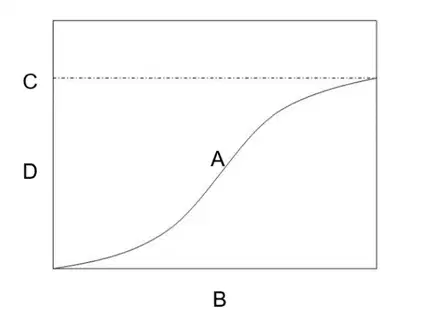
The graph shows
a)
logistic growth
b)
linear growth
c)
a population without limiting factors
d)
exponential growth
7.
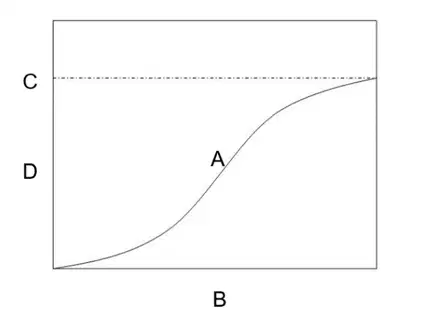
Which letter represents the carrying capacity for this population?
a)
A
b)
B
c)
C
d)
D
8.
Within a tree, you see 5 different species of birds. This collection of birds is called
a)
a biome
b)
a population
c)
a community
d)
an ecosystem
9.
Which of the following is an example of climate?
a)
There is a cold front coming in this weekend
b)
A snowstorm is forecasted to hit the northeast US this week
c)
It is usually hot in Texas in July
d)
It rained 4 inches last week in Seattle, WA
10.
Which of these is NOT an example of an abiotic factor?
a)
soil
b)
bacteria
c)
temperature
d)
rainfall
11.
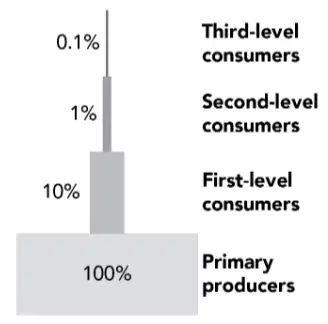
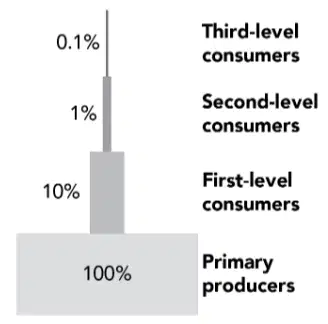
How much chemical energy is transferred from the producer level to the secondary consumer level in a food chain?
a)
.1%
b)
1%
c)
10%
d)
100%
12.
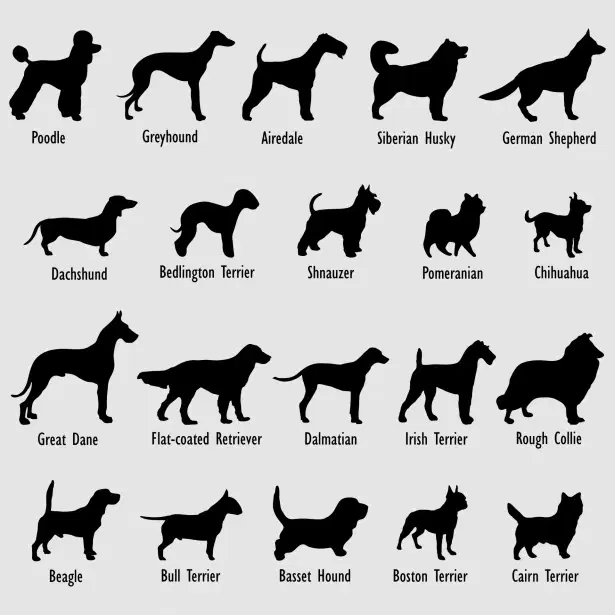
the selective breeding of organisms to produce desired traits
a)
natural selection
b)
variation
c)
survival of the fittest
d)
biogeography
e)
artificial selection
13.
Which of the following is heterozygous?
a)
Mm
b)
mm
c)
HH
d)
hh
14.
Which of the following is homozygous recessive?
a)
QQ
b)
qq
c)
Rr
d)
RR
15.
Which of the following denotes the physical expression of a gene?
a)
genotype
b)
phenotype
c)
appearance
d)
homologous
16.
Which of the following would produce a recessive phenotype?
a)
Hh
b)
hh
c)
RR
d)
Ww
17.
If brown hair is represented by the allele "B" and blond hair is represented by the allele "b" then what must be the genotype of someone who has blond hair?
a)
BB
b)
bb
c)
Bb
d)
either BB or Bb
18.
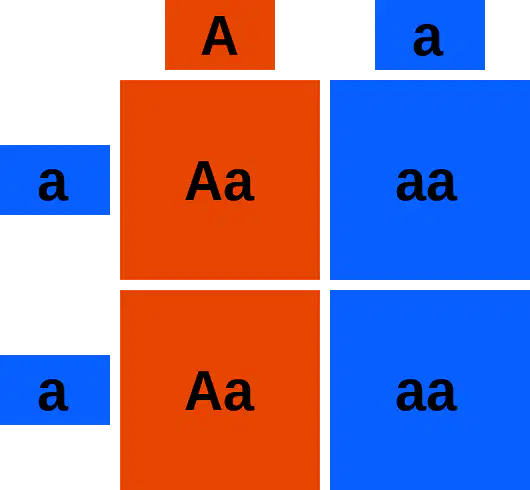
What is the probability of heterozygous offspring?
a)
0%
b)
25%
c)
50%
d)
100%
19.
Two heterozygous (Tt) tall pea plants are crossed. Tall (T) is dominant. Short (t) is recessive. Which is the likelihood of each phenotype?
a)
50% tall and 50% short
b)
75% tall and 25% short
c)
100% short
d)
100% tall
20.
Webbed fingers (F) are dominant over nonwebbed fingers (f). If parent A (Ff) and parent B (Ff) have children, which of the following are true? Select all that apply
a)
Phenotypes: 75% chance of having webbed fingers and 25% chance of not.
b)
Phenotypes: 25% chance of having webbed fingers and 75% chance of not
c)
Genotypes: FF 75%, Ff 50%, ff 25%
d)
Genotypes: FF 25%, Ff 50%, ff 25%
e)
Phenotypes: 100% chance of having webbed fingers and 0% chance of not.
21.
If you have a parent who has GgBb as their genotype, what are the possible alleles they could donate to their gametes?
a)
GB, Gb, gB, gb
b)
Gb, Gb, Gb, GB
c)
GB, GB, gb, gb
d)
GG, BB, gg, bb
22.

The hEAR gene codes for ear shape. The dominant allele (E) is for an attached ear lobe. The recessive allele (e) is for an attached ear lobe. The shape of the earlobe is:
a)
the genotype
b)
the phenotype
c)
controlled by half an allele
d)
inheritable only from mom
23.

Look at the following Punnett square. What genotype do the parents have to be?
a)
RR, RR
b)
Rr, Rr
c)
RR, rr
d)
rr, rr
24.
The likelihood that a particular event will occur
a)
chance
b)
probability
c)
heredity
d)
phenomenon
25.
Identical alleles from the same gene (GG or gg)
a)
homozygous
b)
heterozygous
c)
genotype
d)
phenotype
26.
Two different alleles from the same gene (Gg)
a)
homozygous
b)
genotype
c)
heterozygous
d)
phenotype
27.
The physical appearance of an organism
a)
genotype
b)
punnett square
c)
phenotype
d)
genetic makeup
28.
The specific genetic makeup of an organism
a)
phenotype
b)
genotype
c)
genetic makeup
d)
heterozygous
29.
The likelihood that a particular event will occur
a)
probability
b)
chance
c)
heredity
d)
phenomenon
30.
Identical alleles from the same gene (GG or gg)
a)
homozygous
b)
heterozygous
c)
genotype
d)
phenotype
31.

Mendel is called
a)
the father of peas
b)
the father of genetics
c)
the father of meiosis
d)
a wacko monk
32.

contrasting forms of a trait, such as tall or short, are called
a)
chromosomes
b)
dominants
c)
hybrids
d)
alleles
33.
If John is described as a tongue roller with a widow's peak, we are describing his
a)
genotype
b)
phenotype
c)
alleles
d)
pedigree
34.
Mendel cross-pollinated pea plants by taking the _________ from one flower and transferring it to _________ flower
a)
gamete, the same
b)
autosome, the same
c)
gamete, a different
d)
autosome, a different
35.
A visual representation or a family tree showing inheritance patterns is called a(n)
a)
Punnett square
b)
pedigree
c)
gene linkage map
d)
phenotype
36.
A woman with webbed toes (Ww) marries a man with normal toes (ww). Webbed toes is a ________ trait.
a)
recessive
b)
dominant
c)
masked
d)
sex-linked
37.
The trait tongue rolling is dominant (T) in humans. If there is a cross between a homozygous recessive individual and a heterozygous individual, which of the following is a possible genotype of their offspring?
a)
Tt
b)
TT
c)
tongue roller
d)
non-tongue roller
38.
If two heterozygous individuals are crossed, what is the genotype ratio of their offspring? make a punnett square
a)
1:2:1
b)
1:2
c)
1:3:1
d)
3:1
39.
A heterozygous individual could have the following 2 alleles
a)
pp
b)
Zz
c)
YY
d)
none of these
40.
The passing of traits from parents to offspring is called
a)
genetics
b)
heredity
c)
development
d)
biology
41.
What is the risk of having a child affected by a disease with an autosomal recessive inheritance pattern if both the mother and father are carriers for that disease? make a punnett square
a)
0%
b)
25%
c)
50%
d)
75%
42.
How many pairs of autosomes do humans have in their bodies?
a)
22
b)
44
c)
23
d)
46
43.
Snapdragons can be red, pink, or white. When crossing a red snapdragon (RR) with a pink snapdragon (RW), what % of the offspring will be red?
*RW is not a typo* make a punnett square
a)
0%
b)
50%
c)
25%
d)
75%
44.
If a sexually-reproducing organism has 24 chromosomes in its somatic (body) cells, how many chromosomes would you expect in its gametes?
a)
6
b)
12
c)
24
d)
48
45.
Hemophilia is a sex-linked disorder. Jack, Susan, and their 3 daughters do not have symptoms of hemophilia. Their son, however, does exhibit symptoms of hemophilia because:
a)
Susan is homozygous
b)
Jack is homozygous
c)
Suzan is heterozygous
d)
all of the above are equally probable
46.
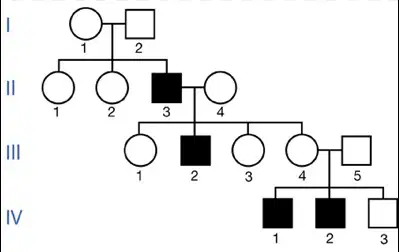
What type of inheritance pattern does the pedigree illustrate?
a)
incomplete dominance
b)
multiple alleles
c)
autosomal dominant
d)
sex-linked
47.
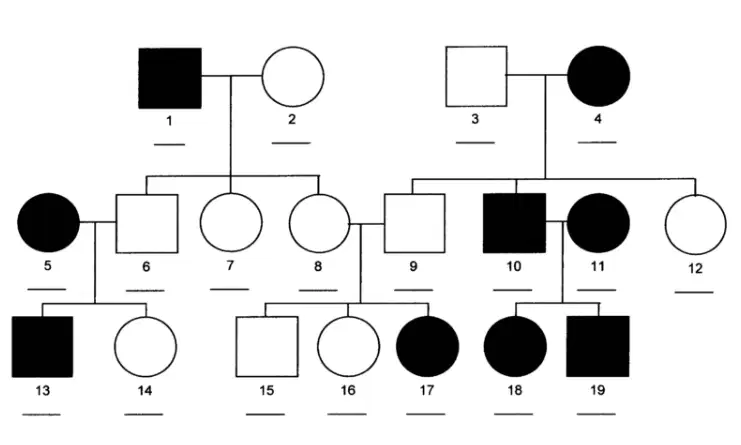
Analyze the pedigree. What type of inheritance is shown?
a)
Autosomal dominant
b)
Autosomal recessive
c)
sex-linked
d)
multiple alleles
48.
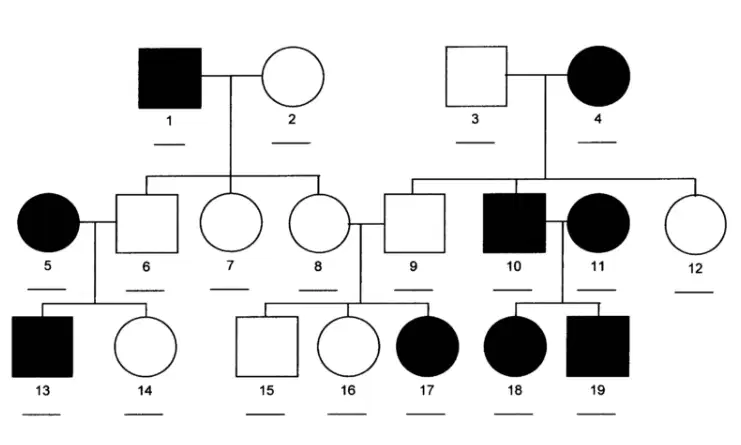
Analyze the pedigree. The pedigree below shows the inheritance pattern for two families of individuals with attached earlobes. Using what is the genotype of individual number 17?
a)
EE
b)
Ee
c)
ee
d)
none of the above
49.
What is the complete diploid set of chromosomes grouped together in pairs called?
a)
karyotype
b)
genotype
c)
autosome chart
d)
pedigree
50.
When chromosomes do not come apart
a)
replication
b)
nondisjunction
c)
error in mitosis
d)
separation
51.
Two different alleles from the same gene (Gg)
a)
heterozygous
b)
homozygous
c)
genotype
d)
phenotype
52.
The physical appearance of an organism
a)
phenotype
b)
genotype
c)
punnett square
d)
genetic makeup
53.
The specific genetic makeup of an organism
a)
genotype
b)
phenotype
c)
genetic makeup
d)
heterozygous
54.
A diagram used to predict the outcome of a genetic cross
a)
Punnett Square
b)
Genetic diagram
c)
phenotype
d)
hybrid table
55.
States that genes for different traits segregate independently during the formation of gametes
a)
Principle of Independent Assortment
b)
Principle of Dominance
c)
Principle of factor crosses
d)
Punnett Principle
56.
Incomplete dominance
a)
Neither allele is completely dominant over another allele
b)
One trait is covered up by the dominant trait
c)
the phenotype of an organism is the same as one of the parent organisms
d)
an organism inherits too many copies of an allele
57.
A situation in which the phenotypes produced by both alleles are clearly expressed
a)
codominance
b)
multiple alleles
c)
incomplete dominance
d)
polygenic traits
58.
Many traits are produced by the interaction of several genes
a)
polygenic traits
b)
multiple traits
c)
phenotype
d)
genotype
59.
diploid
a)
double
b)
single
c)
quadruple
d)
octuple
60.
genetics
a)
the study of biological inheritance
b)
the study of green plants
c)
the study of animals
d)
the study of populations
61.
The joining of male and female reproductive cells
a)
gamete formation
b)
fertilization
c)
trait formation
d)
principle of dominance
62.
a specific characteristic coded by a gene
a)
genotype
b)
trait
c)
hybrid
d)
DNA
63.
the offspring of crosses between parents with different contrasting characteristics
a)
traits
b)
hybrids
c)
fertilization
d)
genetic mixes
64.
genes
a)
segments of RNA passed on from parent to offspring
b)
segments of DNA passed on from offspring to parent
c)
factors that determine individuals characteristics, passed on from parent to offspring
d)
alleles that code for specific DNA sequences
65.
the principle of dominance states
a)
some people are winners and others are losers
b)
some alleles are dominant and others are recessive
c)
only dominant alleles code for traits
d)
only recessive alleles code for traits
66.
What is the definition of genetic segregation?
a)
discrete packages of DNA
b)
the separation of alleles
c)
the coming together of two strands of DNA to form a whole chromosome
d)
the joining of alleles
67.
What are reproductive cells called?
a)
gametes
b)
egg cells
c)
sperm cells
d)
somatic cells
68.
I studied for the vocab quiz
a)
Yes
b)
No
69.
genetics
a)
the study of biological inheritance
b)
the study of green plants
c)
the study of animals
d)
the study of populations
70.
the offspring of crosses between parents with different contrasting characteristics
a)
traits
b)
fertilization
c)
genetic mixes
d)
hybrids
71.
the principle of dominance states
a)
some people are winners and others are losers
b)
only dominant alleles code for traits
c)
some alleles are dominant and others are recessive
d)
only recessive alleles code for traits
72.
There are two species of cactus that live in Joshua Tree. One cactus opens its flowers at night in February, the other opens its flowers in the day in February. What type of isolation is this?
a)
Diurnal isolation
b)
Temporal isolation
c)
Desert isolation
d)
Geographic isolation
73.
different versions of heritable traits found within a population
a)
variation
b)
fossil
c)
evolution
d)
adaptation
e)
genes
74.

structures that are similar in different species of common ancestors
a)
homologous structures
b)
vestigial structures
c)
evolutionary structures
d)
adaptational structures
e)
variational structures
75.
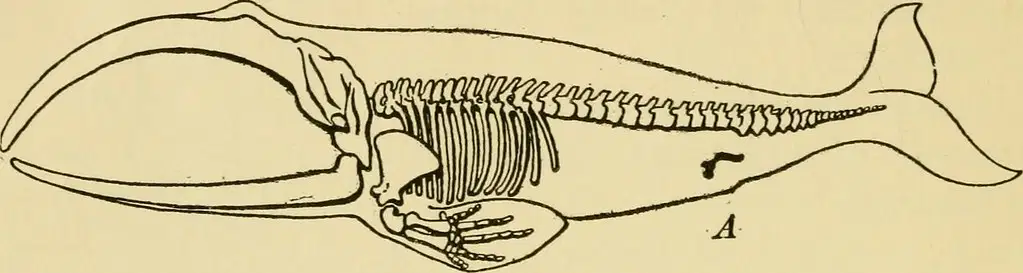
an inherited structure that has lost much or all of its original function
a)
analogous structure
b)
vestigial structure
c)
biogeographical structure
d)
Darwinial structure
e)
extinctional structure
76.
Natural Selection acts at the ______ level
a)
individual
b)
community
c)
species
d)
biological
77.
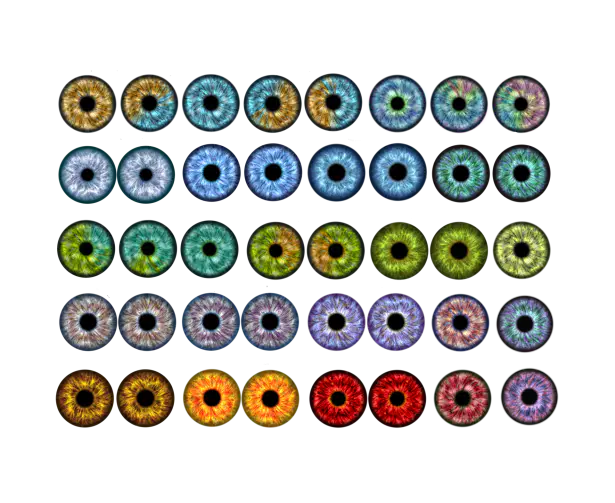
In all types of selection, variation is provided by ___________
a)
Humans
b)
Breeders
c)
Nature
d)
Offspring
78.
Natural selection removes ________ to change ________
a)
individuals; species
b)
species; populations
c)
communities; populations
d)
organisms; communities
79.
Which is an example of a postzygotic barrier to reproduction?
a)
hybrid inviability
b)
geographic isolation
c)
mechanical isolation
d)
behavioral isolation
80.
Two species of birds inhabit the same island. Members of the same species find each other by making distinct calls. What type of isolation is this?
a)
Vocal
b)
Geographical
c)
Behavioral
d)
Temporal
81.
Lamarck had several ideas about evolution. Which one belonged to Darwin?
a)
Use it or lose it
b)
Inheritance of acquired traits
c)
survival of the fittest
d)
tendency towards perfection
82.
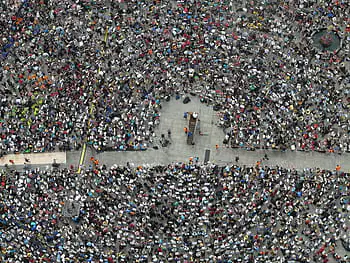
What three things did Malthus think worked to lower population levels?
a)
War
b)
Famine
c)
Disease
d)
Prison
e)
Natural disasters
83.
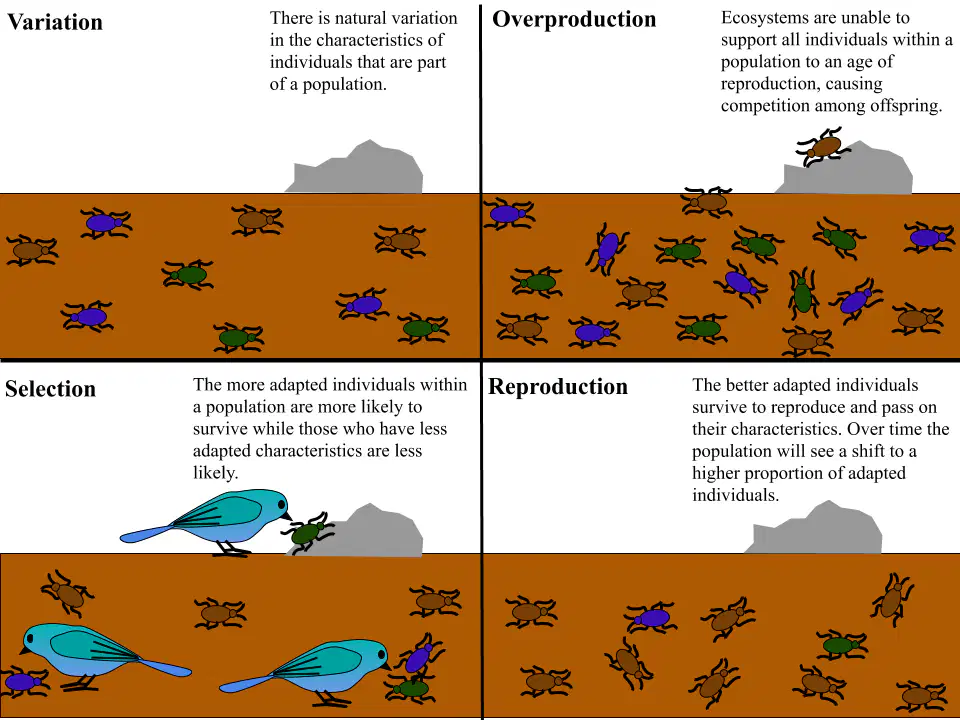
Natural selection works by
a)
rewarding favorable traits in the gene pool
b)
creating favorable adaptations for organisms in the gene pool
c)
removing traits that inhibit an organisms fitness from the gene pool
d)
chance mutations that alter the gene pool
84.
Why is having a lot of offspring a good thing?
**Hint** More offspring = more __________
4 lines
85.

Explain the photo below.
1. Is this an example of a prezygotic or postzygotic barrier to reproduction?
2. What specific type of isolation is occurring?
3. Will this situation result in a new species?
4 lines
86.
Organisms that eat both plants and meat
a)
omnivores
b)
herbivores
c)
autotrophs
d)
carnivores
87.
Which is NOT true about food webs?
a)
Food webs show the transfer of energy among organisms
b)
Food webs are more accurate than food chains
c)
Food webs are simpler than food chains
d)
Food webs contain decomposers and scavengers throughout
88.
A network of interconnecting food chains is a(n)
a)
ecosystem
b)
biosphere
c)
food web
d)
energy pyramid
89.
Tim is mapping trees in a section of land. He counts the trees in a one square kilometer and records the number. What is he describing?
a)
Population densiy
b)
population distribution
c)
population growth
d)
population outline
90.
Scientists have observed the exponential growth of lionfish in the Caribbean Sea. Which of these predictions about the future of the lionfish population is the most likely to occur?
a)
The population will continue to grow exponentially indefinitely
b)
a limiting factor will cause the growth of the lionfish population to slow down, forming a pattern of logistic growth
c)
a limitin factor will cause the lionfish population to decline rapidly and eventually decrease to zero
d)
The population will enter a cycle of increasing and decreasing numbers, typical of many predators and prey
91.
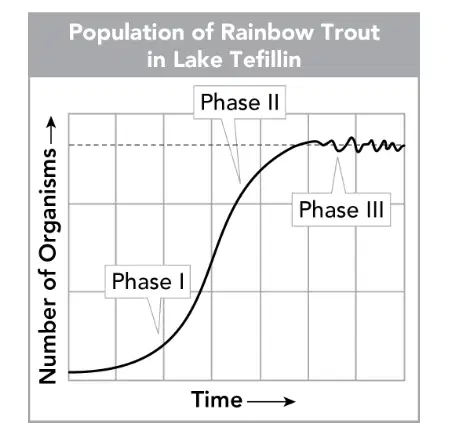
Lake Tefillin is a large freshwater lake that is popular for recreation. One year, the managers of the lake introduce a population of rainbow trout to the lake. The graph shows the growth of the population over several years.
Which best describes the growth pattern of the rainbow trout?
a)
Exponential growth, because the lake provides unlimited resources to the population
b)
Logistic growth, because the effect of limiting factors increases with the population size
c)
Exponential growth, because limiting factors are always affecting the population
d)
Logistic growth, because the lake provides unlimited resources until the population reaches carrying capacity
92.
Autotrophs can be classified into two groups according to which of these properties?
a)
energy source: either sunlight or chemicals
b)
food type: either plant matter or animal matter
c)
food quality, either living matter or dead matter
d)
water quality, either fresh water or salt water
93.
Rabbits are members of a community in a meadow. The rabbits eat grasses, clover, as well as roots, seeds, and tree bark. What defines the organisms that share the same trophic level as the rabbits?
a)
snakes, hawks, and other animals that eat rabbits
b)
community members that interact with rabbits
c)
meadow animals that are about the same size as a rabbit
d)
meadow animals that eat plants and plant products
94.
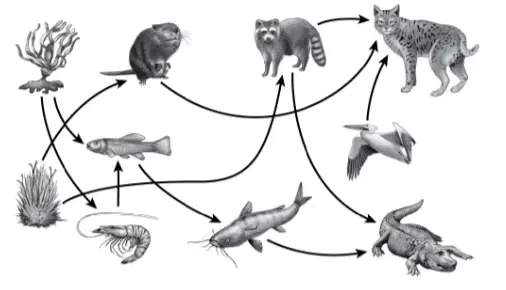
The diagram shows a model of feeding relationships in an ecosystem. What is shown by the arrows that lead to and from the raccoon?
a)
The raccoon is part of several food chains, but not a food web.
b)
The raccoon is part of several food chains and several food webs.
c)
The raccoon is part of one food web, but no food chains.
d)
The raccoon is part of one food web and several overlapping food chains.
95.
Which statement describes all primary producers?
a)
All harness the energy of sunlight through the process of photosynthesis.
b)
All take in energy to assemble energy-rich compounds.
c)
All are small, single-celled organisms, such as bacteria and algae.
d)
All take in food and break it apart to release energy.
96.
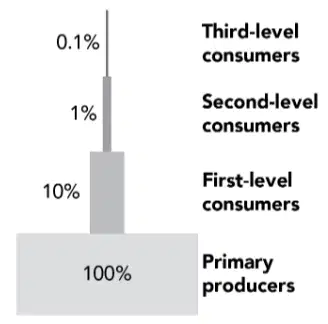
The diagram shows a model of an ecosystem. What does the model represent?
a)
the total biomass in each trophic level
b)
the total amount of energy in the ecosystem
c)
the relative amount of energy available at each trophic level
d)
the conservation of energy as energy transfers between organisms
97.
A pyramid of biomass is one way to model an ecosystem. How does the amount of biomass generally change from the bottom of the pyramid to the top?
a)
The amount of biomass decreases.
b)
The amount of biomass increases.
c)
The amount of biomass varies only slightly, and may increase or decrease.
d)
The amount of biomass varies widely, and both increases and decreases.
98.
Each organism in a food chain represents a feeding step or
a)
trophic level
b)
pyramid
c)
consumer
d)
producer
99.
The following food chain is found in a pond ecosystem:
Algae -> Zooplankton -> Minnow -> Bluegill
Which of the following changes could be expected if the zooplankton are killed with a new pesticide?
a)
The algae population would die.
b)
The minnow population will increase.
c)
The zooplankton population will eat something else.
d)
The bluegill population will die.
100.
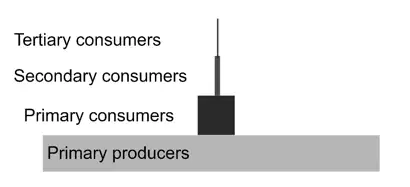
Which of the following is TRUE about the energy pyramid?
a)
There is less energy available in the producer level because their tissues are less dense than those at higher trophic levels.
b)
There is less energy available to the tertiary consumers because of the loss of energy through metabolism in each of the lower levels.
c)
There is more energy available to primary consumers than is available to secondary consumers because they don’t spend as much time hunting for prey.
d)
There is more available energy in the tertiary consumers than the secondary consumers because they have greater muscle mass at the top trophic levels.
101.
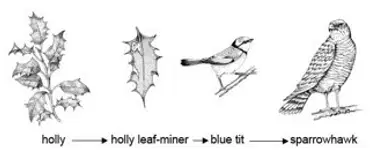
In this picture, the holly leaf miner is a ________________.
a)
first-level or primary consumer
b)
second-level or secondary consumer
c)
third-level or tertiary consumer
d)
producer
102.
Harvey is studying the turtles that live in a pond. His knowledge of ecology will be MOST USEFUL for explaining which of these observations of the turtles?
a)
The carapace (shell) of the turtle appears to be an extension of its spine.
b)
A female turtle lays a clutch of eggs along the shore of the lake, and not in the water
c)
One summer, the size of the turtle population suddenly increases, but then gradually decreases.
d)
A turtle may remain underwater for several minutes, but then surfaces for at least a brief moment.
103.
Ecology includes studying ecosystems at different levels. Which is the largest or broadest level?
a)
biome
b)
community
c)
biosphere
d)
ecosystem
104.
Which is a description of climate, and not the weather?
a)
Summer is wetter and warmer than winter.
b)
A hurricane is likely to reach southeast Florida this afternoon.
c)
The air today is more humid than it was yesterday.
d)
No rain is likely to fall for the next week.
105.
An increase in the concentrations of greenhouse gases in Earth’s atmosphere would have which of these effects on temperature?
a)
a decrease in average temperatures on Earth’s surface
b)
an increase in average temperatures on Earth’s surface
c)
an increase in average temperature in the upper atmosphere
d)
a decrease in average temperature within all Earth systems
106.
Which factors are used to characterize a biome, such as the desert, tropical rain forest, or temperate grasslands? Select two answers.
a)
biotic factors, such as plant and animal life
b)
abiotic factors, such as climate and soil.
c)
precise lines of latitude and longitude
d)
levels of greenhouse gases in the atmosphere
107.

The graph presents information about the climate of Dallas, Texas. Which of the following best describes this climate?
a)
warm temperatures and rainy weather all year long
b)
warm summers, cold winters, seasonal precipitation
c)
seasonal temperatures, little precipitation
d)
warm, wet summers; cold, dry winters
108.
The soil of the temperate forest is often rich in humus. Which statement best explains the presence of humus in the temperate forest?
a)
Humus forms from fallen leaves, dead wood, and other dead organic matter.
b)
Tree roots break rocks into humus as they grow.
c)
Cold winter weather preserves humus in the soil.
d)
Dry conditions allow humus to form.
109.

The coastal ocean is home to kelp forests and coral reefs. Which factor explains why the coastal ocean tends to be more productive than waters of similar depths in the open ocean?
a)
warm water temperature
b)
brightness of the water
c)
low salinity of the water
d)
nutrients supplied by runoff from the land
110.
Kevin is constructing an explanation of the importance of freshwater ecosystems. Which of these statements would be MOST useful to include in the explanation?
a)
Freshwater ecosystems are distributed evenly across a continent.
b)
Freshwater ecosystems hold less than 3 percent of Earth’s surface water.
c)
Freshwater ecosystems keep fresh water in one place, and do not release it.
d)
Freshwater ecosystems stay about the same during the year.
111.

Estuaries serve which important role for marine ecosystems?
a)
providing spawning and nursery grounds for many marine animals
b)
adding oxygen to the ocean water
c)
removing carbon dioxide from the ocean water
d)
removing salt from the ocean water
112.
A team of deep-sea divers and biologists are exploring the open ocean. As they dive downward from the surface, they observe significant changes to the ocean community at a depth of about 200 meters. What is the main cause of the changes at this depth?
a)
loss of brightness of the water
b)
increasing salinity of the water
c)
increasing temperature of the water
d)
decreased oxygen concentration of the water
113.
Which of these subjects is MOST LIKELY to be studied in ecology?
a)
the method of water transport in a tree
b)
a comparison of muscle cells among birds and reptiles
c)
the circulatory system of earthworms
d)
the interaction between populations of wolves and deer
114.
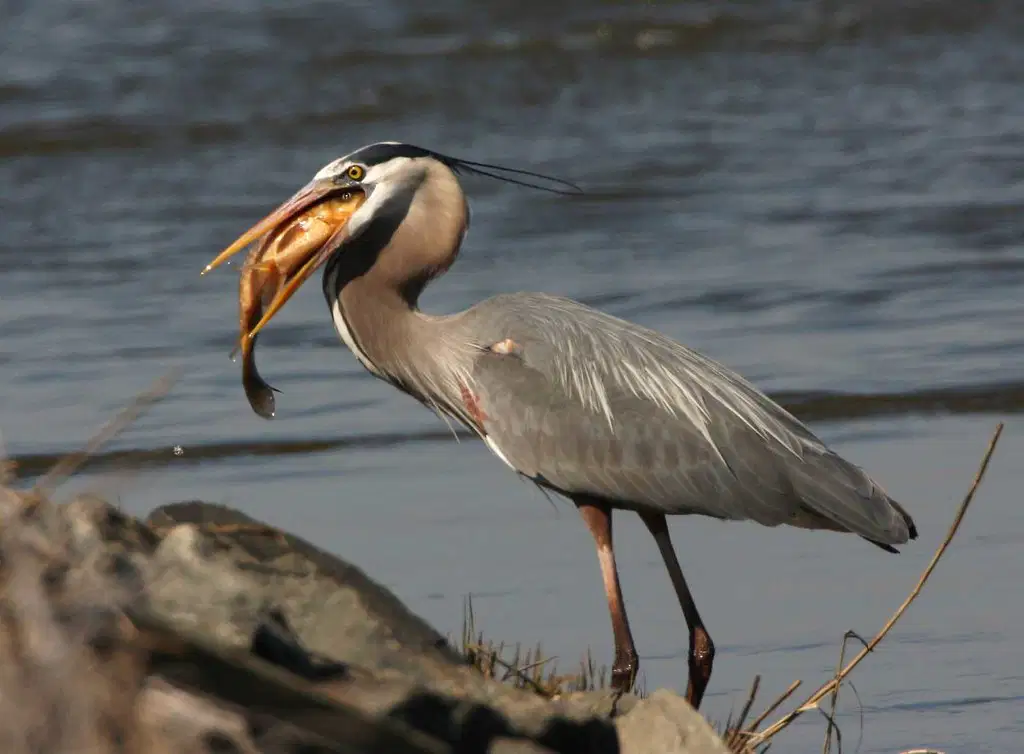
A heron is affected by many factors in its environment. What distinguishes the biotic factors from the abiotic factors?
a)
location in the water or out of the water
b)
plant or animal
c)
living or nonliving
d)
food or not food
115.
Which data are MOST useful for analyzing the climate of the region?
a)
average time of sunrise and sunset in July
b)
the highest and the lowest daily rainfall in July of this year
c)
the daily high temperature for every day in July of this year
d)
average temperatures for July, measured over 30 years
116.
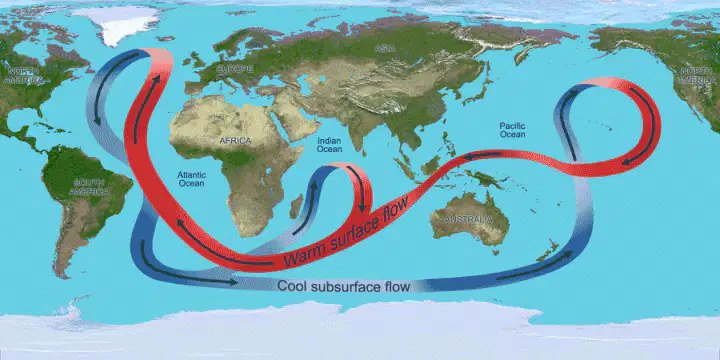
What is the relationship between global winds and global ocean currents?
a)
The pattern of global winds is one of the factors that drives global ocean currents.
b)
The pattern of global ocean currents is one of the factors that drives global winds.
c)
Both are caused by heat from the sun, and they do not affect each other.
d)
Both are caused by Earth’s rotation, and they do not affect each other.
117.
The temperate grasslands biome includes regions of several continents. What do all of the regions have in common?
a)
the same species of grazing animals
b)
the same species of grasses
c)
the same seasonal patterns of temperature and precipitation
d)
the same amount of land that is covered in grasses
118.
Dr. Simeon and her team are studying global climate change. They develop a set of mathematical equations that relate climate data gathered over the past 100 years. Then, with the aid of a computer, they use the equations to predict climate change in the future.
The team’s use of mathematical equations and computers is an example of which science process?
a)
observation
b)
gathering evidence
c)
experimentation
d)
modeling
119.
Jorge is exploring the ocean. On which of these journeys is he MOST LIKELY to pass from the photic zone into the aphotic zone?
a)
a boat trip from the shore to the middle of the ocean
b)
a boat trip from the middle of the ocean to the shore
c)
a submarine dive from the surface into deep ocean water
d)
a walk from the intertidal zone into shallow ocean water
120.
Which of the following is an example of a homozygous recessive genotype?
a)
AA
b)
Aa
c)
aa
d)
aA
121.
In a dihybrid cross, what is the expected phenotypic ratio of the offspring?
a)
9:3:3:1
b)
3:1
c)
1:2:1
d)
1:1
100 %

