wayground logo

Free Printable Worksheets

Font size

S
M
L
XL
Worksheets

Unit 4 Genetics Review

Total questions: 116

Worksheet time: 2hrs 16mins

Name
Class
Date
1.

A segment of DNA that codes for a specific trait is a __________.

a)

Mutation

b)

Homologous chromosome

c)

Gene

d)

DNA

2.

DNA is copied during

a)

During cell division

b)

All the time

c)

During protein production

3.

Which of the following is NOT part of a nucleotide

a)

sugar

b)

phosphate

c)

nitrogen base

d)

amino acid

4.
Adenine bonds with ______________.
a)
Guanine
b)
Thymine
c)
Cytosine
d)
Adenine
5.
Guanine bonds with ______________.
a)
Adenine
b)
Guanine
c)
Cytosine
d)
Thymine
6.
Why is DNA important?
a)
it is very small and very complicated
b)
it's in everything
c)
it serves as the blueprint for traits of all living things
d)
because we eat it every day for energy
7.
What are the 4 nitrogen bases?
a)
adenine, thymine, cytoplasm, and guanine
b)
adenine, thymine cytosine, and guanine
c)
adenine, thymine, cytosine, and gylcerol
d)
adenine, thymine, cytosine, and glucose
8.
Which sequence of DNA bases would pair with this partial strand
ATG TGA CAG
a)
ATG TGA CAG
b)
TAC ACT GTC
c)
GTA AGT GAC
d)
CAT TCA CTG
9.

In eukaryotes, which organelle is DNA usually found in?

a)

cell membrane

b)

vacuole

c)

chloroplast

d)

nucleus

10.
Which shows the correct complementary base pairing for DNA?
a)
C-A, T-G
b)
A-G, C-T
c)
C-G, U-A
d)
T-A, G-C
11.
What does DNA stand for?
a)
Deoxyribonucleic acid
b)
Denitrogenous acid
c)
Deribonucleic acid
d)
Diribonucleic acid
12.
The building block of nucleic acids are nucleotides.  Nucleotides are composed of a sugar, a phosphate group, and a _________________ base.
a)
oxygen
b)
hydrogen
c)
nitrogen
d)
carbon
13.
The sugar in DNA is ?
a)
sucrose
b)
glucose
c)
deoxyribose
d)
fructose
14.
Which of the following monomers are repeatedly joined together to form a strand of DNA?
a)
amino acids
b)
nucleotides
c)
fatty acids
d)
polysaccharides
15.
Which 2 molecules form the sides (backbone) of the DNA ladder?
a)
deoxyribose sugar and adenine
b)
deoxyribose sugar and a hydrogen bond
c)
deoxyribose sugar and the nucleus
d)
deoxyribose sugar and phosphate
16.
The two strands of nitrogenous bases in DNA are joined by which type of bond?
a)
polar bonds
b)
ionic bonds
c)
covalent bonds
d)
hydrogen bonds
17.
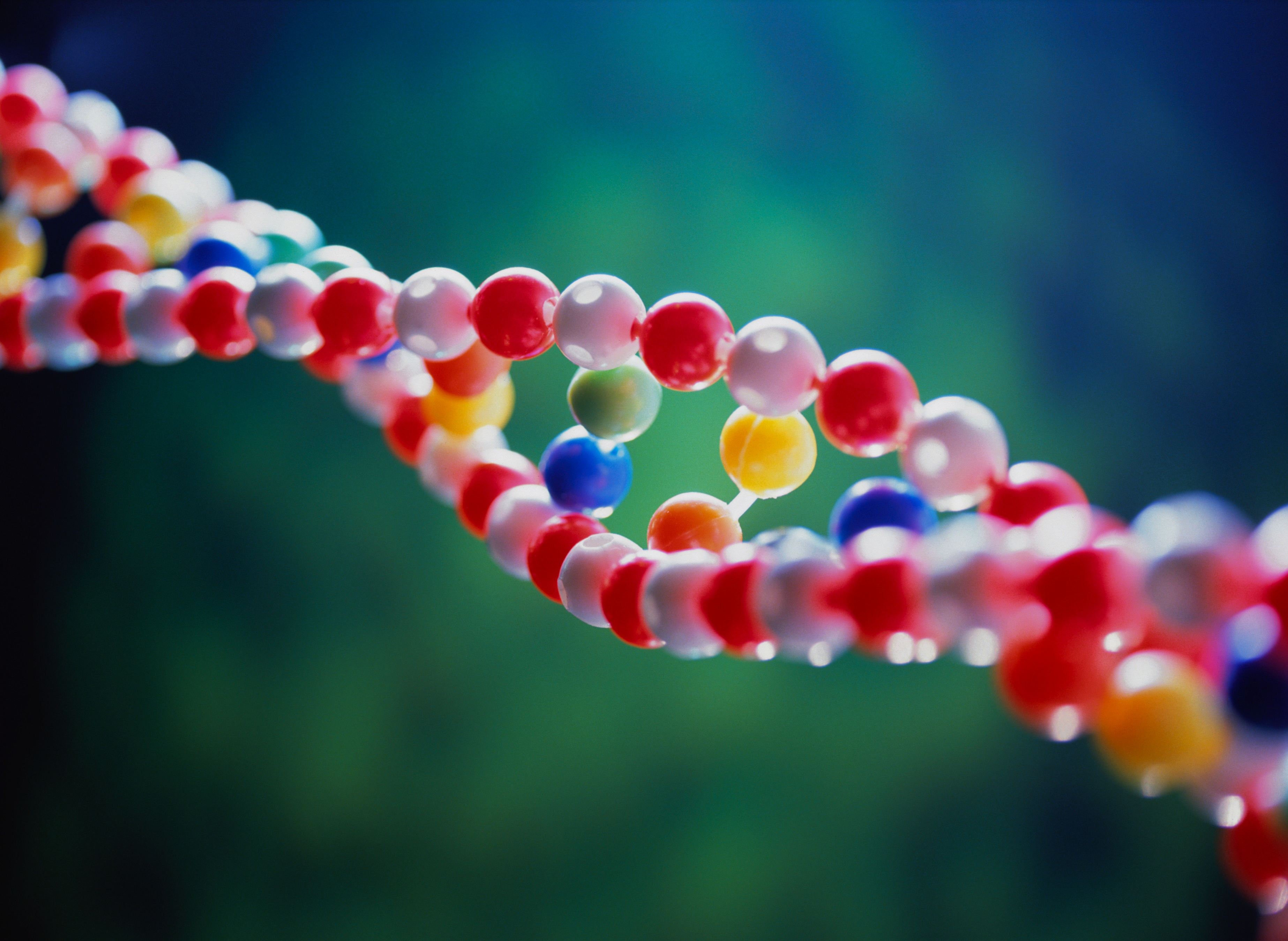
The drawing shows the structure of what molecule?
a)
A DNA molecule
b)
A lipid molecule
c)
A carbohydrate molecule
d)
A protein molecule
18.
X outlines a(n) ___________.
a)
amino acid
b)
nitrogen base 
c)
nucleotide
d)
nitrogen base pair
19.
Identify #2.
a)
nitrogen base
b)
phosphate group
c)
deoxyribose sugar
d)
nucleotide
20.
Traits that are passed from generation to generation are called ____________________
a)

Acquired Traits

b)
Inherited Traits
c)
Inclined Traits
d)

Modified Traits

21.
Which series is arranged in order from largest to smallest in size?
a)

gene, chromosome, nucleus, cell, nucleotide

b)

cell, nucleus, chromosome, gene, nucleotide

c)

nucleotide, chromosome, cell, nucleus

d)

cell, gene, nucleotide, nucleus, chromosome

22.
Who was given credit for determining the shape of DNA? 
a)
Avery
b)
Watson and Darwin
c)
Watson and Crick
d)
Franklin and Crick
23.

The molecule pictured is a building block of _______.

a)

a lipid

b)
DNA
c)
a carbohydrate
d)
a protein
24.

What TWO parts of the nucleotide make up the backbone of the DNA strand?

a)

Phosphate

b)

Nitrogenous base

c)

Hydrogen bonds

d)

5-Carbon Sugar

25.

If we were to pick apart a piece of DNA, what type of chemical bond would be found WITHIN a strand of that DNA?

a)

Covalent bond

b)

Hydrogen Bond

c)

Ionic Bond

d)

van der Waals forces

26.

What is the importance of DNA?

a)

It does nothing

b)

It looks cool

c)

It is the genetic code for life

d)

It does some stuff

27.

What makes up the SIDES of a DNA ladder?

a)

nitrogen bases

b)

sugars & phosphates

c)

genes & chromosomes

d)

RNA

28.
Which of the following best describes a DNA molecule?
a)
double helix
b)
contains ribose
c)
made of amino acids
d)
contains Uracil
29.

What makes up the rungs (steps) of a DNA ladder?

a)

sugars & phosphates

b)

nitrogen bases

c)

sugars

d)

genes & chromosomes

30.

What is the first phase of the cell cycle

a)

Interphase

b)

Prophase

c)

Telophase

d)

Mitosis

31.

What is the last stage of the cell cycle?

a)

Cytokinisis

b)

Mitosis

c)

Miosis

d)

Anaphase

32.
Put the following stages of mitosis in order: anaphase, prophase, metaphase, and telophase. 
a)
prophase, metaphase, telophase, anaphase
b)
prophase, anaphase, metaphase, telophase
c)
prophase, metaphase, anaphase, telophase
d)
prophase, telophase, metaphase, anaphase
33.
Structure (b) is a ____.
a)
chromosome
b)
chromatid
c)
centromere
34.
Structure (a) is a ____.
a)
chromosome
b)
chromatid
c)
centromere
35.
Structure (c) is a ____.
a)
chromosome
b)
chromatid
c)
centromere
36.
Name the phase:
a)
Anaphase
b)
Telophase
c)
Metaphase
d)
Prophase
37.
Name the phase:
a)
Prophase
b)
Metaphase
c)
Anaphase
d)
Telophase
38.
Name the phase:
a)
Prophase
b)
Metaphase
c)
Anaphase
d)
Telophase
39.
Name the phase:
a)
Prophase
b)
Metaphase
c)
Anaphase
d)
Telophase
40.
The stages of mitosis in order
a)
Metaphase, Anaphase, Prophase, Telophase
b)
Prophase, Anaphase, Metaphase, Telophase
c)
Prophase, Metaphase, Anaphase, Telophase
d)
Anaphase, Prophase, Telophase, Metaphase
41.
Name the previous phase.
a)
Prophase
b)
Metaphase
c)
Anaphase
d)
Telophase
42.
The phase in mitosis where chromosomes move away and are pulled apart by spindles to opposite sides of the cell.
a)
prophase
b)
anaphase
c)
metaphase
d)
telephase
43.

Which is Metaphase?

a)

A

b)

E

c)

C

d)

F

44.
Where does a cell contain it's genetic material?
a)
nucleus
b)
nucleolus
c)
cytoskeleton
d)
golgi
45.

The cell spends most of it's life in ________________.

a)

mitosis

b)

cytokinesis

c)

Interphase

d)

None of the above

46.

During what phase of the cell cycle does the cell prepare for mitosis?

a)

G1 phase

b)

S phase

c)

G2 phase

d)

M phase

47.

During what phase of the cell cycle does the cell grow?

a)

G1 phase

b)

S phase

c)

M phase

d)

Cytokinesis

48.

During what phase of the cell cycle is DNA replicated?

a)

G1 phase

b)

S phase

c)

G2 phase

d)

M phase

49.
Put the following stages of the cell cycle in order: G2, S, G1, M. 
a)
G1, S, G2, M
b)
S, G1, G2, M
c)
G1, M, G2, S
d)
M, G1, S, G2
50.
When examining actively dividing cells under a microscope, in which stage will most of the cells be in?
a)
Prophase
b)
Anaphase
c)
Telophase
d)
Interphase
51.
Which of the following describes cell activity during the G1 phase of the cell cycle?
a)
the cell undergoes mitosis
b)
the cell increases in size and produces new organelles
c)
DNA is replicated
d)
the cell is in a resting place
52.
Which does NOT represent a correct pairing of phase and event?
a)
Metaphase: chromosomes are aligned along the equatorial plate
b)
Prophase: chromosomes are condensed
c)
Anaphase: DNA is replicating
d)
Telophase: nuclear envelopes are forming
53.

In mitosis, the two resulting cells are

a)

different from the starting cell and identical to each other.

b)

different from the starting cell and different from each other.

c)

identical to the starting cell and different from each other.

d)

identical to the starting cell and identical to each other.

54.

Fruit fly body cells have 8 chromosomes. After mitosis, you would expect a resulting fruit fly daughter cell to have ...

a)

16 chromosomes.

b)

46 chromosomes.

c)

8 chromosomes.

d)

4 chromosomes.

55.

In which type of cells will mitosis occur?

a)

egg cells

b)

sperm cells

c)

jail cells

d)

Body cells except the sperm and egg cells

56.

After meiosis is complete, the new cells:

a)

are all identical

b)

are all different

c)

are half identical and half different

d)

are all stretched out

57.

How many daughter cells are produced from meiosis ?

a)

10

b)

6

c)

4

d)

2

58.

The female sex cell is called

a)

zygote

b)

sperm

c)

fertilization

d)

egg

59.

The male sex cell is called

a)

egg

b)

zygote

c)

sperm

d)

mitosis

60.

Humans have how may chromosomes ?

a)

112

b)

46

c)

8

d)

67

61.

Most of the cells in the human body are produced by

a)

mitosis

b)

meiosis

62.

Why do we need meiosis?

a)

To double the number of chromosomes going into sex cells

b)

To halve the number of chromosomes going into sex cells

c)

To triple the number of chromosomes going into sex cells

d)

To not change the number of chromosomes going into sex cells

63.

Name that process

a)

Mitosis

b)

Meiosis

c)

Mutation

d)

Cell Cycle

64.

During which phase of the meiotic cell cycle does DNA Replication occur?

a)

Interphase

b)

Prophase

c)

Metaphase

d)

Telophase

65.

In Meiosis if the parent cells has 40 chromosomes, then how many will the daughter cells have

a)

40

b)

10

c)

20

d)

18

66.

The stages of mitosis in order

a)

Metaphase, Anaphase, Prophase, Telophase

b)

Prophase, Anaphase, Metaphase, Telophase

c)

Prophase, Metaphase, Anaphase, Telophase

d)

Anaphase, Prophase, Telophase, Metaphase

67.

A cat has a total of 38 chromosomes in its body cells. How many in its gametes?

a)

38

b)

19

c)

76

d)

10

68.

Identify the stage of mitosis.

a)

interphase

b)

prophase

c)

metaphase

d)

anaphase

69.

Identify the stage of mitosis.

a)

interphase

b)

prophase

c)

anaphase

d)

cytokinesis

70.

Identify the stage of mitosis.

a)

interphase

b)

prophase

c)

anaphase

d)

cytokinesis

71.

Identify the phase of mitosis.

a)

prophase

b)

metaphase

c)

anaphase

d)

telophase

72.

Which phase comes NEXT?

a)

prophase

b)

metaphase

c)

anaphase

d)

telophase

73.

What phase of mitosis is shown?

a)

Interphase

b)

Prophase

c)

Telophase

d)

Cytokinesis

74.
What phase of mitosis is shown?
a)
Prophase
b)
Metaphase
c)
Anaphase
d)
Telophase
75.

What phase of mitosis is shown?

a)

Prophase

b)

Metaphase

c)

Anaphase

d)

Telophase

76.
What phase of mitosis is shown?
a)
Interphase
b)
Prophase
c)
Cytokinesis
d)
Telophase
77.
What phase of mitosis is shown?
a)
Prophase
b)
Metaphase
c)
Anaphase
d)
Telophase
78.
What phase of mitosis is shown?
a)
Interphase
b)
Prophase
c)
Telophase
d)
Anaphase
79.
The process of cell division that creates identical body cells with a full set of DNA
a)
mitosis
b)
meiosis
c)
transcription
d)
translation
80.
The type of cell division that makes gamete cells for sexual reproduction that only contain half a set of DNA.
a)
mitosis
b)
meiosis
c)
transcription
d)
translation
81.
What are gametes?
a)
sex cells with half a set of DNA.
b)
regular cells that contain a full set of DNA
c)
a type of protein
d)
a region of DNA that codes for one particular trait.  
82.
When sperm and egg cells are created they are all.....
a)
genetically unique
b)
genetically identical 
83.
Mitosis creates...
a)
1 cell
b)
2 cells
c)
3 cells 
d)
4 cells 
84.
Meiosis creates...
a)
1 cell
b)
2 cells
c)
3 cells 
d)
4 cells 
85.

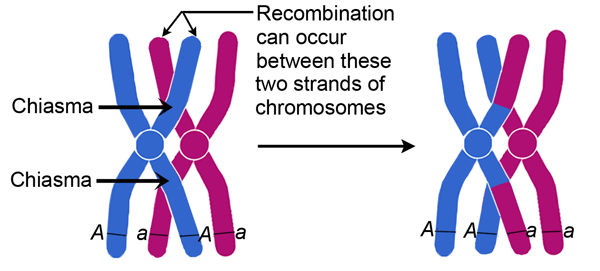
This image shows chromosomes during Prophase 1. Which of the following correctly describes the process shown?

a)

segregation of sister chromatids

b)

condensation and segregation of alleles

c)

mutationin which the DNA content of the gene is altered

d)

crossing - over in which alleles are exchanged

86.

Heterozygous is when...

a)

the alleles are the same

b)

the alleles are different

c)

the alleles are absent

d)

the alleles are present

87.

T - tall and t = short

In the punnett square below, what belongs in the missing square

a)

tt

b)

Tt

c)

Bb

d)

TT

88.

G = green, g = yellow

The genotype for a yellow plant is...

a)

GG

b)

Gg

c)

gg

d)

all of the choices result in yellow

89.

B = brown fur b = white fur

In the punnett square, what is the probability for white fur?

a)

0%

b)

25%

c)

50%

d)

75%

90.

Which of the following alleles is homozygous (purebred) recessive?

a)

Tt

b)

tt

c)

TT

d)

t

91.

Aa, DD, bB, yy are all examples of

a)

genotypes

b)

phenotypes

92.

In peas, round is dominant to wrinkled and yellow is dominant to green. Based on this dihybrid cross, what fraction of the offspring will have wrinkled, yellow seeds?

a)

9/16

b)

3/16

c)

1/16

d)

16/16

93.
Which combination is Homozygous Dominant
a)
HH
b)
Hh
c)
hh
d)
hH
94.

The following genotypes are ​ (a)   ​ : Tt, Mm and Gg​ ​

Choose from the below words
heterozygous
homozygous
95.

The following physical descriptions are ​ (a)   hair color, eye color, height.

Choose from the below words
phenotypes
genotypes
96.
Which combination is Homozygous Dominant
a)
HH
b)
Hh
c)
hh
d)
hH
97.

Which Combination is Heterozygous

a)

AA

b)

Aa

c)

aa

d)

none of the above

98.

Another word for heterozygous is

a)

purebred

b)

hybrid

c)

dominant

d)

recessive

99.

Which of the following would produce a recessive phenotype?

a)

hh

b)

Rr

c)

Ww

d)

BB

100.
What is the percentage of homozygous recessive offspring?
a)
0%
b)
25%
c)
50%
d)
75%
101.
What percentage of the possible offspring will be hybrids?
a)
25%
b)
50%
c)
75%
d)
100%
102.
What percentage of the offspring will be heterozygous dominant?
a)
100%
b)
75%
c)
50%
d)
25%
103.
If two purebred species (BB) are crossed, what percentage of their offspring would be BB?
a)
25%
b)
50%
c)
75%
d)
100%
104.
What is the percentage of a homozyogus dominant offspring?
a)
75%
b)
50%
c)
25%
d)
0%
105.
What percentage of the offspring will be purebred dominant?
a)
0%
b)
25%
c)
50%
d)
75%
106.
In Mendel's pea plants, the homozygous recessive phenotype was white flowers.  If Mendel crossed two homozygous recessive pea plants, what color flowers would be seen in the offspring?
a)
white and purple
b)
white 
c)
purple
d)
lavendar
107.
What is the percentage of homozygous recessive offspring?
a)
0%
b)
25%
c)
50%
d)
75%
108.
A tall plant (TT) is crossed with a short plant (SS) and a medium plant (TS) results. This is what type of inheritance pattern?
a)
Incomplete Dominance
b)
Codominance
109.

In Andalusian fowls, black individuals (BB) and white individuals (WW) are homozygous. Heterozygous individuals are grey (BW).

What is the genotype ratio for a cross between a grey fowl and a white fowl?

a)

2 BB: 2 BW: 0 WW

b)

0 BB: 4 BW: 0 WW

c)

0 BB: 2 BW: 2 WW

d)

1 BB: 2 BW: 1 WW

110.
This is an example of ___________.
a)
 Incomplete Dominance
b)
 Codominance
111.
A calico cat shows both the traits for orange fur and black fur. What kind of allele expression is this?
a)
Incomplete Dominance
b)
Co dominance
112.

Which of the following statement is correct regarding Codominance?

a)

Both alleles are expressed equally

b)

Neither allele is expressed

c)

Expression of a trait depends upon the environment

113.

Red is incompletely dominant to white in snapdragons. Which cross would result in 100% pink flowers?

a)

RR x rr

b)

rr x rr

c)

Rr x Rr

d)

RR x RR

114.
This type of inheritance pattern is a MIXTURE of both traits, like the old theory of blending
a)
incomplete dominance
b)
co-dominance
c)
complete dominance
d)
recessive pattern
115.
This type of inheritance pattern shows BOTH traits in possible offspring:
a)
complete dominance
b)
incomplete dominance
c)
co-dominance
d)
Indomitable 
116.
In flowers, 2 pink (RW) flowers are crossed. What are the genotypes and phenotypes of their offspring?
a)
100% pink (RW)
b)
50% pink (RW); 25% white (WW); 25% red (RR)
c)
75% pink (RW); 25% white (WW)
d)
100% red (RR)