
 Worksheets
BIOLOGY REVIEW QUIZ - TRANSPORT IN CELLS, PLANTS AND ANIMALS
Total questions: 114
Worksheet time: 1hrs 2mins
Diffusion is the movement of particles from
an area of equilibrium to an area of high concentration.
an area of low concentration to an area of high concentration.
an area of high concentration to an area of low concentration.
all of the answers describe what occurs in diffusion.
Osmosis is the movement of ________ across a semi-permeable membrane.
food
energy (ATP)
oxygen
water
A high/steep concentration gradient means
diffusion will occur at a decreased rate
diffusion will occur at an increased rate
diffusion will occur at a constant rate
concentration gradient does not affect the rate of diffusion
Which is true about active transport?
Substances move from a high to low concentration
Substances move down the concentration gradient
Energy is required
No energy is required
Which is an example of osmosis?
water moving into the root cells of a plant
carbon dioxide moving into the leaf of a plant cell
oxygen moving into the bloodstream from the lungs
potassium ions moving in and out of an animal cell
When red blood cells are placed in distilled water, the cells swell as water molecules enter them. By what process do water molecules move into the cells?
Diffusion
Active Transport
Osmosis
This cell organelle helps organisms maintain homeostasis by controlling what substances enter and leave the cell.
cell membrane
nucleus
vacuole
cell wall
In a nerve cell, ATP energy is used to pump sodium (Na) out of the cell and potassium (K) into the cell. This is an example of...
Diffusion
Active Transport
Osmosis
When the concentration of particles inside of a cell is the same as the concentration of particles outside of the cell.
concentration gradient
equilibrium
passive transport
active transport
A cell moves particles using energy against the concentration gradient by
active transport
passive transport
diffusion
osmosis
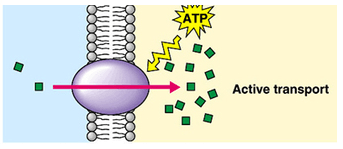
Active Transport uses energy in the form of-
Glucose
ATP
Sodium
DNA
These are found in large numbers in the lining of the small intestine.
Alveoli
Ville
Villi
Arteries

High temperatures make diffusion happen more quickly
True
False
Which type of cell is found in the greatest numbers in blood?
Red blood cell
White blood cell
Platelets
What happens to breathing and heart rate during exercise?
Breathing rate increases and heart rate decreases
They both increase
They both decrease

Observe the image well. Then choose the correct statement.
A is an artery since it has the biggest lumen to carry more blood.
A is a vein since it is very elastic.
B is an artery because it has thick muscular and elastic walls.
B is a vein since all veins have a small lumen
Capillaries are the link between arteries and veins. Capillaries are efficient because: (Tick all the right answers)
1 cell thick for a short diffusion distance
Blood in them travels at a very high speed to ensure diffusion
Blood in them travels at a very low speed to ensure diffusion
The network of capillaries creates a large SA for efficient diffusion.
Arteries have a thick elastic wall to:
Carry oxygenated and deoxygenated blood to all parts of body.
Pump the blood to rest of body.
Withstand the high pressure exerted by the blood.
Name the main artery of the human body.
Pulmonary Artery
Hepatic Artery
Aorta
In the heart which ventricle has the thickest wall?
left ventricle
right ventricle
In the elderly persons, the pulse rate tends to fall with age. This means that:
They would have enough oxygen circulating around their body.
They can feel fatigued due to less oxygen circulating around their body.
They are more prone to diseases.
The blood vessel that carries deoxygenated blood to the lungs is the:
Pulmonary artery
Pulmonary vein
Vena cava
Aorta
Athletes with high cholesterol levels in their blood may experience fatigue because:
Enough oxygen is reaching their muscles.
Less oxygen is available for anaerobic respiration.
Less oxygen is available for aerobic respiration.
An athlete training for the Olympic games was told it is better if he trains at high altitudes. This is because:
The body will build more white blood cells to fight off pathogens
The body will build more platelets to avoid loss of blood in case of injury during the games.
The body will build more red blood cells to carry more oxygen molecules.
A blood sample showed that the white blood cell count was very high. Explain this result.
The body needed to build more energy
The body needed to carry nutrients around the body
The body was healthy, and no signs of infections were visible.
The body was fighting off pathogens.
The presence of valves in the heart prevents
Oxygenated blood from mixing with deoxygenated blood
Backflow of blood
A rise in the blood pressure
The liquid part of the blood is known as:
blood
tissue fluid
plasma
Platelets are necessary:
To avoid entry of pathogens
To avoid loss of WBC
To avoid loss of blood
To avoid entry of pathogens and to avoid loss of blood.
Tick all the substances that may be carried by the plasma
dissolved nutrients
carbon dioxide
oxygen
urea
nitrogen
Mammals have a double circulatory system. This means that
Oxygenated blood passes twice through the heart
Deoxygenated blood passes twice through the heart
The heart pumps deoxygenated blood to lungs and oxygenated blood to rest of body
a mixture of oxygenated and deoxygenated blood is pumped out of heart to the rest of body
If a doctor needs to take a sample of blood from a patient, the blood vessel he would use is the:
artery
vein
Vascular tissue that transports water and minerals UPWARDS from a plant's roots is know as ______.
Cambium
Stomata
Phloem
Xylem
Plant absorbs water through the _________.
leaves
stem
roots
all of the above
What is the name of the part of the root that allows water and minerals enter?
root hairs
epidermis
phloem
xylem
what is/are adaptation (s) of the root hair for its function ?
it has large surface area to absorb more water
large vacuole to store a lot of water
has many mitochondria for active transport of minerals
it is a place to store the food
How do water enter the roots from the soil?
diffusion
osmosis
transpiration
active transport

Transpiration is
the movement of water through a plant from the roots up the stem
the loss of water from the leaves of a plant by the process of evaporation
the flow of water into plant roots by osmosis from the soil
the process of minerals and sugars moving through plant veins
This is the definition for which word: The movement of particles down a concentration gradient (from a high concentration to a low concentration)
Osmosis
Diffusion
Active transport
Transpiration
This is the definition for which word: The movement of water molecules from a high concentration of water to a low concentration of water across a partially permeable membrane.
Osmosis
Active transport
Diffusion
Transpiration
Why is the evaporation of water from leaves important?
It cools leaves and helps move water up the plant.
It helps the plant to respire
It makes the plant wilt
Which of these is/ are true?
Xylem vessels carry water and dissolved minerals up the plant
Xylem vessels carry dissolved sucrose up and down the plant
Phloem tissue carry water and dissolved minerals up the plant
Phloem tissue carry dissolved sucrose up and down the plant
What happens to the transpiration rate as light intensity increases?
It increases
It decreases
It stays the same
Water and minerals move in which direction within the plant
upward
down
both up and down
Plant transports food made in the leaves to __________.
roots
flowers
stem
all of the above

diagram show the cross section of
stem
root
leaf

what is A
xylem
cambium
phloem
cortex

what is B
phloem
cambium
xylem
cortex

diagram shows cross section of a
leaf
root
stem

what is M
phloem
xylem

what is N
xylem
phloem
Sink is any cell that _______.
stores sugar
makes sugar
excretes sugar
give sugar
COMPLETE: The nervous system is made up of two systems...
(a)
The _______ receive messages and send them to the central nervous system.
Motor neurons
Sensory neurons
Relay neurons
What is an effector ?
also known as nerve impulse
part of body that carry out response example muscle and gland
organ or cell that respond to stimuli example eyes and skin
the signal that travel along the nerve cell
What is a receptor ?
the signal that travel along the nerve cell
also known as nerve impulse
organ or cell that respond to stimuli example eyes and skin
part of body that carry out response example muscle and gland


What is an example of a stimulus for plants?
Touch
Light
Gravity
Water
all of the above
Motor neurons transmit impulses ______
to the CNS from the effector
to the effector from the receptor
from the CNS to the receptor
from the CNS to the effector

Identify the neuron shown above
Motor neuron
Relay neuron
Sensory neuron
The receptors on the tongue are called
auditory nerves
taste buds
sensitive hairs
sensory cells
Which of the following CORRECTLY describes the typical nervous pathway?
receptor -> sensory neuron -> relay neuron -> motor neuron -> effector
effector -> sensory neuron -> relay neuron -> receptor -> motor neuron
receptor -> motor neuron -> relay neuron -> sensory neuron -> effector
effector -> sensory neuron -> relay neuron -> motor neuron -> receptor
In a neuron, conversion of electrical signal to chemical signal occurs at
Axonal end
Dendritic end
Cell body
Axon
Correct sequence of electrical impulse transmission in a neuron is from
dendrite, axon, axonal end,cell body
cell body, dendrite, axon,axonal end
dendrite, cell body, axon, axonal end
axonal end, axon, cell body, dendrite
Which is the correct sequence of the components of a reflex arc
Receptors, spinal cord,sensory neuron, motor neuron, muscle
Receptors, muscle, sensory neuron, motor neuron, spinal cord
Receptors, sensory neuron, spinal cord, motor neuron, muscle
Receptors, motor neuron, spinal cord, sensory neuron, muscle
Posture and balance of the body is controlled by
Cerebrum
Cerebellum
Medulla
Pons
Which is not a reflex action
Swallowing
Coughing
Knee jerk
Closing of eyes on flashing light
Spinal cord originates from
Cerebrum
Medulla
Cerebellum
Pons
Part of the brain that controls respiration, heart beat and peristalsis is
Cerebrum
Cerebellum
Hypothalamus
Medulla
Most highly developed part of human brain is
Pons
Medulla
Cerebrum
Cerebellum
Centre for regulating body temperature is
Pons
Cerebellum
Medulla
Hypothalamus
In human, the number of cranial nerves is
12
31
24
26
Taste receptors are
Phonoreceptors
Statoreceptors
Olfactory receptors
Gustatory receptors
The microscopic gap between two adjacent neurons throgh which a nerve impulse passes is
Neurotransmitter
Synapse
Axon terminal
Dendrite
Which nerves arise from the brain and emerges through the skull
Spinal nerves
Thoracic nerves
Cranial nerves
Lumbar nerves
Which of the following is an example of autonomous nervous system
Knee jerk reflex
Swallowing of food
Peristalsis
Reflex action
Smooth muscles, cardiac muscle and organs are regulated by
Central nervous system
Autonomous nervous system
Peripheral nervous system
Somatic nervous system
Part of the brain responsible for hearing is
Cerebrum
Cerebellum
Hypothalamus
Medulla
The autonomic nervous system has control over
Reflex actions
Sense organs
Skeletal muscles
Internal organs
The human nervous system is made of specialised cells called (a)
These cells have
a long thread of cytoplasm called an (a)
They can transmit (a)
impulses very quickly.
The brain and spinal cord make up the (a) nervous system.
The nerves outside the
brain and spinal cord form the (a) nervous system.
Changes in an organism´s environment are called (a) , and are sensed by specialised cells.
Which of the following are the external stimuli?
Sugar level
Light intensity
Osmotic pressure of blood
Cholesterol level
Which of the following are the external stimuli?
Sugar level
Light intensity
Osmotic pressure of blood
Cholesterol level
Which type of cells do all sense organs contain?
ciliated
effector
mesophyll
receptor
What is the meaning of response?
The ability to detect the stimuli and respond to them accordingly
The changes from internal environment and external environment
A receptive structure in a sensory cells that detect stimuli
The way an organism reacts after detecting a stimulus

