
 Worksheets
SEPARATION TECHNIQUES (Mixtures)
Total questions: 35
Worksheet time: 28mins

To separate a mixture of salt and water what separation method is used?
Filtration
Distillation
Chromatography
Evaporation
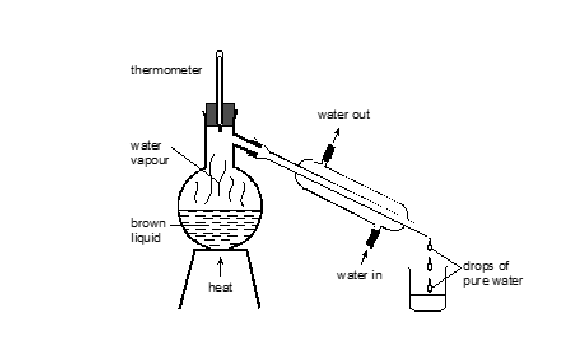
Which separation technique uses the apparatus shown in the diagram?
filtration
evaporation
distillation
chromatography
Which of the following pairs of substances may best be separated through through distillation?
sand and soil
water and soil
salt and sand
water and alcohol
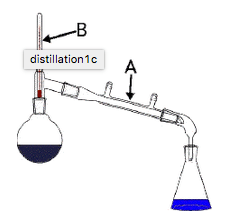
Charcoal powder is insoluble in water. When water is filtered, the charcoal powder becomes the _______.
solute
residue
filtrate
solvent

This process allows the fine flour particles to pass through the holes of the strainer while the bigger impurities remain on the strainer. What is this process called?
(a)
What is the basis for separating the components of a mixture through distillation?
freezing points of the substances
room temperature
decaying period
boiling points of the substances

Which of the following statements is NOT true about the image?
The process is called filtration.
A process known as sedimentation is important to make the separation possible.
The substance that passes through the filter paper is called the filtrate.
This method is used to separate insoluble solids from liquids.

The image shows a mixture of concrete nails and saw dusts. What technique is best to use to separate the nails from the saw dusts?
sieving
chromatography
decantation
magnetic separation

Name the separation technique
Centrifuge
Bunsen burner
Distillation
Evaporation

Name the separation technique
Distillation
Crystallisation
Magnetic Separation
Condensation

Name the separation technique
Filtration
Evaporation
Distillation
Separation
True or false: Filtration can be used to separate substances in a solution
True
False
In a salt water solution ...
Salt is the solute and water is the solvent
Salt is the solvent and water is the solute
True or false: Sieving can be used to separate a mixture with two solid components of different sizes
True
False
How can we separate an insoluble solid from a liquid?
chromatography
evaporation
filtration
condensation

Which separation technique is shown below
using a magnet
separating funnel
Centrifuging
Chromatography

Which is not a separation technique?
Filtrating
Distillating
Evaporating
Dissolving
Solutions are made up of...?
Solutes and insolubles
Solubles and solutes
Solutes and solvents
Solubles and solvents
If something is insoluble in water, it will not...
Separate after distillation
Dissolve in water
Dissolve in anything except water
Separate after filtration
In a solution of saltwater, what is the solute?
Water
Saltwater
Salt
There is no solute, it is insoluble
Which part of a filtration is the "filtrate"?
The filter paper
The solid material left in the funnel
The liquid that has gone through
The conical flask
During filtration, the solid that is trapped in the filter paper is called the (a)
During filtration, the liquid that has passed through the filter paper is called the (a)

Which separation technique is this instrument for?
Distillation
Filtering
Magnetic separation
Sieving

You've got a mixture of powdered sugar and cooking salt. What is the suitable separation technique for this mixture? Hint: the particles of cooking salt are much bigger than those of powdered sugar.
filtering
sieving
distillation
separation technique

