wayground logo

Free Printable Worksheets

Font size

S
M
L
XL
Worksheets

Unit Six Review (with a sprinkle of Unit Five)

Total questions: 74

Worksheet time: 28mins

Name
Class
Date
1.

Industrialism in Egypt differed from Industrialism in England in that

a)

It was driven more by the state then independent capitalists

b)

It was driven more by independent capitalists than the state

c)

In did not involve foreign intervention

d)

Machines were adapted much less in production

2.

Russia's industrial process can best be described as

a)

evolving organically by Russian middle class investors

b)

directed by outside colonial powers

c)

rapid because of the maintenance of serfdom

d)

directed by the state through ministers like Sergei Witte
3.

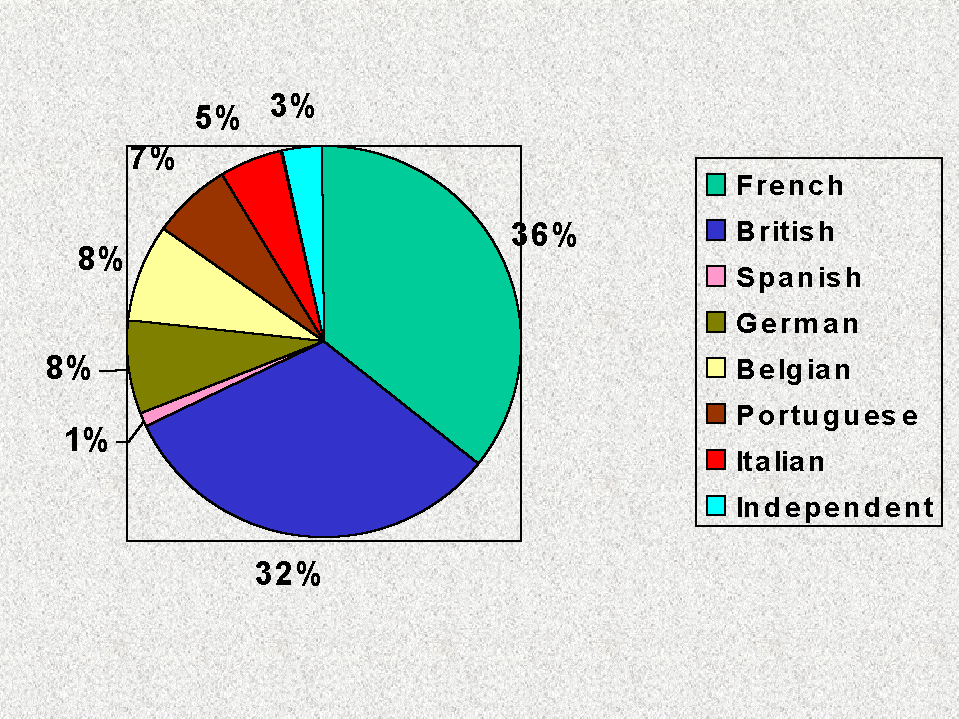
This likely represents

a)

imperialism in Africa

b)

imperialism in Asia

c)

imperialism in the Americas

d)

global imperialism

4.

The Xhosa cow killing movement is a resisitance movement

a)

in Egypt

b)

in Botswana

c)

in China

d)

in South Africa

5.

One of the major theoretical contributors to the justification of imperialism was

a)

the Cathoic Church

b)

Darwin's "Survival of the Fittest" theory

c)

Karl Marx's theories

d)

Adam Smith's ideas

6.

The Sepoy Rebelion was caused by

a)

gun cartriages

b)

insensitivity to religion

c)

cultural misunderstanding

d)

all of the above

7.

The Monroe Doctrine

a)

supported US Imperial ambitions

b)

supported the British control of India

c)

solved the "Scramble for Africa" issue

d)

made the Opium Wars worse

8.

This image represents one of the most important industriesand exports in Peru in the industrial economy

a)

Whale

b)

Guano

c)

Cotton

d)

Rubber

9.

The following was responsible for expanding British holdings in Africa "from the Cape to Cairo".

a)

David Livingston

b)

Henry Stanley

c)

Lord Kirchner

d)

Cecil Rhodes

10.

Which country had the largest sphere of influence in Latin America during the Age of Imperialism?

a)

United States

b)

Spain

c)

Mexico

d)

England

11.

What caused the Taiping and Boxer rebellions?

a)

Foreign economic involvement in China

b)

British selling opium to China

c)

Indians refusing to touch the gunpowder pouches

d)

Americans moving into West North America

12.

What was Japan's response to foreign interference in the nineteenth century?

a)

Adapt to Western politics and culture (Meiji Restoration)

b)

Isolate themselves further by resisting and fighting

c)

Became allies with the Chinese to become the dominant power in the region

d)

Adapt to the ideas of the islanders and tribal people to resist

13.

Which was a state regulation of immigration during the nineteenth century?

a)

Chinese Exclusion Acts

b)

Congo Free State

c)

White New Zealand Policy

d)

Jim Crow Laws

14.

Why, in the time period c. 1750-1900, did European states fight to acquire overseas colonies?

a)

To acquire raw materials to fuel their industrialization

b)

To spread Enlightenment ideas

c)

To abolish slavery worldwide

d)

To stop the spread of Islam throughout the world

15.

Why did European powers turn to indentured servants for labor?

a)

The abolition of the slave trade

b)

The shift in control in India to the British

c)

The growth of industrialization in China

d)

The success of the Atlantic revolutions

16.

In the time period c. 1750-1900, where did migrant workers typically seek work?

a)

Industrial cities

b)

Tropical plantations

c)

Small grain farms

d)

Uncharted territory, such as the Great Plains

17.

Select all of the countries who dominated others through Imperialism

a)

Britain

b)

Japan

c)

China

d)

United States

e)

India

18.
The American desire for a trade relationship with Japan in 1853 led to
a)
The overthrow of the shogun and the modernization of the country
b)
Increased tensions between China and Korea
c)
Greater Russian influence in Manchuria
d)
The colonization of Taiwan
19.

All of the following were reactions to industrialization's negative effects on workers EXCEPT

a)

Labor unions

b)

Communism

c)

The invisible hand

d)

Utilitarianism

20.

Select ALL of the following that are considered an impact of industrialization during the 18th and 19th centuries.

a)

Increased competition between industrialized nations

b)

Rise of global inequalities

c)

Transformation of society.

d)

Decolonization of Africa

21.
A major factor in the expansion of industrialization was the development of
a)
Socialism
b)
Feudalism
c)
Land grants
d)
Railroads
22.
Imperialism
a)
A policy of extending a country's power and influence through diplomacy or military force.
b)
By 1900, half of America's Chinese population lived in urban areas. they were led by prominent merchants and kept the Chinese traditions alive with festival.
c)
Congress advocating for those from India
d)
Ethnic Enclaves helped transplant their culture into new environment and facilitated the development of migrant support network.
23.
Nationalism
a)
A strong feeling of pride in and devotion to one's country
b)
A policy of extending a country's power and influence through diplomacy or military force.
c)
By 1900, half of America's Chinese population lived in urban areas. they were led by prominent merchants and kept the Chinese traditions alive with festival.
d)
Congress advocating for those from India
24.
Charles Darwin
a)
English natural scientist who formulated a theory of evolution by natural selection (1809-1882)
b)
the detailed study of the shape and size of the cranium as a supposed indication of character and mental abilities.
c)
Chiang and the nationalists were forced to flee to Formosa, a large island off the southern coast of China, after the Communist victory in the civil war. Throughout the 1950's, the U.S. continued to recognize and support Chiang's government in Formosa as the legitimate government of China, and to ignore the existence of the Communist People's Republic on the mainland.
d)
a war between China and Japan for influence, power, and territory
25.
East India Company (EIC)
a)
private trading company established in 1600, which expanded through conquest and British military support after the 1750s to administer most of India. As a result of the 1857 mutiny and rebellion, its charter was ended and Indian administration was taken over directly by the British government.
b)
Scottish missionary and explorer who discovered the Zambezi River and Victoria Falls (1813-1873)
c)
The belief that only the fittest survive in human political and economic struggle.
d)
English natural scientist who formulated a theory of evolution by natural selection (1809-1882)
26.
Dutch East India Company (VOC)
a)

A joint stock company chartered by the Dutch government to control all Dutch trade in the Indian and Pacific Oceans.

b)
private trading company established in 1600, which expanded through conquest and British military support after the 1750s to administer most of India. As a result of the 1857 mutiny and rebellion, its charter was ended and Indian administration was taken over directly by the British government.
c)
Scottish missionary and explorer who discovered the Zambezi River and Victoria Falls (1813-1873)
d)
The belief that only the fittest survive in human political and economic struggle.
27.
King Leopold II
a)
King of Belgium (r. 1865-1909). He was active in encouraging the exploration of Central Africa and became the infamous ruler of the Congo Free State (to 1908).
b)
A joint stock company chartered by the Dutch government to control all Dutch trade in the Indian and Pacific Oceans. Also known by its Dutch initials VOC for Verenigde Oostendische Compagnie.
c)
private trading company established in 1600, which expanded through conquest and British military support after the 1750s to administer most of India. As a result of the 1857 mutiny and rebellion, its charter was ended and Indian administration was taken over directly by the British government.
d)
Scottish missionary and explorer who discovered the Zambezi River and Victoria Falls (1813-1873)
28.
Gold Coast
a)
Region of the Atlantic coast of West Africa occupied by modern Ghana; named for its gold exports to Europe from the 1470s onward.
b)
King of Belgium (r. 1865-1909). He was active in encouraging the exploration of Central Africa and became the infamous ruler of the Congo Free State (to 1908).
c)
A joint stock company chartered by the Dutch government to control all Dutch trade in the Indian and Pacific Oceans. Also known by its Dutch initials VOC for Verenigde Oostendische Compagnie.
d)
private trading company established in 1600, which expanded through conquest and British military support after the 1750s to administer most of India. As a result of the 1857 mutiny and rebellion, its charter was ended and Indian administration was taken over directly by the British government.
29.
Cape Colony
a)
Dutch colony established at Cape of Good Hope in 1652 initially to provide a coastal station for the Dutch seaborne empire; by 1770 settlements had expanded sufficiently to come into conflict with Bantus.
b)
Region of the Atlantic coast of West Africa occupied by modern Ghana; named for its gold exports to Europe from the 1470s onward.
c)
King of Belgium (r. 1865-1909). He was active in encouraging the exploration of Central Africa and became the infamous ruler of the Congo Free State (to 1908).
d)
A joint stock company chartered by the Dutch government to control all Dutch trade in the Indian and Pacific Oceans. Also known by its Dutch initials VOC for Verenigde Oostendische Compagnie.
30.
Congo Free State
a)
a large area in Central Africa that was privately controlled by Leopold II of Belgium. He was able to secretly treat the people of the colony very badly until he was forced to give it up.
b)
Dutch colony established at Cape of Good Hope in 1652 initially to provide a coastal station for the Dutch seaborne empire; by 1770 settlements had expanded sufficiently to come into conflict with Bantus.
c)
Region of the Atlantic coast of West Africa occupied by modern Ghana; named for its gold exports to Europe from the 1470s onward.
d)
King of Belgium (r. 1865-1909). He was active in encouraging the exploration of Central Africa and became the infamous ruler of the Congo Free State (to 1908).
31.
Berlin Conference
a)
A meeting from 1884-1885 at which representatives of European nations agreed on rules colonization of Africa
b)
The Kingdom of _____, known today as Thailand, remained relatively independent during through the nineteenth century because they served as a buffer between the colonies of Britain and France in Indochina.
c)
British colony conquered in the 1870s which provided abundant supplies of tin rubber
d)
a peninsula of southeastern Asia that includes Myanmar and Cambodia and Laos and Malaysia and Thailand and Vietnam
32.
Scramble for Africa
a)
Sudden wave of conquests in Africa by European powers in the 1880s and 1890s. Britain obtained most of eastern Africa, France most of northwestern Africa. Other countries (Germany, Belgium, Portugal, Italy, and Spain) acquired lesser amounts.
b)
The treaty signed by the British and Maori in 1840 giving Britain control over New Zealand.
c)
A meeting from 1884-1885 at which representatives of European nations agreed on rules colonization of Africa
d)
The Kingdom of _____, known today as Thailand, remained relatively independent during through the nineteenth century because they served as a buffer between the colonies of Britain and France in Indochina.
33.
Monroe Doctrine
a)
an American foreign policy opposing interference in the Western hemisphere from outside powers
b)
Sudden wave of conquests in Africa by European powers in the 1880s and 1890s. Britain obtained most of eastern Africa, France most of northwestern Africa. Other countries (Germany, Belgium, Portugal, Italy, and Spain) acquired lesser amounts.
c)
The treaty signed by the British and Maori in 1840 giving Britain control over New Zealand.
d)
A meeting from 1884-1885 at which representatives of European nations agreed on rules colonization of Africa
34.
Manifest Destiny
a)
A notion held by a nineteenth-century Americans that the United States was destined to rule the continent, from the Atlantic the Pacific.
b)
an American foreign policy opposing interference in the Western hemisphere from outside powers
c)
Sudden wave of conquests in Africa by European powers in the 1880s and 1890s. Britain obtained most of eastern Africa, France most of northwestern Africa. Other countries (Germany, Belgium, Portugal, Italy, and Spain) acquired lesser amounts.
d)
The treaty signed by the British and Maori in 1840 giving Britain control over New Zealand.
35.
penal colony
a)
a colony to which convicts are sent as an alternative to prison
b)
Detention centers for civilians considered enemies of the state
c)
Used to describe the rivalry and strategic conflict between the British Empire and the Russian Empire before WWI.
d)
Roosevelt's 1904 extension of the Monroe Doctrine, stating that the United States has the right to protect its economic interests in South And Central America by using military force
36.
Seven Years War
a)
(1756-1763 CE) Known also as the French and Indian war. It was the war between the French and their Indian allies and the English that proved the English to be the more dominant force of what was to be the United States both commercially and in terms of controlled regions.
b)
a conflict, lasting from 1899 to 1902, in which the Dutch and the British fought for control of territory in South Africa.
c)
a colony to which convicts are sent as an alternative to prison
d)
Detention centers for civilians considered enemies of the state
37.
Taiping Rebellion
a)
a mid-19th century rebellion against the Qing Dynasty in China, led by Hong Xiuquan
b)
(1756-1763 CE) Known also as the French and Indian war. It was the war between the French and their Indian allies and the English that proved the English to be the more dominant force of what was to be the United States both commercially and in terms of controlled regions.
c)
a conflict, lasting from 1899 to 1902, in which the Dutch and the British fought for control of territory in South Africa.
d)
a colony to which convicts are sent as an alternative to prison
38.
Boxer Rebellion
a)
1899 rebellion in Beijing, China started by a secret society of Chinese who opposed the "foreign devils". The rebellion was ended by British troops.
b)
a mid-19th century rebellion against the Qing Dynasty in China, led by Hong Xiuquan
c)
(1756-1763 CE) Known also as the French and Indian war. It was the war between the French and their Indian allies and the English that proved the English to be the more dominant force of what was to be the United States both commercially and in terms of controlled regions.
d)
a conflict, lasting from 1899 to 1902, in which the Dutch and the British fought for control of territory in South Africa.
39.
Spanish-American War
a)
In 1898, a conflict between the United States and Spain, in which the U.S. supported the Cubans' fight for independence
b)
1899 rebellion in Beijing, China started by a secret society of Chinese who opposed the "foreign devils". The rebellion was ended by British troops.
c)
a mid-19th century rebellion against the Qing Dynasty in China, led by Hong Xiuquan
d)
(1756-1763 CE) Known also as the French and Indian war. It was the war between the French and their Indian allies and the English that proved the English to be the more dominant force of what was to be the United States both commercially and in terms of controlled regions.
40.
Spheres of Influence in China
a)
one country would have special authority or presence and another country would have a different area of authority. China became divided by European powers. The different European countries supported each other through the spheres of influence because of economic advantage
b)
Egyptian laborers who built the Suez Canal
c)
In 1898, a conflict between the United States and Spain, in which the U.S. supported the Cubans' fight for independence
d)
1899 rebellion in Beijing, China started by a secret society of Chinese who opposed the "foreign devils". The rebellion was ended by British troops.
41.
Settler Colony
a)
A form of colonization where foreign family move into a region and an imperial political power oversees the immigration of these settlers.
b)
one country would have special authority or presence and another country would have a different area of authority. China became divided by European powers. The different European countries supported each other through the spheres of influence because of economic advantage
c)
Egyptian laborers who built the Suez Canal
d)
In 1898, a conflict between the United States and Spain, in which the U.S. supported the Cubans' fight for independence
42.
Trail of Tears
a)
The Cherokee Indians were forced to leave their lands. They traveled from North Carolina and Georgia through Tennessee, Kentucky, Illinois, Missouri, and Arkansas-more than 800 miles (1,287 km)-to the Indian Territory. More than 4, 00 Cherokees died of cold, disease, and lack of food during the 116-day journey.
b)
An area to which Native Americans were moved covering what is now Oklahoma and parts of Kansas and Nebraska
c)
Founded in 1816, encouraged owners to free their African slaves and pay to send them back to Africa
d)
indigenous people of New Zealand
43.
Quinine
a)
a drug used for fighting malaria and other fevers
b)
The Cherokee Indians were forced to leave their lands. They traveled from North Carolina and Georgia through Tennessee, Kentucky, Illinois, Missouri, and Arkansas-more than 800 miles (1,287 km)-to the Indian Territory. More than 4, 00 Cherokees died of cold, disease, and lack of food during the 116-day journey.
c)
An area to which Native Americans were moved covering what is now Oklahoma and parts of Kansas and Nebraska
d)
Founded in 1816, encouraged owners to free their African slaves and pay to send them back to Africa
44.
Suez Canal
a)
A ship canal in northeastern Egypt linking the Red Sea with the Mediterranean Sea
b)
a drug used for fighting malaria and other fevers
c)
The Cherokee Indians were forced to leave their lands. They traveled from North Carolina and Georgia through Tennessee, Kentucky, Illinois, Missouri, and Arkansas-more than 800 miles (1,287 km)-to the Indian Territory. More than 4, 00 Cherokees died of cold, disease, and lack of food during the 116-day journey.
d)
An area to which Native Americans were moved covering what is now Oklahoma and parts of Kansas and Nebraska
45.
Tupac Amaru II
a)
Member of Inca aristocracy who led a rebellion against Spanish authorities in Peru in 1780-1781. He was captured and executed with his wife and other members of his family.
b)
A ship canal in northeastern Egypt linking the Red Sea with the Mediterranean Sea
c)
a drug used for fighting malaria and other fevers
d)
The Cherokee Indians were forced to leave their lands. They traveled from North Carolina and Georgia through Tennessee, Kentucky, Illinois, Missouri, and Arkansas-more than 800 miles (1,287 km)-to the Indian Territory. More than 4, 00 Cherokees died of cold, disease, and lack of food during the 116-day journey.
46.
Samory Toure
a)
leader of Malinke peoples in West Africa who formed an army that fought against French for 15 years and proclaimed himself king of Guinea
b)
scholar who inspired resistance against corruption and European control; began an Islamic revival in northern Nigeria
c)
queen of the Asantes that led the fight against the British in the last Asante war, took power after the king was exiled
d)
Born: June 19, 1861 Calamba, Laguna
47.
Sokoto Caliphate
a)
large Muslim state founded in 1809 in what is now northern Nigeria.
b)
triangular arm of land that juts from southeastern Europe into the Mediterranean
c)
queen of the Asantes that led the fight against the British in the last Asante war, took power after the king was exiled
d)
Announced that he was the Mahdi
48.
Ghost Dance
a)
a religious dance of native Americans looking for communication with the dead
b)
Established in Gold Coast among Akan people settled around Kumasi; dominated by Oyoko clan; many clans linked under Osei Tutu after 1650.
c)
From the Arabic term for "land of black people," a large region of West Africa that became part of a major exchange circuit.
d)
large Muslim state founded in 1809 in what is now northern Nigeria.
49.
Indian Rebellion, 1857-1858
a)
Massive uprising of much of India against British rule; also called the Indian Mutiny or the Sepoy Mutiny from the fact that the rebellion first broke out among Indian troops in British employ.
b)
a religious dance of native Americans looking for communication with the dead
c)
Established in Gold Coast among Akan people settled around Kumasi; dominated by Oyoko clan; many clans linked under Osei Tutu after 1650.
d)
From the Arabic term for "land of black people," a large region of West Africa that became part of a major exchange circuit.
50.
Maori Wars
a)
natives of New Zealand fighting British after colonists became more populated and moved more inland.
b)
armed conflict between the Philippines and the United States from 1899-1902. It was a continuation of the Philippine struggle for independence. The Philippines declared war on the US and it became a savage conflict with guerilla warfare. Villages were destroyed, civilians were murdered, and prisoners were tortured. The war ended when Aguinaldo surrendered in 1902.
c)
In 1898, a conflict between the United States and Spain, in which the U.S. supported the Cubans' fight for independence
d)
1899-1902: Rebels in Philippines fought US troops for 3 years trying to achieve independence. US gives them independence after WWII in 1946.
51.
Xhosa Cattle Killing Movement
a)
Pivotal movement that broke the back of the Xhosa and ushered in a new era of colonial expansion and domination of South Africa by the British. The prophecy was that killing all cattle would bring back ancient chiefs and ancestors.
b)
natives of New Zealand fighting British after colonists became more populated and moved more inland.
c)
armed conflict between the Philippines and the United States from 1899-1902. It was a continuation of the Philippine struggle for independence. The Philippines declared war on the US and it became a savage conflict with guerilla warfare. Villages were destroyed, civilians were murdered, and prisoners were tortured. The war ended when Aguinaldo surrendered in 1902.
d)
In 1898, a conflict between the United States and Spain, in which the U.S. supported the Cubans' fight for independence
52.
Anglo-Zulu War
a)
War between the British Empire and the Zulu Kingdom. From complex beginnings, the war is notable for several particularly bloody battles, as well as for being a landmark in the timeline of colonialism in the region. The war ended the Zulu nation's independence.(1879)
b)
Pivotal movement that broke the back of the Xhosa and ushered in a new era of colonial expansion and domination of South Africa by the British. The prophecy was that killing all cattle would bring back ancient chiefs and ancestors.
c)
natives of New Zealand fighting British after colonists became more populated and moved more inland.
d)
armed conflict between the Philippines and the United States from 1899-1902. It was a continuation of the Philippine struggle for independence. The Philippines declared war on the US and it became a savage conflict with guerilla warfare. Villages were destroyed, civilians were murdered, and prisoners were tortured. The war ended when Aguinaldo surrendered in 1902.
53.
Indian National Congress
a)
A movement and political party founded in 1885 to demand greater Indian participation in government. Its membership was middle class, and its demands were modest until World War I. Led after 1920 by Mohandas K. Gandhi, appealing to the poor.
b)
(1830) a congressional act that authorized the removal of Native Americans who lived east of the Mississippi River
c)
A proclamation from the British government which forbade British colonists from settling west of the Appalacian Mountains, and which required any settlers already living west of the mountains to move back east.
d)
The treaty signed by the British and Maori in 1840 giving Britain control over New Zealand.
54.
Cherokee Nation
a)
Native American tribe that was forced to leave their land because of the Indian Removal Act
b)
A movement and political party founded in 1885 to demand greater Indian participation in government. Its membership was middle class, and its demands were modest until World War I. Led after 1920 by Mohandas K. Gandhi, appealing to the poor.
c)
(1830) a congressional act that authorized the removal of Native Americans who lived east of the Mississippi River
d)
A proclamation from the British government which forbade British colonists from settling west of the Appalacian Mountains, and which required any settlers already living west of the mountains to move back east.
55.
Pan-Africanism
a)
the unity of all black Africans, regardless of national boundaries
b)
Last imam in a series of twelve descendants of Muhammad's son-in-law Ali, whom Shi'ites consider divinely appointed leaders of the Muslim community. In occlusion since ca. 873, he is expected to return as an apocolyptic messiah at the end of time.
c)
A people of modern South Africa whom King Shaka united beginning in 1818.
d)
the major ethnic group and language of Bantu-speakers in South Africa
56.
Sepoys
a)
Indian soldiers
b)
the unity of all black Africans, regardless of national boundaries
c)
Last imam in a series of twelve descendants of Muhammad's son-in-law Ali, whom Shi'ites consider divinely appointed leaders of the Muslim community. In occlusion since ca. 873, he is expected to return as an apocolyptic messiah at the end of time.
d)
A people of modern South Africa whom King Shaka united beginning in 1818.
57.
Raj
a)
British rule after India came under the British crown during the reign of Queen Victoria
b)
Indian soldiers
c)
the unity of all black Africans, regardless of national boundaries
d)
Last imam in a series of twelve descendants of Muhammad's son-in-law Ali, whom Shi'ites consider divinely appointed leaders of the Muslim community. In occlusion since ca. 873, he is expected to return as an apocolyptic messiah at the end of time.
58.
Guano
a)
Bird droppings used as fertilizer; a major trade item of Peru in the late nineteenth century
b)
British rule after India came under the British crown during the reign of Queen Victoria
c)
Indian soldiers
d)
the unity of all black Africans, regardless of national boundaries
59.
palm oil
a)
A West African tropical product often used to make soap; the British encouraged its cultivation as an alternative to the slave trade.
b)
a tough elastic polymeric substance made from the latex of a tropical plant or synthetically.
c)
The plant that produces fibers from which many textiles are woven. Native to India, it spread throughout Asia and then to the New World. It has been a major cash crop in various places, including early Islamic Iran, Yi Korea, Egypt, and the US
d)
Bird droppings used as fertilizer; a major trade item of Peru in the late nineteenth century
60.
ivory
a)
hard white material made from elephant tusks
b)
A West African tropical product often used to make soap; the British encouraged its cultivation as an alternative to the slave trade.
c)
a tough elastic polymeric substance made from the latex of a tropical plant or synthetically.
d)
The plant that produces fibers from which many textiles are woven. Native to India, it spread throughout Asia and then to the New World. It has been a major cash crop in various places, including early Islamic Iran, Yi Korea, Egypt, and the US
61.
Cecil Rhodes
a)
Born in 1853, played a major political and economic role in colonial South Africa. He was a financier, statesman, and empire builder with a philosophy of mystical imperialism.
b)
highly valued precious stones
c)
Valuable metallic element that attracted many to California for the "California Gold Rush"
d)
airtight sealed metal container for food or drink or paint etc.
62.
Export Economies
a)
goods produced in that region were not meant for domestic consumption
b)
crops, such as tobacco, sugar, and cotton, raised in large quantities in order to be sold for profit
c)
Owned by British Cecil Rhodes, this company controlled up to 90% of the world's rough diamonds.
d)
Born in 1853, played a major political and economic role in colonial South Africa. He was a financier, statesman, and empire builder with a philosophy of mystical imperialism.
63.
telegraph
a)
A device for rapid, long-distance transmission of information over an electric wire. It was introduced in England and North America in the 1830s and 1840s.
b)
Steamships proved their own versatility by advancing up rivers to points that sailboats could not reach because of inconvenient twists, turns, or winds.
c)
Networks of iron (later steel) rails on which steam (later electric or diesel) locomotives pulled long trains at high speeds. The first were built in England in the 1830s. Success caused the construction of these to boom lasting into the 20th Century
d)
large areas of land with a single plant variety
64.
Treaty of Nanking (Nanjing)
a)
peace treaty signed by China and Great Britain, ending the Opium War but also greatly restricting Chinese control over their own trade with western countries
b)
Central African nation
c)
This early empire has its home along Africa's longest river, with a detailed form of writing.
d)
Europeans' name for the Moluccas, islands rich in cloves and nutmeg
65.
Opium War
a)
a conflict between Britain and China, lasting from 1839 to 1842, over Britain's opium trade in China
b)
peace treaty signed by China and Great Britain, ending the Opium War but also greatly restricting Chinese control over their own trade with western countries
c)
Central African nation
d)
This early empire has its home along Africa's longest river, with a detailed form of writing.
66.
Economic Imperialism
a)
Independent but less developed nations controlled by private business interests rather than by other governments.
b)
A grasslands region in Argentina and Uruguay
c)
substance derived from the opium poppy from which all narcotic drugs are derived
d)
a conflict between Britain and China, lasting from 1839 to 1842, over Britain's opium trade in China
67.
spheres of influence
a)
Areas in which countries have some political and economic control but do not govern directly (ex. Europe and U.S. in China)
b)
unpaid labor required by a governing authority
c)
sharing enough cultural traits and complexes to be recognized as a distinctive cultural entity
d)
Independent but less developed nations controlled by private business interests rather than by other governments.
68.
banana republics
a)
Term given to governments supported or created by the United States in Central America; believed to be either corrupt or subservient to U.S. interests.
b)
a crop produced for its commercial value rather than for use by the grower.
c)
Areas in which countries have some political and economic control but do not govern directly (ex. Europe and U.S. in China)
d)
unpaid labor required by a governing authority
69.
contract laborers
a)
an immigrant who signed a contract in Europe to work for an American employer, often to replace a striking worker
b)
Colonists who received free passage to North America in exchange for working without pay for a certain number of years
c)
A system of enforced servitude in which some people are owned by other people.
d)
British government services
70.
Diaspora
a)
A dispersion of people from their homeland
b)
an immigrant who signed a contract in Europe to work for an American employer, often to replace a striking worker
c)
Colonists who received free passage to North America in exchange for working without pay for a certain number of years
d)
A system of enforced servitude in which some people are owned by other people.
71.
emigrate
a)
To leave one country or region and settle in another
b)
A dispersion of people from their homeland
c)
an immigrant who signed a contract in Europe to work for an American employer, often to replace a striking worker
d)
Colonists who received free passage to North America in exchange for working without pay for a certain number of years
72.
Chinese Exclusion Act
a)
(1882) Denied any additional Chinese laborers to enter the country while allowing students and merchants to immigrate.
b)
South American Indian word that means "land of waters"
c)
an island in the southwestern Indian Ocean
d)
Port of Spain
73.
Ethnic Enclaves
a)
Ethnic Enclaves helped transplant their culture into new environment and facilitated the development of migrant support network.
b)
Culture found in a large, heterogeneous society that shares certain habits despite differences in other personal characteristics.
c)
A group of restless people who fled their home in Scotland in the 1600s to escape poverty and religious oppression. They first relocated to Ireland and then to America in the 1700s. They left their mark on the backcountry of Virginia, the Carolinas, and Georgia. These areas are home to many Presbyterian churches established by the Scots-Irish. Many people in these areas are still very independent like their ancestors.
d)
Built largely in the early 1800s, canals linked the Northeast farming areas with cities and had a powerful effect on westward migration; helped establish New York as an important trading location (8.6.2)
74.
Chinatowns
a)
By 1900, half of America's Chinese population lived in urban areas. they were led by prominent merchants and kept the Chinese traditions alive with festival.
b)
Congress advocating for those from India
c)
Ethnic Enclaves helped transplant their culture into new environment and facilitated the development of migrant support network.
d)
Culture found in a large, heterogeneous society that shares certain habits despite differences in other personal characteristics.