
 Worksheets
Water Cycle
Total questions: 46
Worksheet time: 2hrs 32mins
In the morning, you observe that water droplets have formed on grass. Which process occurred when the water droplets formed on the grass?
condensation
deposition
evaporation
sublimation

What process is happening step A?
transpiration
evaporation
condensation
accumulation

The process in which water vapor is released into the atmosphere through plants.
evaporation
transpiration
condensation
precipitation

The process by which molecules of water vapor become liquid water.
transpiration
evaporation
condensation
accumulation
Any form of water that falls from clouds and reaches Earth’s surface because of gravity.
accumulation
precipitation
condensation
surface runoff

In order for evaporation to occur, liquid water must change state into a ___________.
gas
solid
plasma

In order for condensation to occur, water vapor (gas) must change state into a _________.
solid
liquid
gel
______________ is the step in the water cycle that moves the most amount of water up into the atmosphere.
Condensation
Crystallization
Evaporation

In science a cycle is......
anything that happens naturally
an individual event that occurs
a series of events that repeat themselves
What process is happening step B?
transpiration
precipitation
condensation

What step of the water cycle is happening in arrow D?
Condensation
Evaopration
Run off
What is the energy source for the water cycle?
the sun
water
the Earth
the moon

What part of the water cycle does this picture show?
condensation
precipitation
evaporation

What part of the water cycle does this picture show?
condensation
precipitation
evaporation

When water condenses, water vapor in the air gets ______ and changes back into a liquid.
warm
cold
hot
solid

What is the OPPOSITE of condensation?
transpiration
runoff
precipitation
evaporation

How much of our planet is estimated to be covered with water?
10%
25%
50%
75%

What do you call the changes of water when it evaporates into the air, condenses into clouds, and then precipitates down to Earth?
run-off
the water cycle
evaporation
precipitation

What is rainfall that is not absorbed by soil and travels to the ocean?
run-off
transpiration
precipitation
evaporation
What changes water from one state to another?
clouds
the ocean
a change in temperature
none of the above
The greatest amount of water found on Earth is fresh water. True or False?
True
False

When is the best time for water to evaporate?
cold and snowy
wet and raining
hot and dry
all the time

What process is happening in number 6?
transpiration
evaporation
condensation
accumulation

What is number 1 in the diagram?
condensation
evaporation
runoff
precipitation

What is number 3 in the diagram?
evaporation
precipitation
surface runoff
condensation
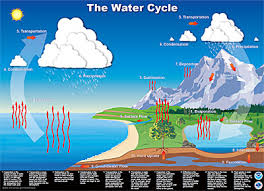
During what part of the water cycle does water vapor turn into liquid droplets?
evaporation
condensation
precipitation
run off

A cold, closed bottle of water is left in the sun. Water forms on the outside of the bottle. This is an example of
evaporation
precipitation
water vapor
condensation
What would happen if less water evaporated from the oceans?
Ocean levels would increase and there would be more precipitation.
Ocean levels would decrease and there would be more precipitation.
Ocean levels would increase and there would be less precipitation.
Ocean levels would decrease and there would be less precipitation.
How are the oceans connected to other bodies of water?
Water evaporates from the oceans and enters the other bodies as precipitation.
Water evaporates from the oceans and enters the other bodies as evaporation.
Water evaporates from the oceans and enters the other bodies as condensation.
Water evaporates from the oceans and enters the other bodies as groundwater.
What is the role of the Sun in the water cycle?
It removes salt water from Earth's air
It provides heat energy to keep all the water moving
It makes the clouds
It cools water in the air and creates precipitation
Condensation creates-
Clouds
Precipitation
Ground water
Evaporation

Water underground is stored in ____________.
aquifers
reservoirs
wells
depositories
Approximately _____ percent of Earth's water is freshwater.
97
1
3
10
Approximately what percent of Earth's water is salt water?
3
70
79
97

The diagram shows the distribution of water on the Earth. Which source is the most abundant supply of liquid surface water that is not salty?
groundwater
oceans
lakes
rivers

The graphic shows that only 3% of the Earth's water is fresh water. The graphic also shows that of this 3%, almost all of it is contained in two reservoirs. What are the two reservoirs that contain almost all of Earth's fresh water?
glaciers and groundwater
streams and estuaries
marshes and swamps
lakes and rivers

The diagram shows the distribution of water on the Earth. Based on the diagram, which is true?
Most of Earth's water is fresh water.
Most of Earth's fresh water is contained in glaciers and ground water.
Most of Earth's water is contained in glaciers.
Most of Earth's fresh water is contained in the oceans.

