
 Worksheets
Protein Synthesis and Mutation Review
Total questions: 70
Worksheet time: 45mins


What is the correct order to make a protein?
Protein, DNA, RNA
RNA, DNA, Protein
DNA, RNA, Protein
Protein, RNA, DNA
RNA has what base that is instead of thymine?
guanine
adenine
thymine
uracil
Which RNA carries the message?
mRNA
rRNA
tRNA
TRANSCRIBE this DNA sequence: TACGTTACT
AUGCAAUGA
ATGCAATGA
AUGGATUGA
TACGTTACT
GTAGTCA
TGGCAAGTACGT
What does tRNA stand for?
transition RNA
transcription RNA
transfer RNA
translation RNA
The main function of transfer RNA (tRNA) is to
carry a message that when translated, forms proteins
form a portion of ribosomes, a cell's protein factories
bring / transfer amino acids from the cytoplasm to the ribosomes
string together complementary RNA and DNA strands
mRNA is read into amino acids during what process?
transcription
transfer
translation
transition
ATG GGA ACT CCA

AUG-CCA-GUA-GGG-UAA

Which of the following is known as the START codon?
UAG
AUG
UGA
UAA
In DNA _______ matches with Adenine
Uracil
Guanine
Cytosine
Thymine

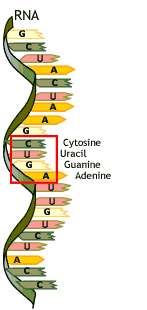
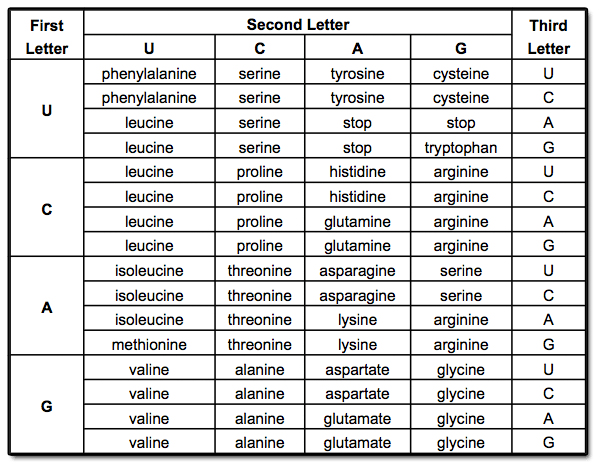
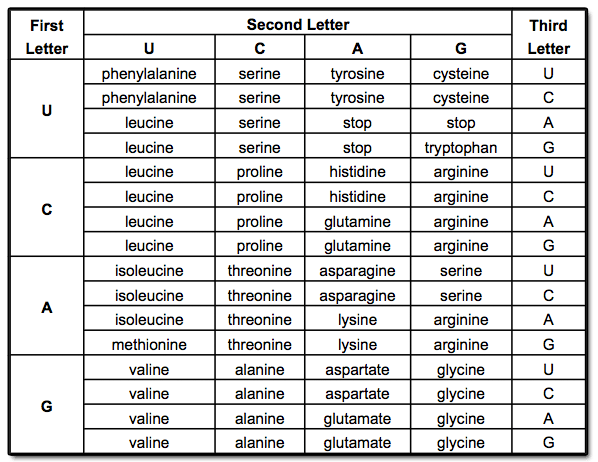
Which amino acid matches with the following codon:
GAU
GLU
SER
ASP
ILE
Which amino acid matches with the following codon:
CAC
STOP
HIS
LYS
ARG
The mutated DNA segment is TTCGCAAG. This is an example of ___ mutation.
GAG-CTC-GAC-AGA
Mutant
GAG CTC-CAC-AGA
In this type of point mutation, one nitrogen base is exchanged for another, different base
substitution
insertion
deletion
translocation
In this type of point mutation, one extra base pair is inserted into a sequence of DNA
substitution
insertion
deletion
translocation
In this type of point mutation, one base pair is lost
substitution
insertion
deletion
translocation

The bottom DNA sequence in the image has been altered by this type of mutation
substitution
insertion
deletion
translocation

The bottom DNA sequence in the image has been altered by this type of mutation
substitution
insertion
deletion
translocation
This type of mutation is possible because certain codons may code for the same amino acid
silent
missense
nonsense
6th sense
DOES THE DNA MUTATION ALWAYS ALTER THE AMINO ACID SEQUENCE?
Yes
No

Which of these changes to the DNA triplet 3' GCT 5" will affect the protein produced?
GTT
TCT
TCC
GCA

Which product are represented in Diagram 1?
Process: transcription; product: mRNA
Process: translation; product: protein
Process: replication; product: new DNA
Process: recombination; product: polymerase
Which process and product are represented in Diagram 2?
Process: transcription; product: mRNA
Process: translation; product: protein
Process: replication; product: new DNA
Process: recombination; product: polymerase
Early-onset Alzheimer’s disease affects people under the age of 65. Less than five percent of people who are diagnosed with Alzheimer’s disease have this type. Many cases of early-onset Alzheimer’s disease are inherited, a type known as familial Alzheimer’s disease (FAD).
Which statement is best supported by this information?
FAD is the result of a genetic change in one or more chromosomes.
Natural selection will continue to reduce the incidence of FAD
FAD affects only the genes of middle-aged people.
Deletion of one amino acid causes FAD.
Mutation: ATC GCAT
What mutation occurred?

What does X represent in the diagram?
X is replication
X is translation
X is transcription
X is meiosis
What does Y represent in the diagram?
Y is a gene
Y is mRNA
Y is transcription
Y is a chromosome
What does Z represent in the diagram?
Z is a mutation
Z is a mitosis
Z is translation
Z is a transport
What process might occur before X in the diagram?
Replication
Transcription
Protein synthesis
Translation
What will most likely be the effect of a mutation change in a DNA molecule?
The organism will be unable to reproduce.
The change will cause a harmful mutation.
The DNA molecule will be unable to replicate.
The DNA molecule will code for a different protein.
Students are modeling mRNA during the process of protein synthesis.
Which answer choice correctly describes the model of the mRNA strand being transcribed?
The mRNA strand is complementary to the DNA template strand; however, uracil instead of adenine is paired with thymine.
The mRNA strand is complementary to the DNA template strand; however, uracil instead of thymine is paired with adenine.
The mRNA strand is an exact copy of the DNA template strand; however, uracil instead of adenine is paired with thymine.
The mRNA strand is an exact copy of the DNA template strand; however, uracil instead of thymine is paired with adenine.

A silent mutation results in the insertion of a different amino acid.
A substitution occurs with the adenine base.
A deletion of a cytosine base occurs.
A base is inserted into one strand of the DNA.
How does DNA in cells determine an organism's complex traits?
DNA contains codes for proteins, which are necessary for the growth and functioning of an organism
DNA separates into long single strands that make up each part of an organism.
DNA produces the energy an organism needs in order to grow.
DNA folds into the nucleus of each of the cells of an organism
A mutation is least likely to affect a cell when the mutation-
reverses the order of bases in a DNA strand.
allow the total number of bases in a DNA sequence to remain the same.
produces a triplet that codes for the same amino acid as the original triplet.
replaces a base with its complementary base.

What is A?
Phosphate group
Sugar Group
Nitrogen Base Pairs
Sugar-Phosphate Backbone?
What is B?
Phosphate group
Sugar Group
Nitrogen Base Pairs
Sugar-Phosphate Backbone?
What is C?
Phosphate group
Sugar Group
Nitrogen Base Pairs
Sugar-Phosphate Backbone?
What is D?
Phosphate group
Sugar Group
Nitrogen Base Pairs
Sugar-Phosphate Backbone?
A model of DNA is shown.
Which single part of the DNA model is most directly associated with the coding of genetic information?
Phosphate group
Sugar Group
Nitrogen Base Pairs
Sugar-Phosphate Backbone?

Which of these identifies the part of the DNA segment labeled X ?
Nucleotide
Phosphate Group
Hydrogen Bonds
Deoxyribose Sugar

Which sample was most likely DNA?
1
2
3
4
Nitrogenous bases are located on both strands of the DNA double helix.
What is the significance of the nitrogenous bases?
The number of adenines and cytosines determines the type of RNA that will be produced.
The order of nitrogenous bases determines the order of amino acids in the proteins synthesized.
The amount of thymine and guanine in the DNA molecules determines the length of the genes.
The type of hydrogen bonding between the nitrogenous bases determines which amino acid will be added to the peptide chain.
Which property is shared by the cells of all living things?
The cells contain DNA composed of adenine, thymine, guanine, and cytosine.
The cells are surrounded by a phospholipid bilayer and a cell wall made of cellulose.
The cells have chromosomes that are located inside a membrane-bound nucleus.
The cells rely on mitochondria to carry out aerobic cellular respiration.

Which two components bond with adenine in a section of double-stranded DNA?
2
3
4
5
6

