
 Worksheets
Unit 8- Motion Study Guide
Total questions: 31
Worksheet time: 48mins
An object moves a distance of 10 meters in 5 seconds. What is the average speed of the object?
0.5 m/s
2.0 m/s
40 m/s
50 m/s
If a train is traveling west at a rate of 30
kilometers per hour, how could a passenger on
the train be moving west at a rate of 28
kilometers per hour?
The passenger is walking east on the train at a
rate of 28 kilometers per hour
The passenger is walking east on the train at a
rate of 2 kilometers per hour.
The passenger is walking west on the train at a
rate of 28 kilometers per hour.
The passenger is walking west on the train at a
rate of 2 kilometers per hour.
An object is moving along a straight line at a
constant speed of 20 m/s. How far did the object
travel during the first 4 seconds?
5 m
20 m
40 m
80 m
What is the velocity of the object with
displacement of 6 km south in 2 hours?
2 km/h south
3 km/h south
4 km/h south
6 km/h south
How far will an object travel if it has a constant
velocity of 25 m/s and travels for 6.0 seconds?
4.2 m
15 m
150 m
1,500 m
A car travels 40 meters due east in 5 seconds,
and a truck travels 64 meters due west in 8
seconds. What is the same for the vehicles
during their periods of travel?
net displacement
average momentum
average velocity
average speed
Marlon is studying a crab population. He has a
large batch of crabs that were captured in the
ocean. He places a plastic tag on a leg of each
crab and releases the entire batch back into the
ocean. The tags include a phone number that
can be called if the crabs are caught. For each
crab, Marlon records the location he released the
crab and the location that it was recaptured.
What can Marlon measure with this data?
the speed the crabs traveled
the velocity the crabs traveled
the acceleration of the crabs
the displacement of the crabs
What is the difference between speed and
velocity?
Velocity includes an object's direction, and
speed does not.
Speed includes an object's direction, and
velocity does not
Velocity is always greater than zero, but speed
can be greater or less than zero.
Speed is always greater than zero, but velocity
can be greater or less than zero.
Which of the following is a displacement?
5 meters per second
10 feet
0.7 grams per centimeter cubed
3 blocks east
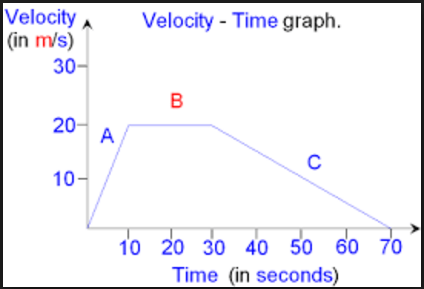
This is a velocity-time graph. What is the object doing in segment A?
Speeding up
Slowing down
Constant Velocity
Not moving

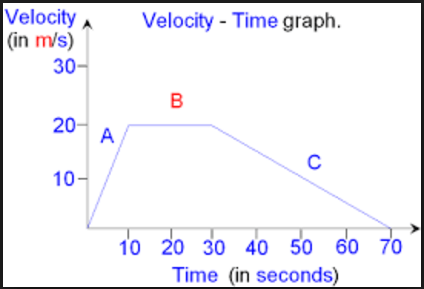
This is a velocity-time graph. What is the object doing in segment C?
Speeding up
Slowing down
Constant Velocity
Not moving


What is occurring on this graph?
Negative acceleration
moving at a constant speed in the positive direction
positive acceleration
negative net force
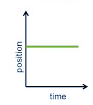
Describe the motion of the object in the graph
Moving with constant speed
Speeding up
Not moving

During which interval is the object speeding up?
A to B
B to C
D to E
E to F



