
 Worksheets
Enzymes Review
Total questions: 38
Worksheet time: 27mins

Is an oxidation reaction that takes place in some foods, mostly fruit and vegetables, causing the food to turn brown
Enzymatic browning
Non-Enzymatic browning

Match the following enzyme with their sources:
Bromelain
milk
papaya
pineapple
stomach of calves

Match the following enzyme with their sources:
Rennin
milk
papaya
pineapple
stomach of calves

The substance on which an enzyme acts is the _____.
active site
coenzyme
substrate

Which of the following can act as a coenzyme?
Bromelain.
B vitamins.
Pepsin

_____ is the naming system for enzymes.
Catalyst
Nomenclature
Substrate
Which factor does not prevent enzymes from working?
Heat.
Acid.
Salt.
Water.

Plunging food into boiling water to stop enzymatic activity is called _____.
activation energy
blanching
enzymatic browning

A charged ion in solution is _____
a coenzyme
an electrolyte
a substrate

An enzyme inhibitor may _____.
bind to the substrate
bind to the enzyme
change the shape of the substrate
All of the above

When the enzyme polyphenol oxidase reacts with oxygen, _____.
a coenzyme is formed
enzymatic browning occurs
melanins are destroyed

Which of the following foods is produced as a result of enzymatic browning?
Raisins.
Caramels.
Toast.

_____ is used to help prevent the browning of cut fruit
Vitamin A
Vitamin C
Vitamin D

Practically all chemical reactions in the body involve the use of enzymes.
True
False
Enzymes sometimes change with repeated use.
True
False
Factors that denature proteins also inhibit enzyme activity
True
False
The energy needed to start a reaction is called the
activation energy
starting energy
promoting energy
reacting energy
A catalyst is an enzyme that
A) speeds up the rate of a reaction.
B) reduces the amount of energy needed for a reaction to start.
Both A and B are correct
Neither A nor B are correct
Once an enzyme has helped a reaction take place, it can then
be reused for another reaction with the same reactants.
be broken down.
be stored in the cell until it is needed again.
be used to help different reactants go through a reaction.
Some factors can change the shape of an enzyme and when an enzyme's shape has changed it no longer works. When this happens we say that the enzyme has been ___.
denatured
altered
modified
renatured
Which of the following can cause a protein's shape to change?
A) pH
B) high temperatures
Both A and B
Neither A nor B

Compare the two pathways, which pathway shows the reaction that has taken place with the help of an enzyme?
Pathway 1
Pathway 2
You cannot tell from these graphs.
Both reactions involved an enzyme.


How does an enzymes shape relate to its function?
the shape of the enzyme has no relation to its function
the enzyme is shaped specially for certain substrates to perform a specific reaction
the enzyme shape acts as a receptor to certain products
the enzyme shape can fit into specific substrates to cease a reaction
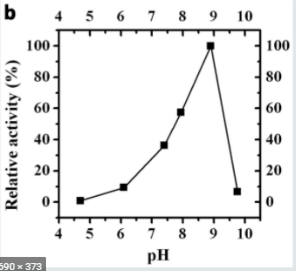
What is the optimal pH for this enzyme?
6
10
9
7
Changes in pH and temperature can ___________________ an enzyme which causes it to lose its shape and affects its function.
puncture
denature
double
delete

