

wayground logo

Free Printable Worksheets

Font size

S
M
L
XL
Worksheets

Precips/Net ionic

Total questions: 85

Worksheet time: 4hrs 39mins

Name
Class
Date
1.

Predict the precipitate when you mix silver nitrate and sodium chloride:

a)

AgNO3

b)

No precipitate

c)

AgCl

d)

NaNO3

2.

When you mix magnesium nitrate and sodium hydroxide

a)

No precipitate

b)

NaOH

c)

NaNO3

d)

Mg(OH)2

3.

When you mix sodium carbonate and copper chloride

a)

NaCl

b)

CuCO3

c)

CuCl2

d)

No precipitate

4.

When you mix lithium iodide and silver nitrate

a)

AgI

b)

LiNO3

c)

AgCl

d)

All of the above

5.

When you mix iron II chloride and potassium carbonate

a)

FeK2

b)

Fe2(CO3)3

c)

FeCl2

d)

FeCO3

6.

When you mix copper nitrate and potassium hydroxide

a)

Cu(OH)2

b)

KNO3

c)

CuOH

d)

No precipitate

7.

potassium chloride and sodium nitrate

a)

KNO3

b)

No precipitate

c)

NaCl

d)

KCl

8.
What precipitate forms when you mix lead (II) nitrate with sodium chloride?
a)
sodium nitrate 
b)
lead (II) chloride 
c)
sodium lead
d)
chloride nitrate 
9.
What precipitate forms when you mix lead (II) nitrate with sodium chloride?
a)
sodium nitrate 
b)
lead (II) chloride 
c)
sodium lead
d)
chloride nitrate 
10.
Which of the following does NOT form a precipitate?
a)
Pb(NO3)2(aq) + 2KI(aq) 
b)
Sr(NO3)2 (aq) + K2SO4(aq) →
c)
AgNO3(aq) + Na2S(aq) →
d)
 Pb(NO3)2(aq) + AgNO3(aq) →
11.
In this equation,
CuCl2 + NaOH  → Cu(OH)2 + NaCl
Which product is insoluble?
a)
copper(II) hydroxide
b)
sodium chloride
c)
sodium hydroxide
d)
copper(II) chloride
12.
Which of these results in the formation of a precipitate?
a)
AgNO3(aq)  +  NaOH(aq)→
b)
BaNO3(aq)  +  CaCl2(aq)→
c)
NaNO3(aq)  +  KOH(aq)→
d)
More than one of these form precipitates
13.
Which of these results in formation of a precipitate?
a)
BaNO3(aq)  +  NaCl(aq)→
b)
KNO3(aq)  +  LiOH(aq)→
c)
Zn(NO3)2(aq)  +  NaOH(aq)→
d)
NaNO3(aq)  +  Ba(OH)2(aq)→
14.
What is the result of the reaction between potassium bromide and ammonium sulfide?
a)
potassium sulfide precipitates
b)
ammonium bromide precipitates
c)
potassium ammonium precipitates
d)
no precipitate is formed
15.
What is the precipitate formed when you mix silver nitrate with copper chloride?
a)
copper nitrate
b)
copper chloride
c)
silver chloride
d)
silver nitrate
16.
Which of these lists contains only soluble substances?
a)
sodium nitrate, potassium chloride, calcium carbonate
b)
lead nitrate, lead chloride, lead sulfate
c)
calcium nitrate, copper chloride, ammonium phosphate
d)
silver nitrate, barium sulfate, copper carbonate
17.

Predict the precipitate of potassium chloride and sodium nitrate

a)

KNO3

b)

No precipitate

c)

NaCl

d)

KCl

18.

When you mix magnesium nitrate and sodium hydroxide

a)

No precipitate

b)

NaOH

c)

NaNO3

d)

Mg(OH)2

19.

When you mix sodium carbonate and copper chloride

a)

NaCl

b)

CuCO3

c)

CuCl2

d)

No precipitate

20.

When you mix iron II chloride and potassium carbonate

a)

FeK2

b)

Fe2(CO3)3

c)

FeCl2

d)

FeCO3

21.

Which of the following pairs of solutions produces a precipitate when combined?

a)

Cu(NO3)2 and NaCl

b)

Fe(NO3)3 and MgCl2

c)

Cu(NO3)2 and K2CO3

d)

CaCl2 and NaNO3

22.

When solutions of MgCO3 and Fe2(SO4)3 are combined, what precipitate(s) forms?

a)

MgSO4

b)

neither form a precipitate

c)

MgSO4 and Fe2(CO3)3

d)

Fe2(CO3)3

23.
In this equation,
ZnCl2 + LiOH  → Zn(OH)2 + LiCl
Which product is insoluble?
a)
zinc hydroxide
b)
lithium chloride
c)
lithium hydroxide
d)
zinc chloride
24.

Which of the following best describes a precipitate?

a)

solid powder that falls out of solution when a solid and liquid reactant combine

b)

solid powder that falls out of solution when two aqueous reactants combine

c)

solid powder that falls out of solution when aqueous and gaseous reactants combine

25.

Which of the following best describes a precipitate?

a)

an insoluble solid

b)

a soluble solid

c)

a soluble gas

d)

an insoluble liquid

26.

Which type of reaction can be a precipitate reaction?

a)

synthesis reaction

b)

single replacement reaction

c)

double replacement reaction

d)

combustion reaction

27.

According to the solubility rules (chart), compounds containing Ammonium cations, NH4+ are:

a)

Not Soluble

b)

Sometimes Soluble

c)

Always Soluble

d)

Always insoluble

28.

According to the solubility rules (reference chart), compounds containing Hydroxide anions, OH-

a)

are insoluble when combined with ammonium

b)

are always insoluble

c)

are soluble when combined with group 1 elements

d)

are insoluble when they form compounds with Calcium

29.

Use the Solubility Rules to determine if the following compound is soluble in water:


MgCl2

a)

Soluble

b)

Insoluble

30.

Use the Solubility Rules to determine if the following compound is soluble in water:


CaSO4

a)

Soluble

b)

Insoluble

31.

Use the Solubility Rules to determine if the following compound is soluble in water:


PbBr2

a)

Soluble

b)

Insoluble

32.

Use the Solubility Rules to determine if the following compound is soluble in water:


Ca(OH)2

a)

Soluble

b)

Insoluble

33.

Use the Solubility Rules to determine if the following compound is soluble in water:


Li2S

a)

Soluble

b)

Insoluble

34.

CaCl2(aq) + 2 AgNO3(aq) → Ca(NO3)2(aq) + 2 AgCl(s)


Give 2 clues that the reaction above is called a precipitate reaction

a)

It's a double replacement reaction that forms one aqueous and one solid product

b)

It's a single replacement reaction that forms one aqueous and one solid product

c)

It's a double replacement reaction that forms two aqueous products

d)

It's a single replacement reaction that forms two aqueous products

35.

CaCl2(aq) + 2 AgNO3(aq) → Ca(NO3)2(aq) + 2 AgCl(s)


Which product above is the precipitate?

a)

CaCl2(aq)

b)

AgNO3(aq)

c)

Ca(NO3)2(aq)

d)

AgCl(s)

36.

Predict the Products of the double-replacement (precipitate) reactions


Pb(NO3)2(aq) + MgI2(aq) →

a)

Pb(NO3)2 (aq) + MgI2 (s)

b)

PbI2 (s) + Mg(NO3)2 (aq)

c)

Pb(NO3)2 (s) + MgI2 (aq)

d)

PbMg (s) + I(NO3)2 (aq)

37.

Predict the Products of the double-replacement (precipitate) reactions


K3PO4(aq) + AlCl3(aq) →

a)

K3PO4 (s) + AlCl (aq)

b)

KCl (aq) + Al2(PO4)3 (s)

c)

KCl (s) + Al2(PO4)3 (aq)

d)

K3AL (s) + Cl3PO4 (aq)

38.

If ammonium carbonate is reacted with copper (II) nitrate, which of the following would be the correct net ionic equation? (Carbonates are not very soluble)

a)

2NH4+ (aq) + CO32- (aq) --> (NH4)2CO3 (s)

b)

2NH4+ (aq) + 2NO3- (aq) --> 2NH4NO3 (s)

c)

CO32- (aq) + Cu2+ (aq) --> CuCO3 (s)

d)

Cu2+ (aq) + 2NO3- --> Cu(NO3)2 (s)

39.

If ammonium carbonate is reacted with copper (II) nitrate, which of the following would be the correct spectator ions (Carbonates are not very soluble)

a)

ammonium and carbonate

b)

ammonium and copper

c)

copper and nitrate

d)

ammonium and nitrate

e)

copper and carbonate

40.
What is the precipitate formed when you mix silver nitrate with copper chloride?
a)
copper nitrate
b)
copper chloride
c)
silver chloride
d)
silver nitrate
41.
Which is the correct net ionic equation for the reaction of AgNO3 and CaCl2?
a)
Ca2+(aq) +  2Cl- (aq) → CaCl(s)
b)
Ag+(aq)  +  Cl- (aq) → AgCl(s)
c)
Ag +  Cl  →  AgCl
d)
Ag+  +  Ca2+   →Ag2Ca (s)
42.
What are the spectator ions in the reaction of sodium chloride with silver nitrate?
a)
silver and nitrate
b)
sodium and chloride
c)
sodium and nitrate
d)
silver and chloride
43.
In this equation,
CuCl2 + NaOH  → Cu(OH)2 + NaCl
Which product is insoluble?
a)
copper(II) hydroxide
b)
sodium chloride
c)
sodium hydroxide
d)
copper(II) chloride
44.
Which of these results in the formation of a precipitate?
a)
AgNO3(aq)  +  NaOH(aq)→
b)
BaNO3(aq)  +  CaCl2(aq)→
c)
NaNO3(aq)  +  KOH(aq)→
d)
More than one of these form precipitates
45.
Which of these results in formation of a precipitate?
a)
BaNO3(aq)  +  NaCl(aq)→
b)
KNO3(aq)  +  LiOH(aq)→
c)
Zn(NO3)2(aq)  +  NaOH(aq)→
d)
NaNO3(aq)  +  Ba(OH)2(aq)→
46.
What are the spectator ions in this reaction?
CuCl2(aq) + NaOH(aq) → Cu(OH)2(s) + NaCl(aq)
 
a)
Cu2+ and OH1-
b)
Na2+ and Cl2-
c)
Na1+ and Cl1-
d)
Na1+ and OH1-
47.
What is the result of the reaction between potassium bromide and ammonium sulfide?
a)
potassium sulfide precipitates
b)
ammonium bromide precipitates
c)
potassium ammonium precipitates
d)
no precipitate is formed
48.
What are the spectator ions in this reaction?
CuCl2(aq) + NaOH(aq) → Cu(OH)2(s) + NaCl(aq)
 
a)
Cu2+ and OH1-
b)
Na2+ and Cl2-
c)
Na1+ and Cl1-
d)
Na1+ and OH1-
49.

What is a Net Ionic Equation?

a)

a balanced chemical equation in which all the reactants and products are given by their chemical formulae.

b)

a chemical equation that shows all soluble species broken into their respective ions.

c)

a chemical equation showing only the species which are actively involved in the reaction.

50.

Which of the following is the correct symbol for a substance in a water solution?

a)

cr

b)

aq

c)

l

d)

s

51.

What are the spectator ions when you mix lead (II) nitrate with sodium chloride?

a)

sodium nitrate

b)

lead (II) chloride

c)

sodium lead

d)

chloride nitrate

52.
What is the result of the reaction between potassium bromide and ammonium sulfide?
a)
potassium sulfide precipitates
b)
ammonium bromide precipitates
c)
potassium ammonium precipitates
d)
no precipitate is formed
53.

Pick the Net Ionic Equation.

a)

2 Na3PO4 (aq) + 3 CaCl2 (aq) --> 6 NaCl (aq) + Ca3(PO4)2 (s)

b)

6 Na+ (aq) + 2 PO43- (aq) + 3 Ca2+ (aq) + 6 Cl- (aq) --> 6 Na+ (aq) + 6 Cl- (aq) + Ca3(PO4)2 (s)

c)

2 PO43- (aq) + 3 Ca2+ (aq) --> Ca3(PO4)2 (s)

54.

Is the following equation a formula, complete, or net ionic equation?

2 HClO(aq) + Ca(OH)2(aq) → 2 H2O(l) + Ca(ClO)2(aq)

a)

Formula Equation

b)

Complete Ionic Equation

c)

Net Ionic Equation

55.

Is the following equation a formula, complete, or net ionic equation?

Co2+ (aq) + S 2-(aq) → CoS (s)

a)

Formula Equation

b)

Complete Ionic Equation

c)

Net Ionic Equation

56.
Which of these lists contains only soluble substances? Don't forget that the halides (family 17) will form precipitates with Ag+, Pb2+ and Hg2+.
a)
sodium nitrate, potassium chloride, calcium carbonate
b)
lead nitrate, lead chloride, lead sulfate
c)
calcium nitrate, copper chloride, ammonium phosphate
d)
silver nitrate, barium sulfate, copper carbonate
57.
Which of the following is the correct net ionic equation for
3AgNO3 (aq) + Na3PO4(aq) --> Ag3PO4(s) + 3NaNO3 (aq)
a)
Ag+1 (aq) + PO4-3(aq) --> Ag3PO4(s) 
b)
3Ag+1 NO3-1 (aq) + 3Na+1 PO4-3(aq) --> Ag PO4(s) + 3Na+1 NO3-1 (aq)
c)
3Ag+1 (aq) + PO4-3(aq) --> Ag3PO4(s) 
d)
None of the above
58.
Which of the following shows all dissolved ionic compounds as free ions
a)
Complete ionic equation
b)
Net ionic equation
59.

In a chemical equation, is it true that -

a)

the reactant side and product side can have different numbers of atoms for each element

b)

there can be different elements on the reactant side and the product side

c)

an element or compound must be accompanied by a phase change

d)

the coefficients indicate the number of molecules of each reactant used and the number of molecules of each product made
60.
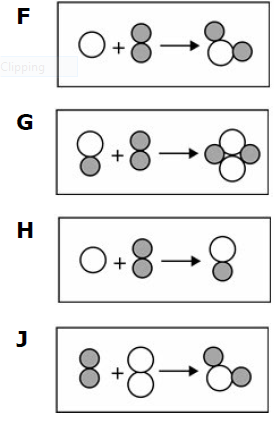
Which of the following models best demonstrates a balanced chemical equation?
a)
F
b)
G
c)
H
d)
J
61.
Which of the following equations demonstrates an actual chemical reaction that forms a new substance?
a)
A
b)
B
c)
C
d)
D
62.
The reactants are on the left side of the chemical equation.
a)
True
b)
False
63.
All of the following reactions are correctly balanced except-
a)
A
b)
B
c)
C
d)
D
64.

Which of the following BEST describes a chemical reaction?

a)

A compound is crushed into a fine powder.

b)

Atoms break apart into even smaller particles.

c)

Existing electron bonds break and reattach to other atoms

d)

Molecules move faster until they fly apart from each other

65.

How many Al atoms are in this compound? 4Al2O3

a)

2

b)

8

c)

6

d)

4

66.

How many F atoms are in this compound?

6MgF2

a)

2

b)

6

c)

8

d)

12

67.
3KOH + H3PO4 --> K3PO4 + 3H2O
a)
Synthesis 
b)
Decomposition
c)
Single displacement
d)
Double displacement
68.
What do the coefficients need to be in the following equation in order to be balanced?
_Mg + _Cl→ _MgCl2
a)
1, 2,1
b)
already balanced
c)
2,1,1
d)
1,1,2
69.
Is this equation balanced?
a)
yes
b)
no
c)
Not enough information
70.
Balance this equation
_Al +_HCl --> _H+_AlCl3
a)
2, 6, 3, 2
b)
it is already balanced
c)
4, 12, 3, 4
d)
2, 1, 4, 5
71.
Balance this equation-
__P+ __O--> __P2O3
a)
it is already balanced
b)
2, 1, 3
c)
1, 2, 3
d)
1, 3, 2
72.
Balance this equation.
_CF+ _Br-- _CBr+ _F2
a)
2,1,2,1
b)
1,2,2,1
c)
1,2,1,2
d)
2,2,2,2
73.
The substances at the beginning of a chemical equation are called the ____
a)
product
b)
yield
c)
chemical symbol
d)
reactants
74.
In a chemical reaction, everything to the rightof the arrow is called ______________.
a)
Products
b)
Yields
c)
Molecules
d)
Reactants
75.

Sodium phosphate in solution reacts with silver nitrate solution to produce sodium nitrate solution a silver phosphate precipitate.

a)

NaPO4(aq) + AgNO3(aq) --> NaNO3(aq) + AgPO4(s) single displacement

b)

Na3P (aq) + Ag3N (aq) --> Na3N (aq) + Ag3P (s) double displacement

c)

Na3PO4(aq) + 3AgNO3(aq) --> 3NaNO3(aq) + Ag3PO4 (s) double displacement

d)

NaP + AgN --> NaN + AgP synthesis

76.
PCl5  +  ___ H2O  →  ___ HCl  +   H3PO4
a)
4, 5
b)
1, 6
c)
3, 8
d)
2,2
77.
__ Al  +  __ FeO  →  Al2O2  +  __ Fe
a)
1, 1, 2
b)
2,1,2
c)
2, 2, 2
d)
2,4,2
78.
 Mg  +  ___ HCl  →   MgCl2  +   H2
a)
1
b)
2
c)
3
d)
4
79.
Which side of a chemical equation is the reactant side?
a)
Left (before the yields sign)
b)
Right (after the yields sign)
80.
Which side of a chemical equation os the product side?
a)
Left (before the yields sign)
b)
Right (after the yields sign)
81.
What is a coefficient?
a)
The small number on the right of the chemical symbol.
b)
The large number to the left of a formula.
82.
Is the equation balanced?: 2H2O + O2 --> 4MgO + 3Fe
a)
Yes
b)
No
83.
Balance this equation:
MgCl2 --> Mg4+ Cl2
a)
It's already balanced.
b)
4MgCl2 --> Mg4+ 4Cl2
c)
4MgCl2 --> Mg4+ 5Cl2
84.
Balance this equation:
FeS + 2HCl -->
FeCl2 + H2O
a)
FeS2 + 2HCl --> FeCl2 + H2O
b)
It's already balanced
c)
FeS2 + 2HCl --> FeCl2 + H4O
d)
None of these
85.
Balance this equation:
 2Li + Cl2 -> LiCl
a)
2Li + Cl2 -> 4LiCl2
b)
2Li + Cl2 -> LiCl2
c)
2Li + Cl2 -> 2LiCl
