Worksheets
Cladograms
Total questions: 44
Worksheet time: 1hrs 18mins
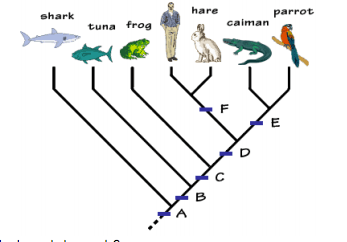
On the cladogram, which organism is the closest relative of the parrot?
Frog
Hare
Caiman
Parrot
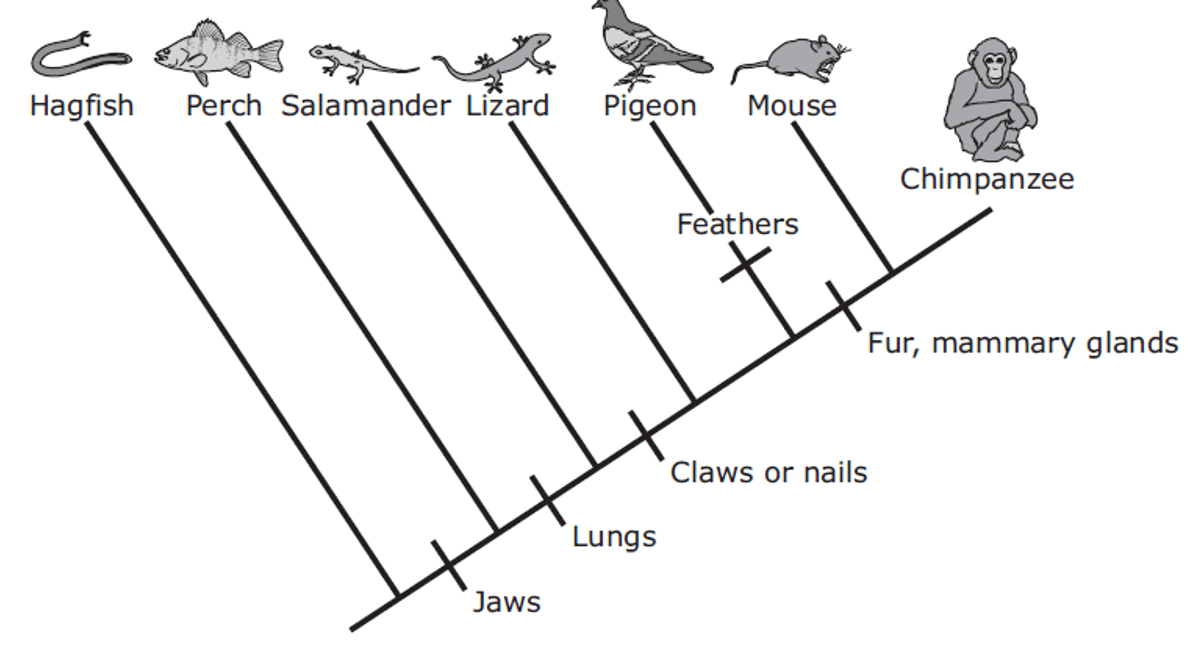
All the animals to the right of the salamander would have the common characteristic of...
Fur
Claws or nails
Lungs
Jaws

What characteristic do all the organisms on this cladogram share?
Being bi-pedal & having language
Complex brains
Fully binocular vision
Partial binocular vision & opposable thumbs


Using the cladogram, which two organisms are more closely related Lizards and Newts OR Lamreys and Sharks
Newts and Lizards
Lampreys and Sharks
Using the cladogram, which two organisms are more closely related Newts and Lizards OR Lynx and Chimpanzee
Newts and Lizards
Lynx and Chimpanzee
Using the cladogram, which characteristics do Chimpanzee and Lynx have in common (check all the boxes that apply).
Jaws
Lungs
Amniotic Membrane
Hair
No tail
Using the cladogram, which characteristics do Sharks and Humans have in common (check all the boxes that apply).
Jaws
Lungs
Amniotic Membrane
Hair
No tail
Using the cladogram, which characteristics do Lynx and Lizards have in common (check all the boxes that apply).
Jaws
Lungs
Amniotic Membrane
Hair
No tail

Which organisms from this cladogram are more closely related Perch and Lizard OR Salamander and Pigeon?
Perch and Lizard
Salamander and Pigeon
Which organisms from this cladogram are more closely related lizard and salamander OR Lizard and Mouse?
Lizard and Salamander
Lizard and Mouse

According to the cladogram in this figure, which characteristics are common characteristics between Birds and Lizards? (Check all boxes that apply)
Jaws
Lungs
Claws and Nails
Feathers
Fur, Mammary Glands
According to the cladogram in this figure, which characteristics are common characteristics between Mouse and Salamander? (Check all boxes that apply)
Jaws
Lungs
Claws and Nails
Feathers
Fur, Mammary Glands
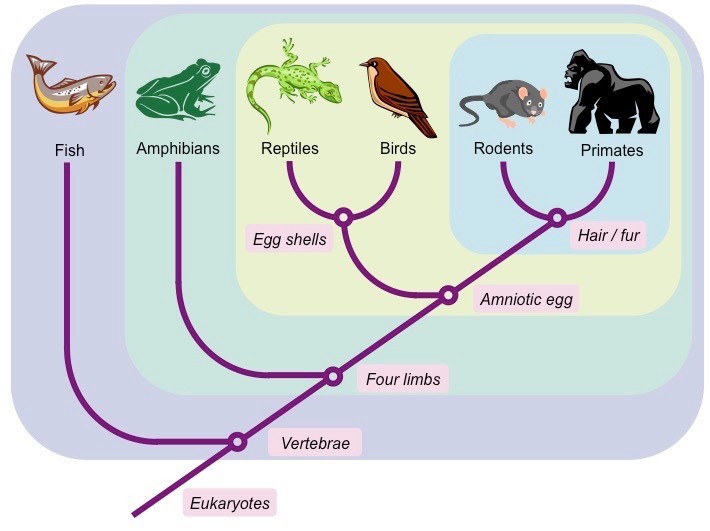
What characteristic distinguishes amphibians from birds and reptiles?
Amniotic egg
Egg shells
Vertebrae
Hair/fur

What number is the common ancestor of C and D
1
2
3
4

Of the following anatomical structures, which are homologous to the wing of a bat?
the tail of a kangaroo
the flipper of a whale
the wing of a butterfly
the arm of a human

Images of the embryo and adult stages of three different organisms are shown.
Which of the following is the best conclusion that can be drawn from this evidence?
Having similar embryos indicates that these organisms eat the same types of food.
Having similar embryos indicates that these organisms live in a similar environment.
Having similar embryos indicates that these organisms share a recent common ancestor.
Having similar embryos indicates that a certain protein controls how many legs the adult organisms will have.

Whales have pelvic (hip) bones, even though they don't have legs. These are called vestigial structures - bones or other structures that aren't useful but are still there. What do whales' pelvic bones suggest?
That whales are related to sharks
That one whale was born without legs and now no whales have legs
That whales have an ancestor that had legs
That pelvic bones have no purpose in any animal
What can be used as evidence for evolution? (select all that apply).
Any common function of structures between species (i.e. birds and insects both have wings)
Body parts of different species that are similar in structure and location.
Similarities of embryos from different species.
Fossil records showing structures and locations of species.
Structures in modern species that are unused and unnecessary, but were used by past species.

Select the animal(s) that possess the trait of a placenta.
bullfrog
chimpanzee
kangaroo
shark
Select the animal(s) that possess the trait of a vertebrae.
bullfrog
chimpanzee
kangaroo
shark
Select the animal(s) that possess the trait of mammary glands.
bullfrog
chimpanzee
kangaroo
shark
Select the animal(s) that possess the trait of two pairs of limbs.
bullfrog
chimpanzee
kangaroo
shark
Ostriches have wings, but do not fly. Humans have an appendix with no apparent function. Whales contain bones for rear legs. Each of these are examples of...
homologous structures
vestigial structures
analogous structures
natural selection
Researchers discovered that the legs of birds are homologous to the feet of reptiles. Which claim is BEST supported by this fact?
Birds do not require legs
Birds and reptiles have a common ancestor
They randomly developed the same structures
Selection pressures have acted on birds, but not on reptiles
'Homologous structures' refers to:
body parts of two different species that have similar structure and location in each species.
body parts that have the same function, but very different structures.
structures that sound the same.
two organisms that have about the same sized parts of their structure.

What type of evidence of evolution is pictured?
vestigial structures
homologous structures
embryology
DNA studies
Evolved from the same ancestor, but have different functions
Homologous structures
Analogous structures
Vestigial structures
All of the above

Penguin flipper and fish fin
Homologous
Vestigial
Analogous
None of the above
Which of the following are vestigial structures humans have? Select all that apply.
Appendix
Tailbone
Forearm bones
Goosebumps

Whales have pelvic bones. What type of structure does this best represent?
Homologous structure
Analogous structure
Vestigial structure
None of the above