wayground logo

Free Printable Worksheets

Font size

S
M
L
XL
Worksheets

Unit 4 Genetics Review

Total questions: 40

Worksheet time: 33mins
Name
Class
Date
1.
Which of the following best describes a DNA molecule?
a)
double helix
b)
contains ribose
c)
made of amino acids
d)
contains Uracil
2.
Why is DNA important?
a)
it is very small and very complicated
b)
it's in everything
c)
it serves as the blueprint for traits of all living things
d)
because we eat it every day for energy
3.
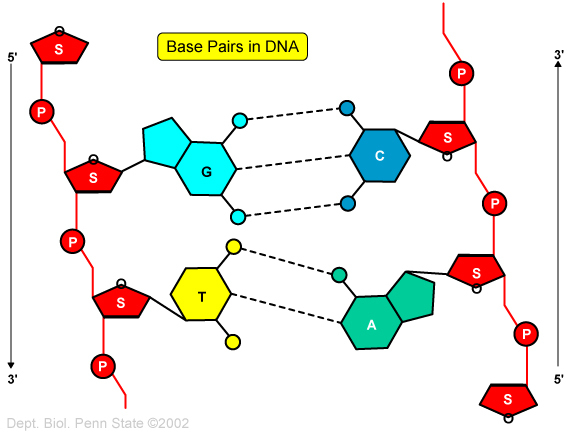
Which 2 molecules form the sides (backbone) of the DNA ladder?
a)
deoxyribose sugar and adenine
b)
deoxyribose sugar and a hydrogen bond
c)
deoxyribose sugar and the nucleus
d)
deoxyribose sugar and phosphate
4.
Nitrogenous bases are joined by which type of bond?
a)
polar bonds
b)
ionic bonds
c)
covalent bonds
d)
hydrogen bonds
5.
Cytosine always pairs with
a)
Adenine
b)
Thymine
c)
Uracil
d)
Guanine
6.
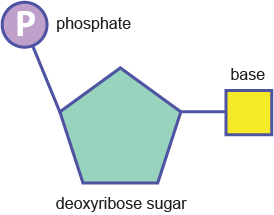
Nucleotides are made up of a sugar, phosphate, and..?
a)
nitrogenous base
b)
nucleic acid
c)
cholesterol
d)
fatty acid
7.
What is the complement to the DNA strand below:
5'-ATGCCAT-3'
a)
5'-TACGGTA-3'
b)
3'-TACGGTA-5'
c)
3'-ATGGCAT-5'
d)
5'-ATGGCAT-3'
8.
Which of the following is not a nitrogen base found in DNA?
a)
Thymine
b)
Uracil 
c)
Guanine
d)
Adenine
9.
The sugar in DNA is ____________________.
a)
deoxyribose
b)
ribose
10.
The sugar in RNA is ____________________.
a)
deoxyribose
b)
ribose
11.
I am a single strand.
a)
DNA
b)
RNA
12.
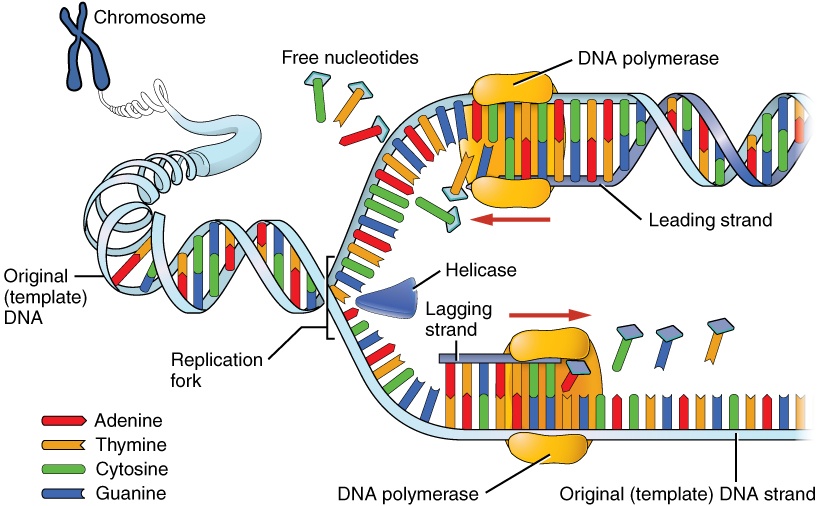
Which enzyme has the job of unzipping the double helix?
a)
Helicase
b)
Polymerase
c)
Ligase
d)
Primerase
13.
If a strand reads:
3' A A A T T T C 5'
The matching strand would read...
a)
5' T T T A A A G 3'
b)
3' T T T A A A G 5'
c)
5' A A A T T T C 3'
d)
3' U U U A A A G 5'
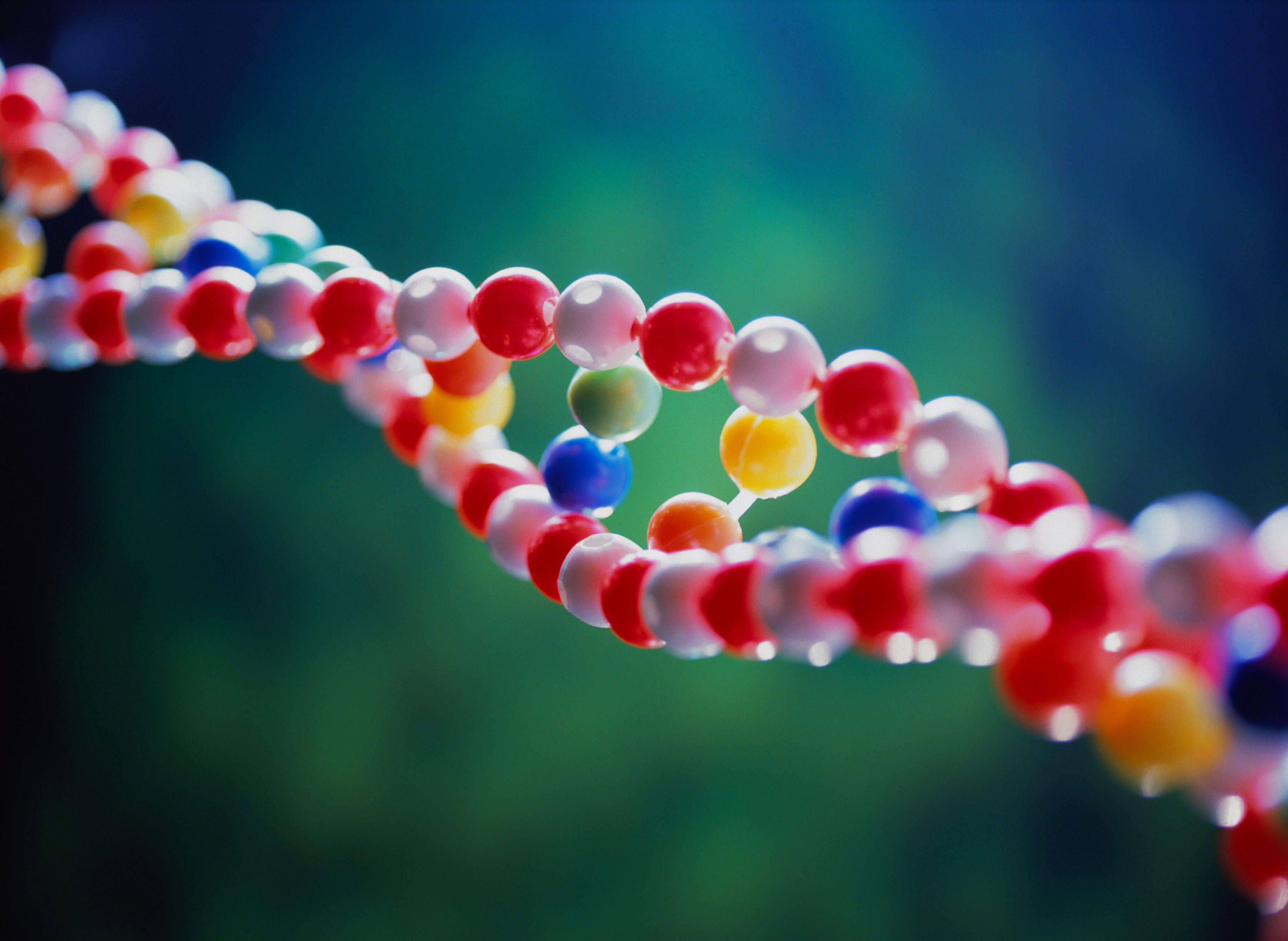
14.
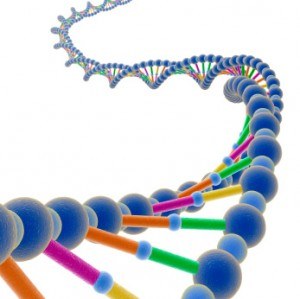
This picture is illustrating the ____ nature of DNA.
a)
anti-parallel
b)
deoxyribosic
c)
helical
d)
radioactive
15.
DNA replication turns one strand of DNA into two new strands of DNA. What percent of each new strand is the old strand?
a)
Half of each new DNA is the old DNA
b)
The old strand of DNA was digested, so none
c)
The new DNA is entirely made up of the old DNA
d)
About every sixth base comes from the old DNA
16.
Sometimes, DNA is called "semi-conservative." Why might this be?
a)
The old strand is "conserved" and used to make the new strands
b)
Uracil is "conserved" in that it is only used to make the new strands
c)
ATP is "conserved" via the usage of facilitated diffusion
d)
Ligase is "conserved" in that it is denatured by the process
17.

In what process is mRNA synthesized?

a)

Transcription

b)

Translation

c)

DNA Replication

d)

Mitosis

18.

Where does TRANSCRIPTION occur?

a)

Nucleus

b)

Ribosome

c)

Cytoplasm

d)

Mitochondria

19.

Why must transcription occur where DNA can be found?

a)

because DNA can't leave the nucleus

b)

because ribosomes are in the nucleus

c)

because DNA polymerase is found there

d)

because helicase unzips the DNA

20.

How many nucleotides equal 1 amino acid?

a)

1

b)

2

c)

3

d)

4

21.

TRANSCRIBE this DNA sequence: TACGTTACT

a)

AUGCAAUGA

b)

ATGCAATGA

c)

AUGGATUGA

d)

TACGTTACT

22.

Which of the following are differences in the structure between RNA and DNA

a)

DNA uses deoxyribose sugar, RNA uses sugar ribose

b)

DNA pairs Adenine with Uracil, RNA pairs Adenine with Thymine

c)

DNA is a double helix, RNA is a single helix

d)

DNA pairs Adenine with Thymine, RNA pairs Adenine with Uracil

23.

Which organelle is the location where protein is made?

a)

Ribosome

b)

Nucleus

c)

Cytoplasm

d)

Nucleotide

24.

When these bond together, they form a protein

a)

Amino Acids

b)

Peptide Bonds

c)

Ribose

d)

Nucleotides

25.
What is the term for a three-nucleotide sequence that codes for an amino acid?
a)
base
b)
codon
c)
amine
d)
serine
26.
The process to go from DNA to mRNA is _______
a)
translation
b)
transcription
c)
replication
27.
The process to go from mRNA to a protein is called ____
a)
transcription
b)
rRNA
c)
replication
d)
translation
28.
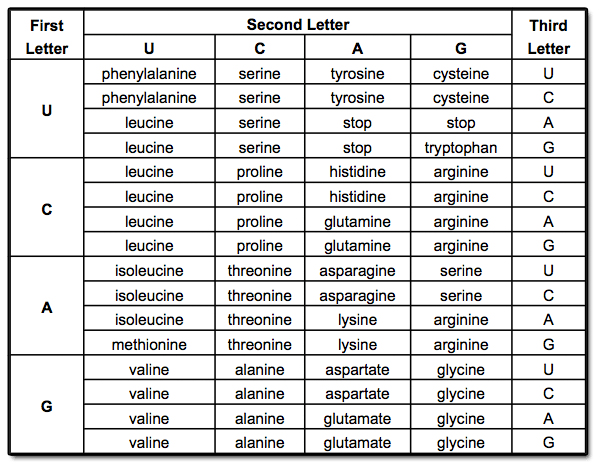
What amino acid is represented by the codon UUA?
a)
Phenylalanine
b)
Tyrosine
c)
Leucine
d)
Stop codon
29.
Does the order of amino acids in a protein matter?
a)
YES!
b)
NO!
30.
How many base pairs would be needed to chain together 3 amino acids?
a)
3
b)
6
c)
9
d)
12
31.

CROSSING OVER INCREASES

a)

LIFE SPAN

b)

GENETIC VARIATION

c)

THE NUMBER OF OFF-SPRING

d)

ALL ARE TRUE

32.

CROSSING OVER TAKES PLACE DURING

a)

PROPHASE II

b)

PROPHASE I

c)

INTERPHASE

d)

METAPHASE I

33.

WHAT TYPE OF CELLS STORE THE GENETIC INFORMATION THAT IS PASSED TO OFF-SPRING

a)

BODY CELLS

b)

MITOSIS

c)

EGG

d)

SPERM

e)

EGG AND SPERM

34.

MEIOSIS

a)

REDUCES THE NUMBER OF CHROMOSOMES BY ONE HALF

b)

PRODUCES UNIQUE SEX CELLS-1N

c)

ALLOWS TRAITS TO BE PASSED TO OFFSPRING

d)

ALL ARE TRUE

e)

INCREASE GENETIC VARIATION

35.

FERTILIZATION OCCURS WHEN

a)

THE SPERM UNITES WITH THE EGG

b)

THE SPERM UNDERGO MEIOSIS

c)

THE EGG UNDERGOES MEIOSIS

d)

THE EGG AND SPERM UNDERGOES MEIOSIS

36.

MEIOSIS PRODUCES 4 CELLS-THE CHROMOSOME NUMBER IS ...

a)

DIPLOID

b)

HAPLOID

37.

NORMAL HUMANS HAVE 46 CHROMOSOMES, HOW MANY WILL THE GAMETE CELLS HAVE AFTER MEIOSIS?

a)

46

b)

23

c)

12

d)

92

38.
Females have ____ and males have _____ chromosomes.
a)
XX, XY
b)
XY, XX
c)
XX, XX
d)
XY, XY
39.
Identify the phase:
a)
Metaphase I
b)
Metaphase II
c)
Anaphase I
d)
Anaphase II
40.
Identify the phase.
a)
Metaphase I
b)
Metaphase II
c)
Anaphase I
d)
Anaphase II