wayground logo

Free Printable Worksheets

NEW

Font size

S
M
L
XL
Worksheets

Waves and Electromagnetic Spectrum

Total questions: 25

Worksheet time: 22mins

Name
Class
Date
1.
Waves that move particles of the medium parallel to the direction in which the waves are traveling are called ___________. 
a)

Longitudinal Waves

b)
Transverse Waves
c)
Surface Waves
d)
Combination Waves 
2.
Which electromagnetic waves are used in ovens and cell phone communications?
a)
Infrared rays
b)
ultraviolet rays
c)
microwaves
3.
For waves in any medium, as the wavelength decreases, what happens to the frequency?
a)
It also decrease
b)
It stays the same
c)
It increases
4.
Which of the following has wavelengths longer than microwaves?
a)
Infrared waves
b)
Radio waves
c)
Visible light
5.

Which electromagnetic waves allow us to treat cancer?

a)
Gamma rays
b)
X-rays
c)
Ultraviolet rays
6.
Which electromagnetic waves help doctors detect broken bones inside your body?
a)
gamma rays
b)
x-rays
c)
ultraviolet rays
7.
Which electromagnetic waves are used in devices such as heat lamps & TV remote controls?
a)
ultraviolet rays
b)
microwaves
c)
infrared rays
8.

Which has the LONGEST wavelength and, therefore, the lowest frequency and lowest energy?

a)
Gamma Rays
b)
Radio Waves
c)
Visible Light
d)
Infrared rays
9.

Which has the SHORTEST wavelength and, therefore, the highest frequency and highest energy?

a)
Radio waves
b)
Ultraviolet Rays
c)
Gamma Rays
d)
X-rays
10.
Which section of the spectrum is the ONLY one we can see?
a)
X-rays
b)
Visible Light
c)
Gamma Rays
d)
Ultraviolet Rays
11.

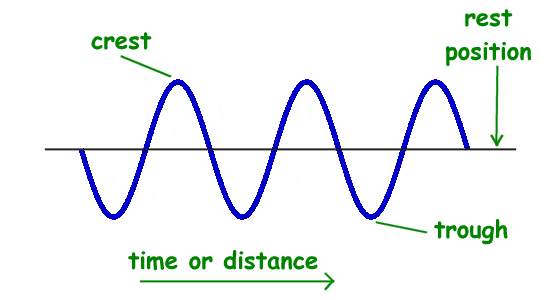
A student is measuring the distance between the crest and the rest position of both a mechanical wave and an electromagnetic wave. Which question is the student trying to answer?

a)

What is the speed of the waves?

b)

What is the amplitude of the waves?

c)

What is the wavelength of the waves?

d)

What is the frequency of the waves?

12.

Which distance represents the wavelength?

a)

W

b)

X

c)

Y

d)

Z

13.

Which distance represents the amplitude?

a)

W

b)

X

c)

Y

d)

Z

14.

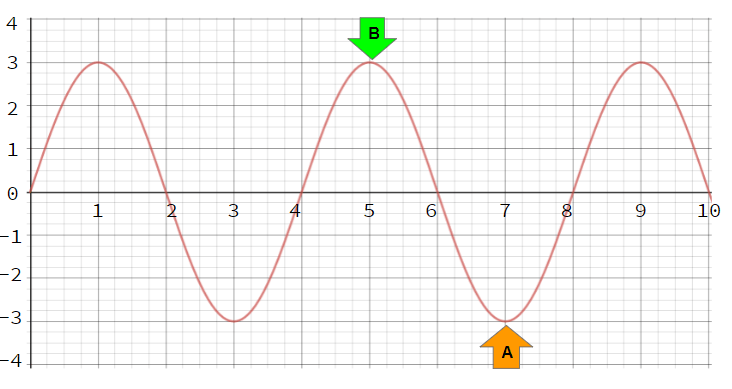
Point A represents what?

a)

Trough

b)

Midpoint

c)

Crest

d)

node

15.

What is measured from crest to crest or trough to trough?

a)

mediums

b)

resting position

c)

wavelength

d)

origin

16.

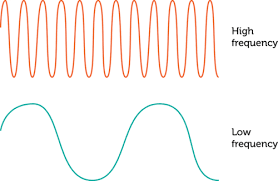
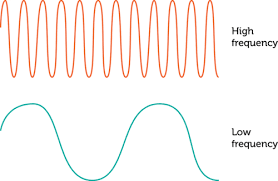
If a wave has a greater frequency, what happens to the wavelength?

a)

increases

b)

decreases

c)

stays the same

17.

If a wave has a greater frequency, what happens to number of waves per second?

a)

increases

b)

decreases

c)

stays the same

18.

What is the amplitude of this wave?

a)

2

b)

3

c)

6

d)

10

19.

What is the wavelength of this wave?

a)

1

b)

2

c)

3

d)

4

20.

A disturbance that transfers energy from place to place through matter or space

a)

wave

b)

position

c)

time

d)

protein

21.

How are Electromagnetic waves different from Mechanical waves?

a)

EM waves have very short wavelengths

b)

EM waves transmit energy instead of matter

c)

EM waves can travel through the vacuum of space (without a medium)

d)

EM waves can change direction by reflection
22.
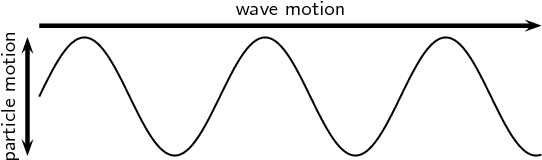
What kind of wave is pictured below?
a)
compressional wave
b)
transverse wave
c)
sound wave
d)
mechanical wave
23.
Waves are a transfer of what?
a)
Heat
b)
Light
c)
Energy
d)
Food
24.
The units for frequency are measured in _____________.
a)
hertz
b)
seconds
c)
m/s
d)
m
25.

A wave has wavelength of 10 m and a speed of 340 m/s. What is the frequency of the wave?

Speed = Wavelength x Frequency

a)
34 m/s
b)
3400 Hz
c)
3400 m/s
d)
34 Hz