wayground logo

Free Printable Worksheets

Font size

S
M
L
XL
Worksheets

since

Total questions: 84

Worksheet time: 1hrs 15mins

Name
Class
Date
1.

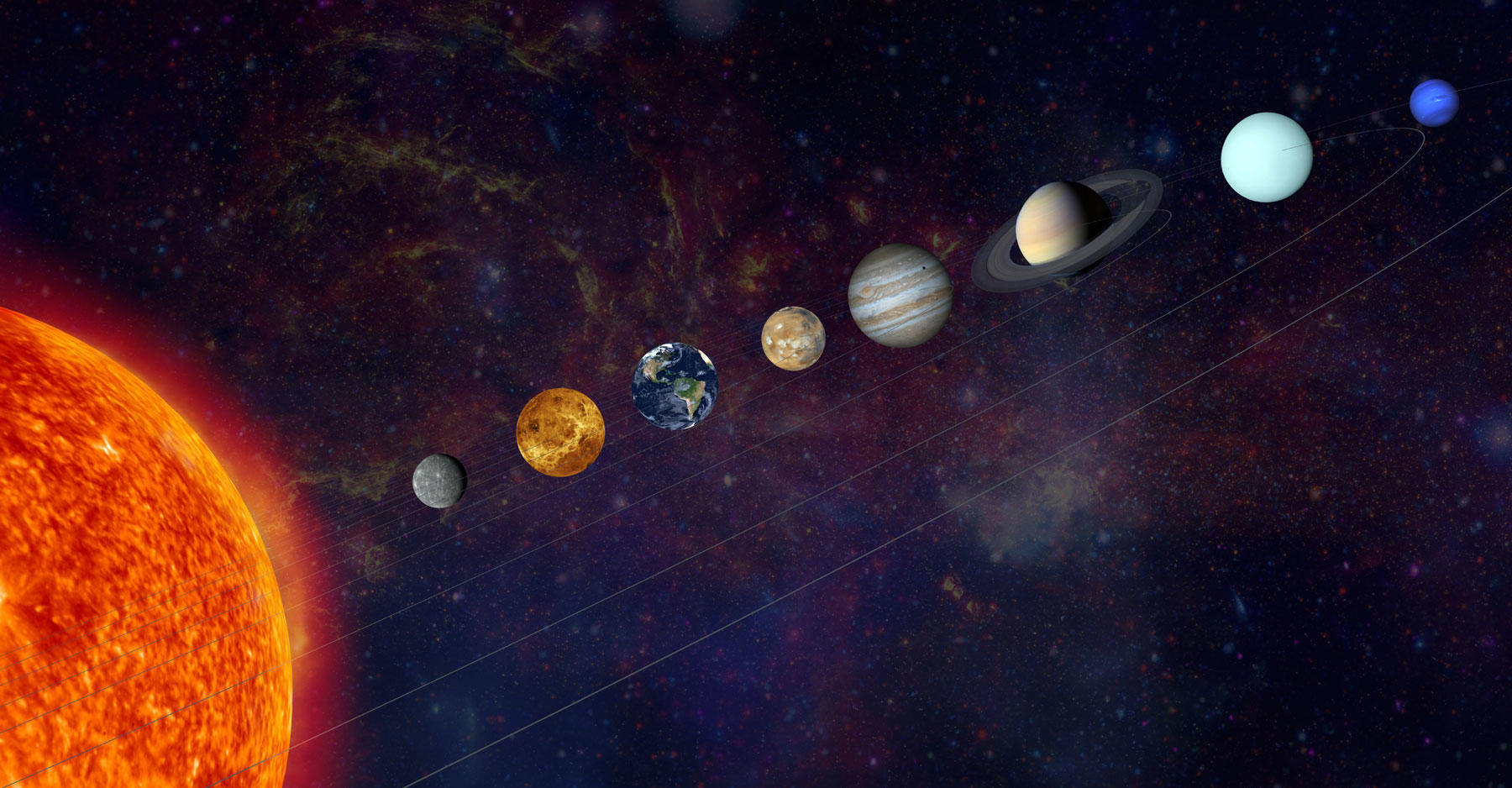
Seventh planet from the sun.

a)

Pluto

b)

Uranus

c)

Saturn

d)

Jupiter

2.

Known as the red planet

a)

Saturn

b)

Mercury

c)

Venus

d)

Mars

3.

What attracts a body toward any other object in space

a)

the sun

b)

satellites

c)

gravity

d)

astroid belt

4.

Which of the following demonstrates how a rotating object spins.

a)

spinning top

b)

falling pebble

c)

bouncing basketball

d)

air hockey puck

5.

What causes the changes from night to day on Earth?

a)

Earth's tilt

b)

Earth's orbit of the sun

c)

The moon orbiting Earth

d)

Earth rotating on its axis

6.

How long does it take the moon to revolve around the Earth?

a)

One season

b)

one rotation of the moon

c)

one Earth rotation

d)

one Earth revolution

7.

Do the inner or outer planets have more moon?

a)

inner

b)

outer

8.

Are the inner or outer planets made up of mostly rock?

a)

inner

b)

outer

9.

Do the inner or outer planets revolve around the sun faster?

a)

inner

b)

outer

10.

Which of the following is NOT a reason why Earth is the only planet with life as we know it?

a)

It's atmosphere

b)

It has water

c)

It's distance from the sun

d)

It's moon

11.

What can transport rovers and people to planets and the moon?

a)

spacecraft

b)

probes

c)

telescopes

d)

airplanes

12.

What is the second planet from the sun?

a)

Mercury

b)

Earth

c)

Jupiter

d)

Venus

13.

How are galaxies classified?

a)

location

b)

size

c)

shape

d)

numer of planets

14.

Do the inner or outer planets have rings?

a)

inner

b)

outer

15.

What causes Earth's seasons?

a)

Earth's orbit

b)

Earth's tilt on its axis

c)

The moon

d)

The speed in which Earth rotates

16.

What type of moon is this?

a)

new moon

b)

full moon

c)

waxing gibbous

d)

waning gibbous

17.

What kind of moon is this?

a)

waning gibous

b)

waxing gibbous

c)

waning crescent

d)

full moon

18.

What kind of moon is this?

a)

waning gibbous

b)

waxing gibbous

c)

waning crescent

d)

waxing crescent

19.

What helps scientists move telescopes in space, controls satellites, launches rockets and works aboard the ISS?

a)

Hubble Space Telescope

b)

Computers

c)

Rovers

d)

Deep Space Probes

20.

What is a remote controlled vehicle that explores Mars?

a)

Computer

b)

Hubble Space Telescope

c)

Rover

d)

Deep Space Probe

21.
Which is the largest object in our solar system?
a)
Sun
b)
Jupiter
c)
Earth
d)
Pluto
22.
Which planet is closest to the sun?
a)
Uranus
b)
Mercury
c)
Neptune
d)
Earth
23.
What is a common characteristic of the inner planets?
a)
Large
b)
Gaseous
c)
Rings
d)
Rocky Surface
24.
True or False
The planets are all equally distanced from each other.
a)
True
b)
False
25.
Which planet is the smallest?
a)
Mercury
b)
Venus
c)
Earth
d)
Mars
26.
Which planet rotates to give day/night every 24 hours?
a)
Mercury
b)
Venus
c)
Earth
d)
Mars
27.
What is in between the inner planets and the outer planets?
a)
Asteroid belt
b)
Kuiper belt
c)
Sun
d)
Moon
28.
Which planet has a Great Dark Spot?
a)
Jupiter
b)
Saturn
c)
Uranus
d)
Neptune
29.
Which planet is the largest?
a)
Jupiter
b)
Saturn
c)
Uranus
d)
Neptune
30.
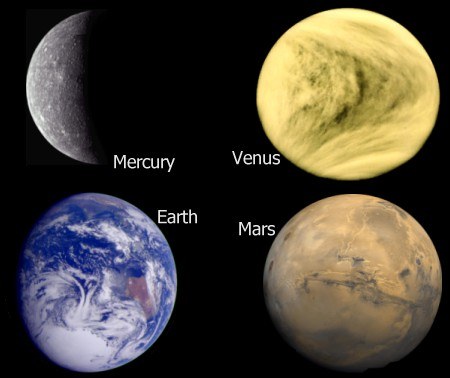
Almost Earth’s twin in size and mass, this planet has very thick atmosphere.
a)
Venus
b)
Mars
c)
Mercury
d)
Neptune
31.
The surface of this planet appears red due to rusting iron in the rocks.
a)
Mercury
b)
Mars
c)
Pluto
d)
Venus
32.
Only planet known to have life
a)
Earth
b)
Mars
c)
Venus
d)
Mercury
33.

This cold, blue planet was discovered by a mathematical prediction.

a)

Neptune

b)

Jupiter

c)

Mars

d)

Venus

34.
Which of the following is an accurate model of how the Sun, Earth, and Moon move?
a)
Sun and moon orbit Earth
b)
Earth and moon orbit Sun
c)
Earth orbit's the Sun and the moon orbits Earth
d)
Earth and sun orbit moon
35.
One of the main differences between the outer and inner planets is __________.
a)
The inner planets all have water
b)
the inner planets are much bigger than the outer planets
c)
the outer planets are gas planets
d)
the outer planets have rings, and the inner planets don't
36.
The order of the planets is:
a)
Mars,Venus,Earth,
Mercury,Saturn
Jupiter, Uranus, Neptune
b)
Earth,Venus,Mars
Jupiter, Neptune,
Mercury,Saturn,
Uranus
c)
Mercury,Venus,Earth
Mars,Jupiter,
Saturn,Uranus
Neptune
37.
Stars are grouped together according to patterns known as ___________________.
a)
constellations
b)
solar systems 
c)
galaxies
38.
Which planet in the solar system has a significant ring system?
a)
Neptune
b)
Mars
c)
Saturn
39.
Which planet in the solar system is the largest?
a)
Earth
b)
Uranus
c)
Jupiter
40.
 How is the Sun similar to the stars that can be seen at night?
a)
The Sun makes light energy
b)
The Sun takes light energy from space. 
c)
The Sun warms the Earth with its light
41.
1.  Earth's seasons are caused by the tilt of the____________.
a)
axis
b)
hemispheres
c)
gravity
42.
1.  When all of the moon is lit up it is called a _____________.
a)
New Moon
b)
Gibbous Moon
c)
Full Moon
43.
1.  If it is summer in the Northern Hemisphere, then it will be _____________ in the Southern Hemisphere.
a)
Fall
b)
Summer
c)
Winter
44.
Which letter or letters represent daytime on Earth? 
a)
B
b)
C
c)
B and C
d)
A and B
45.
The Earth is constantly spinning on its axis, like you might spin a basketball on your finger.

It is this spinning of the Earth that causes
 
a)
the seasons
b)
night and day
c)
moon phases
46.
Our Sun is one of many stars in the Milky Way Galaxy. Which term BEST describes our Sun?
a)
large
b)
average sized
c)
small
47.
Which of these causes the phases of the moon?
a)
earths orbit around the sun
b)
the moons orbit around earth
c)
the orbit of the sun as it orbits earth
d)
the orbit of the moon as it orbits the sun
48.
Which statement describing the relationship between stars and planets is true?
a)
planets orbit the sun and stars do not
b)
planets create light, and stars reflect light energy
c)
stars orbit some planets
d)
the sizes of the planets are directly related to the sizes of nearby stars
49.
Earth and the other planets closest to the Sun are made mostly of _______
a)
gas
b)
metal
c)
water
d)
rock
50.
The moon is a natural  ______ of Earth.
a)
comet
b)
axis
c)
satellite
d)
space probe
51.
Earth's ________ on its axis causes day and night.
a)
rotation
b)
revolution
c)
phase
d)
comet
52.
One kind of  _______ is the crescent Moon.  
a)
axis
b)
asteroid
c)
phase
d)
space probe
53.
One full orbit of an object around another object is called a ________.
a)
axis
b)
rotation
c)
revolution
d)
satellite
54.
The __________ has planets, moons, comets, and asteroids.
a)
solar system
b)
earth
c)
rotation
d)
United States
55.
One of the main differences between the outer and inner planets is __________.
a)
The inner planets all have water
b)
the inner planets are much bigger than the outer planets
c)
the outer planets are gas planets
d)
the outer planets have rings, and the inner planets don't
56.
Where is the asteroid belt found?
a)
between earth and mars
b)
Between Uranus and Neptune
c)
Between Mercury and Venus
d)
Between Mars and Jupiter
57.
Select the order from smallest to largest.
a)
Sun, Milky Way, solar system, universe
b)
Sun, Milky Way, universe, solar system
c)
Sun, solar system, Milky Way, universe
d)
Sun, solar system, universe, Milky Way
58.
Why does Earth have different seasons? 
a)
because of the distance between Earth and the sun 
b)
because of the speed of Earth as it rotates on its axis 
c)
because of the amount of light blocked by the moon on its axis 
d)
because of the tilt of Earth on its axis as it moves around the sun 
59.
Which factor makes Earth different from all the other planets in the solar system in its ability to support life? 
a)
The Earth is exposed to rays from the sun. 
b)
The Earth has only one moon that orbits around it. 
c)
The Earth rotates in an elliptical orbit around the sun. 
d)
The Earth has a breathable atmosphere. 
60.
Which best explains why the moon has phases?
a)
The moon’s position changes in relation to the sun and Earth. 
b)
The sun’s position changes in relation to the moon and Earth. 
c)
The Earth casts a shadow on the moon as it rotates. 
d)
The moon rotates along its axis
61.
Day and night is caused by the _____________ of earth on its axis.
a)
revolution
b)
orbit
c)
rotation
62.
As the Earth travels around the sun, this tilt causes different areas of the Earth’s surface to get different amounts of daylight at different times of the year. The angle of the Sun’s rays to the surface also causes areas to have more or less of the Sun’s energy. This causes the ________.
a)
months
b)
day and night
c)
seasons
d)
years
63.
Which outer planets have rings?
a)
Just Saturn
b)
Saturn and Jupiter
c)
Jupiter, Neptune, and Saturn
d)
all 4 of them
64.
a pattern of stars that form an imaginary picture or design in the sky
a)
Orbit
b)
Rotate
c)
constellation
d)
Milky Way
65.
A spiral galaxy of stars that contains our Sun
a)
Planisphere
b)
Intensity
c)
Star
d)
Milky Way
66.
The pattern of stars in a constellation stays the same, but a planet can be seen in different locations at different times because _______________.
a)
Stars don't move; planets revolve and rotate
b)
Stars and planets revolve and rotate.
c)
Stars not planets move
d)
Planets don't move; Stars revolve and rotate.
67.
Which color star has medium temperature?
a)
Bluish-White
b)
Yellow
c)
Reddish-Orange
68.
Which of the following causes seasons?
a)
the earths tilt
b)
the earths rotation
c)
the earths revolution around the sun
d)
the earths size 
69.
Besides Pluto, which planet is the furthest planet from the sun?
a)
Mercury
b)
Earth
c)
Neptune
d)
Uranus
70.
What is similar about all of the inner planets?
a)
rocky
b)
gasses
c)
many moons
d)
takes a long time to revolve around the sun
71.
What is similar about all of the Outer Planets?
a)
small
b)
large
c)
few moons
d)
takes a short amount of time to go around the sun
72.
Which direction do all of the planets go around the sun?
a)
clockwise
b)
counter-clockwise
c)
verticle
d)
horizontal
73.
Which planet is the largest?
a)
Jupiter
b)
Saturn
c)
Neptune
d)
Uranus
74.
Besides Pluto, which planet is the smallest?
a)
Mercury
b)
Venus
c)
Earth 
d)
Mars
75.
Between which two planets is the asteroid belt located?
a)
Mercury & Venus
b)
Mars & Jupiter
c)
Uranus & Neptune
d)
Neptune & Pluto
76.
Which planet takes the least time to go around the sun?
a)
Mercury
b)
Earth
c)
Mars
d)
Jupiter
77.
Which planet is red because of iron oxide or rust?
a)
Venus
b)
Mars
c)
Jupiter
d)
Saturn
78.

Which planet is the closest planet to the sun?

a)

Mercury

b)

Venus

c)

Mars

d)

Pluto

79.

Which planet's average temperature make it the hottest planet in the solar system?

a)

Mercury

b)

Venus

c)

Earth

d)

Mars

80.

Which planet has the greatest range in daytime and night time temperatures?

a)

Mercury

b)

Earth

c)

Jupieter

d)

Neptune

81.

The "Great Red Spot" is a storm on which planet?

a)

Earth

b)

Mars

c)

Jupiter

d)

Saturn

82.

Which planet rotates on its side?

a)

Venus

b)

Earth

c)

Saturn

d)

Uranus

83.

Why is Venus's atmosphere yellow?

a)

banannas

b)

sulfer

c)

nitrogen

d)

iron

84.

which planet is closest to the earth

a)

mercury

b)

veanus

c)

earth

d)

mars