
 Worksheets
Dilations
Total questions: 91
Worksheet time: 5hrs 35mins


A(3,3) B(6,6) C(9,3)


What type of transformation is this?
rotation
translation
reflection
dilation

What type of transformation is this?
rotation
translation
reflection
dilation

What type of transformation is this?
rotation
translation
reflection
dilation

What type of transformation is this?
rotation
translation
reflection
dilation
This type of transformation changes the size:
rotation
translation
reflection
dilation

Which is the pre-image (first one)?
Purple
Blue
Translated figures are always __________________.
Congruent
Bigger
Smaller
Rotated
A reflection ____________________.
turns a figure around a point.
slides an object form one place to another.
flips or mirrors an object across a line.
changes the size of an object.
The point A (8, 12) was dilated to become point A' (2, 3). What was the scale factor?
½
¼
4
2


What are the coordinates for the center of dilation?
(0, 0)
(-3, -1)
(-12, 6)
(-3, -3)


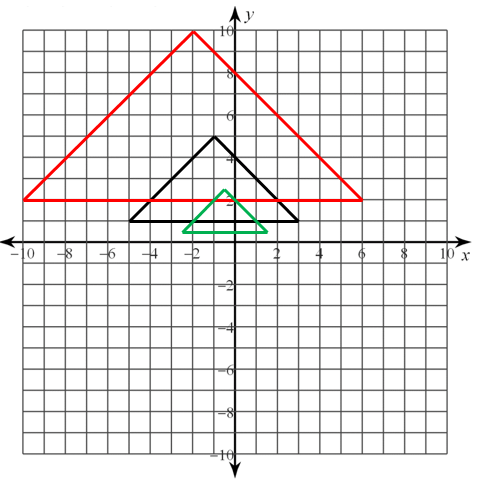
use a synonym for larger
use a synonym for smaller
A(3,3) B(6,6) C(9,3)


A(3,3) B(6,6) C(9,3)


Is this an enlargement or a reduction?
Enlargement
Reduction

Is this an enlargement or a reduction?
Enlargement
Reduction

Is this an enlargement or a reduction?
Enlargement
Reduction

Is this an enlargement or a reduction?
Enlargement
Reduction

Triangle E’F’G’ is a dilation of triangle EFG.
Which rule best represents the dilation shown?
(x, y) --> (2x, 2y)
(x, y) --> (0.5x, 0.5y)
(x, y) --> (x + 2, y - 2)
(x, y) --> (2x, 0.5y)

Quadrilateral WXYZ was dilated with the origin as the center to create quadrilateral W’X’Y’Z’.
Which rule best represents the dilation that was applied to quadrilateral WXYZ to create quadrilateral W’X’Y’Z’?
(x, y) --> (0.4x, 0.4y)
(x, y) --> (x + 3, y + 2)
(x, y) --> (2.5x, 2.5y)
(x, y) --> (x - 3, y - 2)

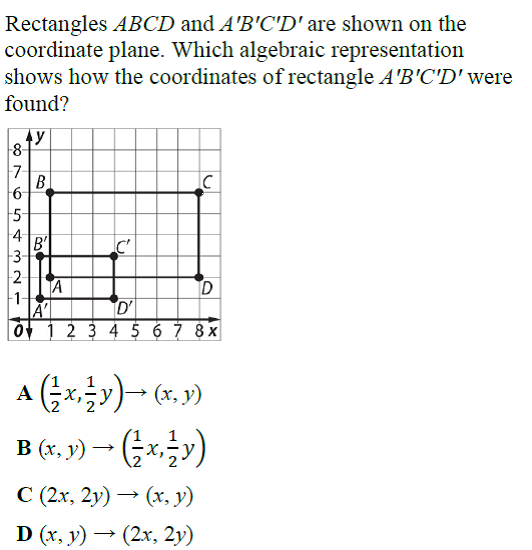
Trapezoid A’B’C’D’ is the dilation of trapezoid ABCD.
Which algebraic representation shows this dilation?
(x, y) --> (2x, 2y)
(x, y) --> (0.5x, 0.5y)
(2x, 2y) --> (x, y)
(x, y) --> (3x, 2y)
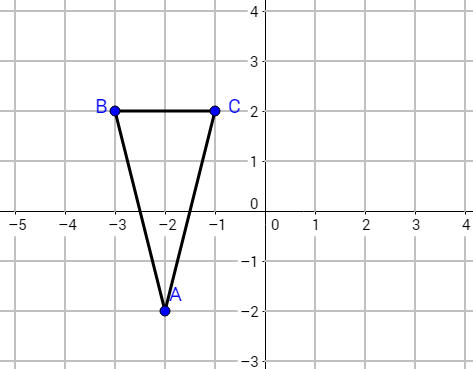
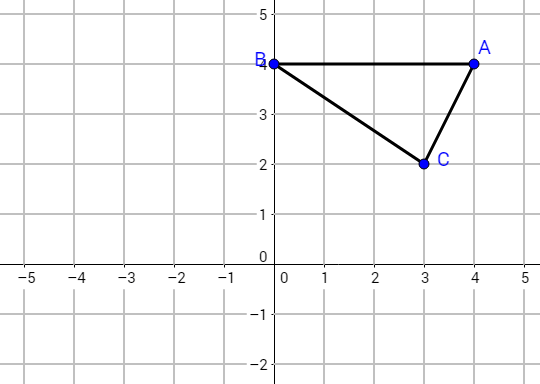
Triangle ABC is dilated by a scale factor of one-half to form Triangle A’B’C’ with the origin as a center of dilation.
Which rule represents this dilation?
(x, y) --> (2x, 2y)
(x, y) --> (1/2x, 1/2y)
(2x, 2y) --> (x, y)
(x, y) --> (1/3x, 1/3y)

Triangle A’B’C’ is the dilation of triangle ABC.
Which algebraic representation shows this dilation?
(x, y) --> (1/2x, 1/2y)
(x, y) --> (2x, 2y)
(x, y) --> (x + 1/2, y)
(x, y) --> (1/2x, y)

Triangle A’B’C’ is the dilation of triangle ABC.
Which algebraic representation shows this dilation?
(x, y) --> (1/2x, 1/2y)
(x, y) --> (2x, 2y)
(x, y) --> (x + 1/2, y)
(x, y) --> (1/2x, y)

Triangle A’B’C’ is the dilation of triangle ABC.
Which algebraic representation shows this dilation?
(x, y) --> (2x, 2y)
(x, y) --> (1/3x, 1/3y)
(x, y) --> (3x, 3y)
(x, y) --> (x + 3, y - 3)
A line segment is dilated by a scale factor of 2 centered at a point not on the line segment. Which statement regarding the relationship between the given line segment and its image is true?
The line segments are perpendicular, and the image is one-half of the length of the given line segment.
The line segments are perpendicular, and the image is twice the length of the given line segment.
The line segments are parallel, and the image is twice the length of the given line segment.
The line segments are parallel, and the image is one-half of the length of the given line segment
The line whose equation is 3x – 5y = 4 is dilated by a scale factor of 5/3 centered at the origin. Which statement is correct?
The image of the line has the same slope as the pre-image but a different y-intercept.
The image of the line has the same y-intercept as the pre-image but a different slope.
The image of the line has the same slope and the same y-intercept
as the pre-image.
The image of the line has a different slope and a different y-intercept from the pre-image.
A line that passes through the points whose coordinates are (1,1) and (5, 7) is dilated by a scale factor of 3 and centered at the origin. The image of the line
is perpendicular to the original line
is parallel to the original line
passes through the origin
is the original line
A three-inch line segment is dilated by a scale factor of 6 and centered at its midpoint. What is the length of its image?
9 inches
2 inches
15 inches
18 inches
Line segment A'B' whose endpoints are (4, -2) and (16, 14) is the image of AB after a dilation of 1/2 centered at the origin. What is the length of AB?
5
10
20
40

In the diagram below, CD is the image of AB after a dilation of scale factor k with center E. Which ratio is equal to the scale factor k of the dilation?
EC : EA
BA : EA
EA : BA
EA : EC
After a dilation with center (0, 0) the image of DB is D'B'. If DB = 4.5 and D'B' = 18, the scale factor of this dilation is
1/5
5
1/4
4

On the graph below, point A(3, 4) and BC with coordinates B(4, 3) and C(2, 1) are graphed. What are the coordinates of B' and C' after BC undergoes a dilation centered at point A with a scale factor of 2?
B'(5,2) and C'(1, -2)
B'(6, 1) and C'(0, -1)
B'(5, 0) and C'(1, -2)
B'(5, 2) and C'(3, 0)


What is the rule for rotating a figure 90 degrees counterclockwise
(-y, x)
(-x, -y)
(y, -x)
(-y, -x)
What is the rule for rotating a figure 180 degrees
(-y, x)
(-x, -y)
(y, -x)
(-y, -x)
What is the rule for rotating a figure 270 degrees counterclockwise
(-y, x)
(-x, -y)
(y, -x)
(-y, -x)


Rotate ΔPQR 270o counterclockwise about the origin.
P(-5 , 2) ; Q(1 , 5) ; R(3 , -2)
P'(-2 , -5) ; Q'(-5 , 1) ; R'(2 , 3)
P'(-5 , -2) ; Q'(1 , -5) ; R'(3 , -2)
P'(2 , 5) ; Q'(5 , -1) ; R'(-2 , -3)
P'(5 , -2) ; Q'(-1 , -5) ; R'(-3 , 2)

