
 Worksheets
CA#6 Re-Test Review
Total questions: 52
Worksheet time: 47mins


What taxa are in a scientific name?
Genus and Kingdom
Species and Family
Species and Class
Genus and Species
(Taxonomy) An organism's scientific name includes its...
Family & Genus
Kingdom & Family
Genus & Species
Class & Genus

What kingdom does yeast belong to?
Kingdom Animalia
Kingdom Plantae
Kingdom Protista
Kingdom Fungi
Kingdom Eubacteria

What kingdom does a lion belong to?
Kingdom Animalia
Kingdom Plantae
Kingdom Protista
Kingdom Fungi
Kingdom Eubacteria
One major difference between a bacterium and a protist is the presence of
ribosomes
cell membrane
nucleus
type of reproduction
Organisms in the same class would also be in the same
order
genus
species
phylum
The cell wall of a plant is composed of cellulose. Cellulose is a
protein
carbohydrate
lipid
nucleic acid
Why is it important to have an internationally recognized naming system?
We need to be able to communicate about organisms without confusion
Because Darwin established the system
So we can use Latin and Greek
It is important to know all of the common names for an organsism
I am single celled. I am prokaryotic. I have a cell wall that's not made of peptidoglycan. I also live in very extreme conditions. Which domain do I belong in?
Bacteria
Archea
Eukarya
I have a cell wall that's made of peptidoglycan. I live in most conditions. I am also a single celled prokaryote. Which Domain do I belong to?
Domain Archaea. Only archaea live in most places like the mouth and skin of humans.
Domain bacteria. Only bacteria have cell wall made of peptidoglycan
Domain Eukarya. Only Eukarya are prokaryotes with cell walls.
Which domain has organisms that live in harsh environments?
Bacteria
Archaea
Both
Which domain has organisms that live in many environments (in normal conditions)?
Archaea
Bacteria
Both
Which viral life cycle kills its host cell by breaking it open?
lytic
lysogenic

Salmonella is caused by a bacteria. What would be most effective in treating it?
vaccinations
antibiotics
fungal creams
eating a healthy diet
Which viral cycle takes the longest to show symptoms?
Lysogenic
Lytic
What is the first step to both viral cycles?
The virus attaches to a host
the virus injects genetic material
the host gets sick
the cell is destroyed
When the viral DNA becomes active in the lysogenic cycle, which life cycle does it enter?
lytic
lysogenic
cell cycle
DNA replication
If Andy is feeling symptoms from a virus that he contracted, the virus must be in the
lytic cycle
lysogenic cycle
the capsid bursts
the virus becomes dormant
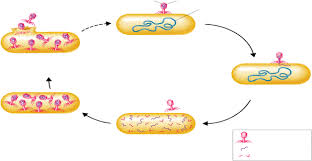
What happens in the lysogenic cycle?
Virus goes in and leaves the host cell
Virus quickly kills the host cell
Virus injects the nucleic acid into the host cell, and the nucleic acid integrates into the host cell DNA and stays dormant for a long time
Bacteria injects DNA into a host cell

This image represents part of the
lytic cycle
lysogenic cycle
Choose the correct order of lytic cycle steps
attachment, entry, assembly, replication, release
attachment, entry, replication, assembly, release
attachment, entry, assembly, release, replication
attachment, release, assembly, replication, entry
Why is important to administer an antiviral within the fist few days of infection?
So that the virus does not go dormant
Because the virus replicates quickly
So that it is not spread
So that it will kill the vector
Which of the following would be appropriate to treat a bacterial infection with?
An antiviral
A vaccine
An antibiotic
Essential oils
Cells with a nucleus are placed into which Domain?
Eukarya
Archaea
Eubacteria
Animalia
Archaebacteria are placed into which Domain?
Archaea
Bacteria
Eubacteria
Eukarya
Organisms in the kingdom Protista are placed into which domain?
Eukarya
Archaea
Animalia
Bacteria





takes over the cell's functions.
A cell with chloroplasts, mitochondria and a nucleus would be
eukaryotic
prokaryotic
both
neither

Which of the following is a reason scientists use scientific names as opposed to their common names?
Scientists around the world use the same names so there is no language barrier
No two species have the same name, so there is no confusion about which organism is being studied
Scientific names can help you know which organisms are related if they share a common genus name
What is the genus name here:
Canis lupus
Canis
lupus

Who is most closely related?
Organisms in the same family
Organisms in the same domain
Organisms in the same kingdom
Organisms in the same class

