wayground logo

Free Printable Worksheets

Font size

S
M
L
XL
Worksheets

Bio2113 Exam 2 Chapters 4-5 Review

Total questions: 121

Worksheet time: 4hrs 28mins

Name
Class
Date
1.
A chemical reaction that builds a larger molecule from two smaller molecules
a)
catabolic
b)
anabolic
2.
A chemical reaction in which a larger molecule is broken down into smaller molecules
a)
catabolic
b)
anabolic
3.
The equations below represent two biochemical processes, A and B. 
Equations
(A) glucose + glucose --> maltose + water
(B) amino acid + amino acid --> dipeptide + water

Which statement about processes A and B is correct?
a)
Processes A and B are examples of dehydration synthesis.
b)
Process A is an example of hydrolysis,  but process B is an example of dehydration synthesis.
c)
Process B requires enzymes, but process A does not.
d)
Processes A and B are examples of hydrolysis.
4.
The following equation represents the digestion of a protein.
Peptide + Water  --->  Amino acid + Amino Acid 
What type of reaction does this demonstrate?
a)
dehydration synthesis
b)
combustion
c)
hydrolysis
d)
single replacement
5.

The totality of an organism's chemical reactions is called

a)

catabolism

b)

anabolism

c)

metabolism

d)

fabulism

6.
What type of metabolism allows you to break down food into energy for your cells?
a)
anabolism
b)
catabolism
c)
exercise
d)
autotroph
7.
What type of metabolism is demonstrated the reaction?
2H2O ----- 2H2 + O2
a)
anabolism
b)
catabolism
c)
dehydration
d)
hydration
8.
What type of metabolism is demonstrated the reaction?
Fe2O3 + 3SO3 → Fe2(SO4)3
a)
anabolism
b)
catabolism
c)
dehydration
d)
hydration
9.
When molecules are being built by chemical reactions it is called 
a)
anabolism
b)
catabolism
c)
fermentation
d)
respiration
10.
When molecules are being broken down in a chemical reaction it is called
a)
anabolism
b)
catabolism
c)
photosynthesis
d)
uptake
11.

A \rightarrow   B + C

a)

Anabolic

b)

Catabolic

12.

A + B \rightarrow   C

a)

Anabolic

b)

Catabolic

13.

In what process is mRNA synthesized?

a)

Transcription

b)

Translation

c)

DNA Replication

d)

Mitosis

14.

Where does TRANSCRIPTION occur?

a)

Nucleus

b)

Ribosome

c)

Cytoplasm

d)

Mitochondria

15.

Why must transcription occur where DNA can be found?

a)

because DNA can't leave

b)

because ribosomes are in the nucleus

c)

because DNA polymerase is found there

d)

because helicase unzips the DNA

16.

How many nucleotides equal 1 amino acid?

a)

1

b)

2

c)

3

d)

4

17.

How many codons equals 1 amino acid?

a)

1

b)

2

c)

3

d)

4

18.

TRANSCRIBE this DNA sequence: TACGTTACT

a)

AUGCAAUGA

b)

ATGCAATGA

c)

AUGGATUGA

d)

TACGTTACT

19.

Which of the following are differences in the structure between RNA and DNA

a)

DNA uses deoxyribose sugar, RNA uses sugar ribose

b)

DNA pairs Adenine with Uracil, RNA pairs Adenine with Thymine

c)

DNA is a double helix, RNA is a single helix

d)

DNA pairs Adenine with Thymine, RNA pairs Adenine with Uracil

20.

Which organelle is the location where protein is made?

a)

Ribosome

b)

Nucleus

c)

Cytoplasm

d)

Nucleotide

21.
What is the term for a three-nucleotide sequence that codes for an amino acid?
a)
base
b)
codon
c)
amine
d)
serine
22.
The process to go from DNA to mRNA is _______
a)
translation
b)
transcription
c)
replication
23.
The process to go from mRNA to a protein is called ____
a)
transcription
b)
rRNA
c)
replication
d)
translation
24.
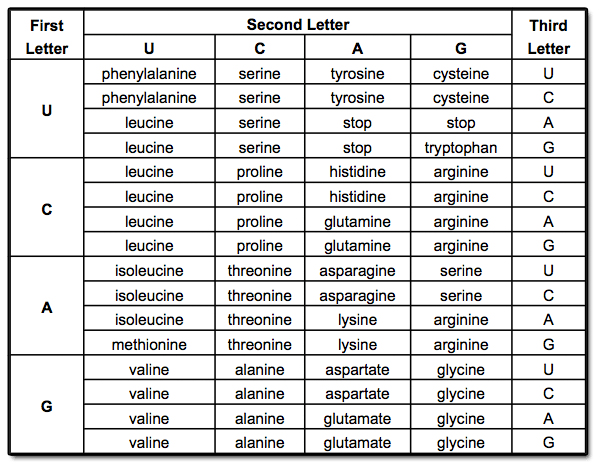
What amino acid is represented by the codon UUA?
a)
Phenylalanine
b)
Tyrosine
c)
Leucine
d)
Stop codon
25.
Does the order of amino acids in a protein matter?
a)
YES!
b)
NO!
26.
A sugar, a phosphate group, and a nitrogen base form the building blocks of which organic compound?
a)
carbohydrates
b)
nucleic acids
c)
lipids
d)
proteins
27.
Which of the following is the template for the production of RNA within a cell?
a)
DNA
b)
protein
c)
ATO
d)
carbohydrate
28.
which process is shown?
a)
diffusion
b)
repiration
c)
recombination
d)
translation
29.
What molecules do both DNA and RNA contain?
a)
uracil
b)
nucleotides
c)
thymine
d)
deoxyribose
30.
The genetic material of an organism is composed of
a)
lipids
b)
proteins
c)
deoxyribonucleic acids
d)
complex carbohydrates
31.
Which of the following best describes how DNA and RNA are similar?
a)
they both contain A and T
b)
They both have a double helix
c)
They are both composed of 5 different nucleotides
d)
they both have C and G
32.
One human disease is caused by a change in one codon in a gene from GAA to GUA. The disease is a result of 
a)
a mutation
b)
crossing-over
c)
a meiosis error
d)
polyploidy
33.
DNA sequence is ACAGTGC. How would this be coded on mRNA?
a)
TGTCACG
b)
UGUCACG
c)
GUGACAU
d)
CACUGUA
34.
What is the relationship between a protein, the cell, and DNA?
a)
DNA is produced by protein which is produced in the cell
b)
Protein is composed of DNA which is produced in the cell
c)
DNA controls the production of protein in the cell
d)
A cell is composed of DNA and protein
35.
Genetic info flows in one direction. Which best represents this flow?
a)
DNA-protein-RNA
b)
Protein-RNA-DNA
c)
RNA-protein-DNA
d)
DNA-RNA-protein
36.
Which process?
a)
mutation
b)
transcription
c)
respiration
d)
translation
37.
Which cellular organelle is responsible for manufacturing ATP?
a)
Ribosome
b)
Nucleus
c)
Mitochondria
d)
Chloroplast
38.
What do all cells use as energy?
a)
Carbs
b)
Protein
c)
Fat
d)
ATP
39.
What are the parts of the ATP molecule?
a)
adenine, thylakoids, stroma
b)
stroma, grana, chlorophyll
c)
adenine, ribose, phosphate groups
d)
NADH, NAHPH, FADH
40.
Energy is released from ATP when
a)
a phosphate group is added
b)
adenine bonds to ribose
c)
ATP is exposed to sunlight
d)
a phosphate group is removed
41.
What is the function of ATP in living things?
a)
provides energy for cells
b)
stores genetic information
c)
provides structure in the nucleus
42.
Where is the energy stored in ATP molecules
a)
In the Ribose Sugar
b)
In the Adenine group
c)
In the Phosphate bonds
d)
In the Bank
43.
The purpose of cellular respiration is to produce ?
a)
energy
b)
oxygen
c)
sugar
d)
protein
44.
What is the sugar that carbs are broken down to?
a)
sucrose
b)
maltose
c)
glucose
d)
lactose
45.
The splitting of the glucose molecule is called?
a)
synthesis
b)
denaturalization
c)
glycolysis
d)
dissolving
46.
The two type of fermentation are alcohol and _____________ acid fermentation. 
a)
lactic
b)
sulfuric
c)
hydrochloric
d)
acetic 
47.
The waste gas given off by cellular respiration is?
a)
oxygen
b)
carbon dioxide
c)
nitrogen
d)
methane
48.
After cellular respiration is complete, on 38% of the energy in glucose is used. What happens to the rest of the energy?
a)
released as heat
b)
stored for later use
c)
eliminated by the digestive system
d)
turned into protein
49.
What is the name of the 1st step of cellular respiration?
a)
Glycolysis
b)
Kreb's Cycle
c)
ETC
d)
Anaerobic respiration
50.
Where does glycolysis take place?
a)
Cytoplasm
b)
Stroma
c)
Thylakoid
d)
Mitochondria
51.
This process releases chemical energy from sugars and other carbon-based molecules to make ATP when oxygen is present.
a)
photosynthesis
b)
light-independent reaction
c)
cellular respiration
d)
light-dependent reaction
52.

Which of the following is a reactant of cellular respiration?

a)

Glucose

b)

Carbon Dioxide

c)

Water

d)

ATP

53.

A decrease in the amount of oxygen available will....

a)

not have an effect on the amount of energy produced during cellular respiration

b)

decrease the amount of glucose produced during cellular respiration

c)

cause the amount of water produced during cellular respiration to increase

d)

decrease the amount of energy produced during cellular respiration

54.

What molecule is produced by cells in order to store glucose?

a)

lactic acid

b)

glycogen

c)

pyruvic acid

d)

electrons

55.
What is a substance called if it speeds up a chemical reaction?
a)
reusable
b)
catalyst
c)
specific
d)
fragile
56.
With what 3 letters do enzymes typically end?
a)
-ose
b)
-ase
c)
-ese
d)
-tic
57.

Enzymes are an example of

a)

Lipids

b)

Carbohydrate

c)

Protein

d)

Nucleic Acid

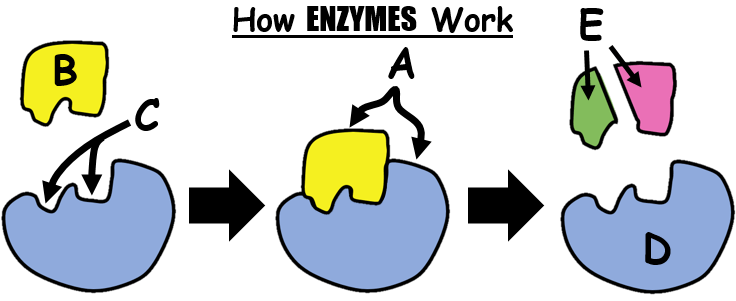
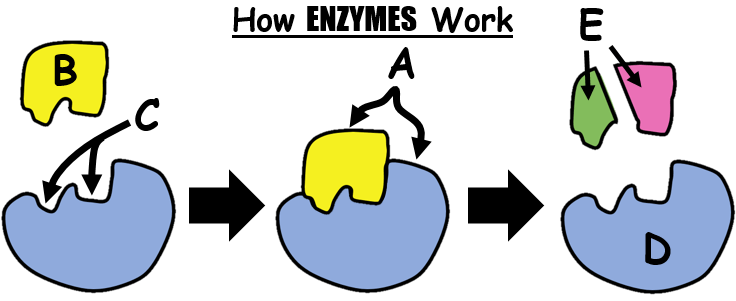
58.
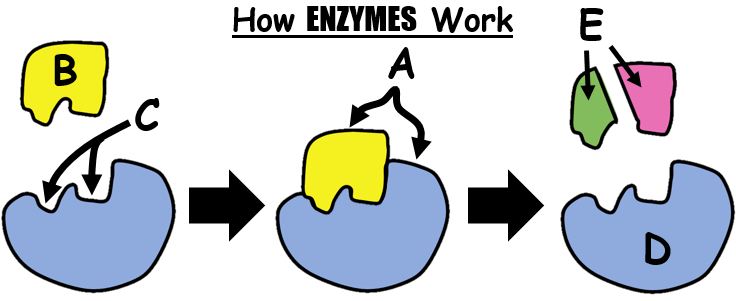
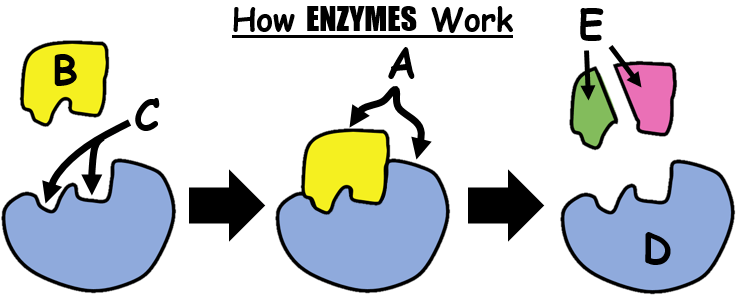
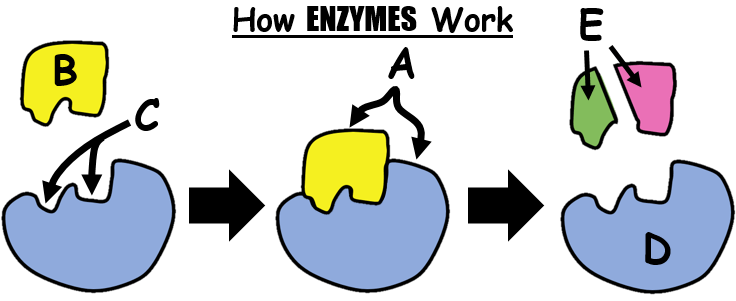
In the diagram, what is letter A? 
a)
product
b)
substrate
c)
enzyme-substrate complex
d)
active site
59.
Letter D...
a)
active site
b)
enzyme
c)
substrate
d)
products
60.
Letter B...
a)
active site
b)
enzyme
c)
substrate
d)
products
61.
Letter C...
a)
active site
b)
enzymes
c)
substrate
d)
products
62.
Letter E...
a)
active site
b)
enzyme
c)
substrate
d)
products
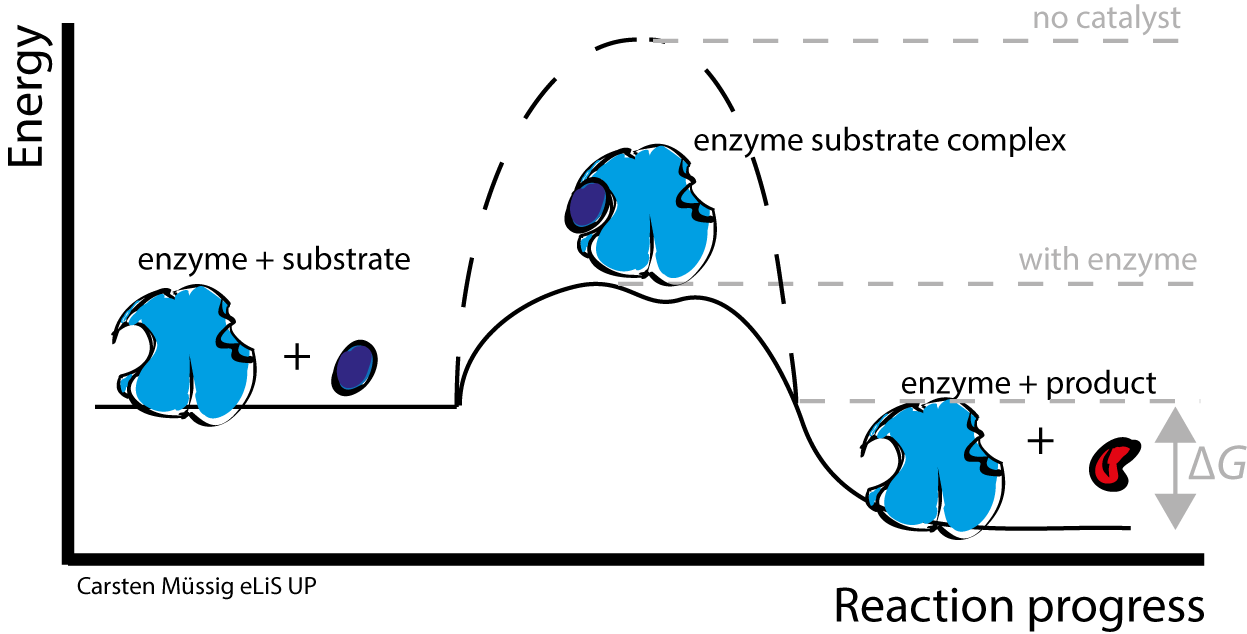
63.
An enzyme speeds up a reaction by
a)
lowering the activation energy.
b)
raising the activation energy.
c)
releasing energy.
d)
absorbing energy.
64.

What happens when enzymes are heated to a high temperature?

a)

The enzymes die.

b)

The shape of the enzyme are changed and it denatures

c)

The enzymes' amino acid sequence changes.

d)

The enzymes remain the same

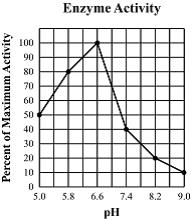
65.
Which of the following conclusions can be drawn from this graph?
a)
The optimum pH of the enzyme is 6.6.
b)
The optimum pH of the enzyme is 5.8
c)
The enzyme’s activity increases as pH increases 5.0 to 9.0
d)
The enzyme’s activity is greater around pH of 8.0 .
66.
Which of these is most likely an enzyme?  
a)
Sucrose
b)
Galactose
c)
Fructose
d)
Amylase
67.
Which enzyme is most efficient in a basic solution?
a)
A
b)
B
68.
Which enzyme has the job of unzipping the double helix?
a)
Helicase
b)
Polymerase
c)
Ligase
d)
Primerase
69.
What is the shape of DNA?
a)
Double helix
b)
Triple helix
c)
Flat, bilayer
d)
Three-pronged rigid ladder
70.
DNA replication turns one strand of DNA into two new strands of DNA. What percent of each new strand is the old strand?
a)
Half of each new DNA is the old DNA
b)
The old strand of DNA was digested, so none
c)
The new DNA is entirely made up of the old DNA
d)
About every sixth base comes from the old DNA
71.

Which is the first step?

a)

DNA Helicase unwinds original DNA strand

b)

RNA Primase lays down RNA primer for new nucleotide bases.

c)

DNA polymerase builds new strands by bring in new nucleotide bases.

d)

Ligase knits together fragments on lagging strand

72.
The bonds that hold the two strands of DNA together come from...
a)
the attraction of phosphate groups 
b)
strong bonds between  bases and sugars
c)
carbon to carbon bonds in the sugar
d)
weak hydrogen bonds between the bases
73.

When does DNA replication occur?

a)

interphase

b)

mitosis

c)

cytokinesis

d)

transcription

74.
What type of respiration requires oxygen?
a)
Aerobic
b)
Anaerobic
75.
What type of respiration does not require oxygen?
a)
Aerobic
b)
Anaerobic
76.
Where in the cell does aerobic respiration take place?
a)
Nucleus
b)
Cytoplasm
c)
Mitochondria
d)
Cell membrane
77.
Which organ breaks down lactic acid?
a)
Liver
b)
Lung
c)
Heart
d)
Bladder
78.

Where in the cell does anaerobic respiration take place?

a)

Nucleus

b)

Cytoplasm

c)

Mitochondria

d)

Cell membrane

79.

Which type of respiration produces the most energy

a)

Anaerobic

b)

Aerobic

c)

Both produce the same amount

80.

The neuron is part of the

a)

nervous tissue

b)

connective tissue

c)

epithelial tissue

d)

muscular tissue

81.

Which is NOT a type of connective tissue?

a)

Dense connective tissue

b)

Areolar tissue

c)

Compact bone

d)

Smooth muscle

82.

Which of the following is a type of epithelial tissue?

a)

smooth muscle

b)

transitional

c)

nervous

d)

blood

83.

the functions of muscle tissue include

a)

binding structures together

b)

forms glands

c)

help move substances and structures in the body

d)

conduct impulses

84.

The function of nervous tissue is to conduct impulses to and from body organs.

a)

True

b)

False

85.

Muscles are located in all the following EXCEPT

a)

in the digestive tract

b)

in the heart

c)

attached to bones

d)

inside bones

86.

The two ways to classify epithelium cells are

a)

number and size

b)

shape and color

c)

shape and number of layers

d)

color and number

87.

Cardiac muscle is found around the

a)

stomach

b)

lungs

c)

heart

d)

liver

88.

Connective tissue are the most abundant tissue in the body.

a)

True

b)

False

89.

All the following are epithelial cell shapes EXCEPT

a)

cubodial

b)

squamous

c)

columnar

d)

triangular

90.

The four types of tissue are

a)

muscle, transitional, epithelial, connective

b)

muscle, nervous, epithelial, connective

c)

muscle, epithelial, connective, squamous

d)

cardiac, transitional, epithelial, connective

91.

The type of type that includes blood

a)

epithelial

b)

muscle

c)

connective

d)

nervous

92.

Tissues work together and make up

a)

cells

b)

organelles

c)

molecules

d)

organs

93.
Which type of tissue is this?
a)
Nervous
b)
Epithelial
c)
Connective
d)
Muscle 
94.
What type of cell produces the matrix in loose connective tissue?  
a)
Chondrocytes 
b)
Fibroblasts 
c)
Osteoblasts 
d)
Adiposites  
95.
What type of epithelium is this:
a)
Simple Columnar
b)
Simple Squamous
c)
Stratified Squamous
d)
Pseudo-stratified Columnar 
96.
Intercalated discs are found in which muscle type?
a)
Cardiac
b)
Skeletal
c)
Lateral
d)
Smooth 
97.
Which type of muscle cells are voluntary? 
a)
Skeletal
b)
Cardiac
c)
Medial 
d)
Smooth 
98.
Which of the following is NOT an arrangement type of epithelial tissue?
a)
Striated
b)
Stratified
c)
Pseudo-stratified 
d)
Simple 
99.
Which type of membrane is found around joints? 
a)
Serous
b)
Mucous
c)
Synovial
d)
Cutaneous 
100.
Which type of tissue is this? 
a)
Cardiac
b)
Nervous
c)
Epithelial
d)
Muscle 
101.

Which tissue is found in the spinal cord?

a)

nervous tissue

b)

skeletal muscle

c)

smooth muscle

d)

cardiac muscle

102.

Nerve tissue is made up of:

a)

neurons and neuroglial cells

b)

connective and muscle tissue

c)

neurons and epithelial cells

d)

muscle tissue and neuroglial

103.

Raising your arm is an example of:

a)

smooth muscle use

b)

skeletal muscle use

c)

cardiac muscle use

d)

nervous tissue use.

104.

what type of tissue is this picture?

a)

cuboidal epithelial

b)

columnar epithelial

c)

squamous epithelial

d)

stratified cuboidal

105.

Urine is confined to the human bladder in part due to the structure of junctions that connect the cells lining the bladder. These junctions form a barrier that prevents the exchange of ions and solutes between the blood and urine. What is the likely identity of these junctions?

a)

Gap junctions

b)

Tight junctions

c)

Adhering junctions

d)

Plasmodesmata

106.

Which type of cellular junction is prominent in cardiac myocytes and allows for a unified contraction of the heart? Hint: in order for these cells to contract in unison, ions need to flow rapidly between them.

a)

Tight

b)

Adhering

c)

Gap

d)

Plasmodesmata

107.

These tissues are cube-shaped

a)

cuboidal

b)

squamous

c)

columnar

108.

These tissues are elongated, with nucleus near the bottom and often ciliated on outer surface

a)

cuboidal

b)

squamous

c)

columnar

109.

This cartilage is located inside the ear tube

a)

elastic

b)

fibrocartilage

c)

hyaline

d)

calcified

110.

This muscle tissue is striated, involuntary, makes up heart wall

a)

cadiac

b)

skeletal

c)

smooth

111.

A tissue that covers a surface, is one cell layer thick, and is composed of flat cells is

a)

simple squamous epithelium

b)

simple cubodial epithelium

c)

simple columnar epithelium

d)

stratified squamous epithelium

e)

transitional epithelium

112.

Epithelium composed of two or more layers of cells with only the deepest layer in contact with the basement membrane is known as

a)

stratified epithelium

b)

simple epithelium

c)

pseudostratified epithelium

d)

columnar epithelium

113.

Stratified epithelium is usually found in areas of the body where the principal activity is

a)

filtration

b)

protection

c)

absorption

d)

diffusion

114.

A type of junction between epithelial cells whose ONLY function is to prevent the cells from coming apart (provided mechanical strength) is the

a)

desmosome

b)

gap junction

c)

dermatome

d)

tight junction

115.

In parts of the body such as the urinary bladder, where considerable stretching occurs, one can expect to find which of these types of cells?

a)

cubodial epithelium

b)

pseudostratified epithelium

c)

transitional epithelium

d)

squamous epithelium

116.

The fibers in dense connective tissue are formed by

a)

fibroblasts

b)

adipose cells

c)

osteoblasts

d)

macrophages

e)

mast cells

117.

Which of these is true of adipose tissue?

a)

site of energy storage

b)

a type of connective tissue

c)

acts as a protective cushion

d)

functions as a heat insulator

e)

all of the above

118.

A __________ membrane lines tubes and cavities that open to the outside of the body.

a)

mucous

b)

synovial

c)

serous

d)

cutaneous

119.

Which of the following composes the extracellular matrix?

a)

Ground substance and protein fibers

b)

only fixed cells

c)

water

d)

all of these

120.

type of membrane of skin

a)

synovial

b)

cutaneous

c)

mucous

d)

serous

121.

How do merocrine, apocrine, and holocrine secretions differ?

a)

In the amount of cytoplasm secreted along with the glandular product.

b)

In the number of cells that secrete.