wayground logo

Free Printable Worksheets

Font size

S
M
L
XL
Worksheets

RMD -CELLS -Salim

Total questions: 121

Worksheet time: 6hrs 6mins
Name
Class
Date
1.

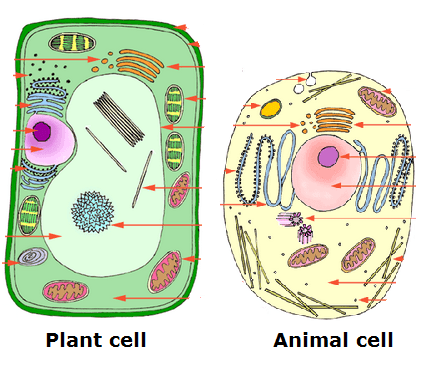
What distinguishes a plant cell from an animal cell? (How do you tell them apart) Hint: There's 3 ways (Check all 3)

a)

Central Vacuole

b)

Mitochondria

c)

Cell Wall

d)

Ribosomes

e)

Chloroplasts

2.

The 3 parts of the Cell Theory are...?

a)

All living things are composed of cells

Cells are the basic units of structure and function in living things

All cells are produced from other cells

b)

All living things are composed of cells

Cells are the basic units of dance and vibes in living things

All cells are destroyed from other aliens

c)

All living things are composed of Jell-O

Cells are the basic units of structure and function in living things

All cells are produced from factories in Canada

d)

All living things are composed of cells

Cells do karate and practice eating whole pies in their free time

All cells are produced from other cells

3.

There are how many main Bio-molecules that help make up cell organelles?

a)

2

b)

6

c)

4

d)

5

4.

These foods contain A LOT of which Bio-molecule that our body LOVES to use for Energy?

a)

Protein

b)

Nucleic Acids

c)

Baconidis

d)

Carbohydrates

5.

Our bodies use this Bio-molecule as it's building material. Often found in meats, eggs, and dairy products.

a)

Carbohydrates

b)

Proteins

c)

Lipids

d)

Baconidis

6.

I am the Bio-molecule responsible for mapping out everything. I am like a blue print to a living organism.

a)

Nucleic Acids

b)

Lipids

c)

Proteins

d)

Carbohydrates

7.

I am the Bio-molecule responsible for storing unused energy and can be used by living organisms as long term, slow energy.

a)

Proteins

b)

Lipids

c)

Carbohydrates

d)

Baconidis

8.

Cellular Respiration occurs within me and I am in BOTH plant and animal cells. I am a....

a)

Nucleus

b)

Golgi Body

c)

Cytoskeleton

d)

Mitochondria

9.

The Golgi Apparatus/Body is responsible for doing what within a cell?

a)

gathers simple molecules

b)

gathers simple molecules and combines them to make lysosomes

c)

gathers simple molecules and combines them to make molecules that are more complex

d)

gathers simple molecules and combines them to make molecules that are more fun than others

10.

I like to be thought of as the "storage bubble" for both plant and animal cells. I am a...

a)

Cell Membrane

b)

Cytoskeleton

c)

Vacuole

d)

Endoplasmic Reticulum

11.

I am the "brain" of the cell or the "control center" for everything happening within the cell. I am a...

a)

Golgi Body/Apparatus

b)

Nucleus

c)

Ribosome

d)

Lysosome

12.

Photosynthesis takes place within me. I am a...

a)

Mitochondria

b)

Cell Wall

c)

Chlorine

d)

Chloroplast

13.

I am often referred to as the "packaging system" within a cell. I "package" proteins and ship them to the Golgi Body. I am a...

a)

Cytoplasm

b)

Endoplasmic Reticulum

c)

Baconidis

d)

Golgi Body

14.

I am the "waste removal expert" within a cell, removing unwanted material. Like a garbage man, I am a...

a)

Waste Management

b)

Nucleus

c)

Ribosome

d)

Lysosomes

15.

I decide what goes in and out of the cell. I am fluid like and found in BOTH plant and animal cells. I am a...

a)

Cell Wall

b)

Cell Membrane

c)

Cytoplasm

d)

Golgi Apparatus

16.

I provide plant cells their rigid shape. I am the...

a)

Basketball that Nic Quarne left in Mr. Woller's room last week

b)

Cytoskeleton

c)

Cell Membrane

d)

Cell Wall

17.

I am found in a plant cell and I provide a "central" and LARGE amount of storage. I am a...

a)

Central Vacuole

b)

Cytoplasm

c)

Central Membrane

d)

Mitochondria

18.

I provide structure from within the cell so it doesn't collapse inwards upon itself. I am made of micro-filaments. I am the...

a)

Cytoskeleton

b)

Cytoplasm

c)

Baconidis

d)

Cell Wall

19.

Plant Cells can perform which reactions? Check ALL that apply.

a)

Photosynthesis

b)

Rock and Roll

c)

Cellular Respiration

d)

Surprised reactions

20.

Animal and Plant Cells are...

a)

Shopkoytes

b)

Eukaryotes

c)

Prokaryotes

d)

The building blocks of non-living things

21.

Who looked at living organisms in dental scrapings and pond water, and became known as "the father of microbiology?"

a)

Rudolf Virchow

b)

Anton van Leeuwenhoek

c)

Matthias Schleiden

d)

Theodor Schwann

22.

Who came up with the name "cells" while looking at a slice of cork under a microscope?

a)

Matthias Schleiden

b)

Anton van Leeuwenhoek

c)

Robert Hooke

d)

Rudolf Virchow

23.

In 1838, who was the German botanist that found that all plants were made of cells?

a)

Matthias Schleiden

b)

Theodor Schwann

c)

Rudolf Virchow

d)

Robert Hooke

24.

What is NOT a part of cell theory:

a)

all cells come from existing cells

b)

all cells have a nucleus

c)

all living things are made of cells

d)

cells are basic unit of structure and function in living things

25.

Prokaryotes are

a)

bacteria

b)

fungi

c)

plants

d)

animals

26.

Prokaryotic cells do NOT have membrane bound organelles or ______________________________.

a)

cytoplasm

b)

a nucleus

c)

ribosomes

d)

DNA

27.

Eukaryotes include fungi, plants, animals, and....

a)

bacteria

b)

protists

c)

archaebacteria

d)

eubacteria

28.

In eukaryotic cells DNA is primarily contained within the:

a)

cytoplasm

b)

ribosomes

c)

vacuoles

d)

nucleus

29.

Of the two types of cells, which one is smaller and more simplistic?

a)

prokaryotic cells

b)

eukaryotic cells

30.

All cells have a cell membrane, cytoplasm, DNA, and...

a)

cell wall

b)

nucleus

c)

ribosomes

d)

chloroplast

31.

The fluid portion of the cell (all cells have this):

a)

nucleus

b)

cytoplasm

c)

pili

d)

cell membrane

32.

Structures that have different jobs within the cell:

a)

antibodies

b)

lipids

c)

organelles

d)

blood cells

33.

Structure in the cell made of protein and RNA, used for protein synthesis...(found in all cells)

a)

nucleus

b)

cell membrane

c)

cytoplasm

d)

ribosomes

34.

What kind of microscope (seen here) is common in classrooms, uses light to shine through a sample, with a maximum magnification of about 1000 to 1500x?

a)

Dissecting microscope

b)

Compound light microscope

c)

Scanning Electron Microscope (SEM)

d)

Transmission Electron Microscope (TEM)

35.

What type of cell is an animal cell?

a)

Prokaryotic

b)

Eukaryotic

36.

What type of cell is a plant cell?

a)

Prokaryotic

b)

Eukaryotic

37.

What type of cell is a bacterial cell?

a)

Prokaryotic

b)

Eukaryotic

38.

How to prokaryotes reproduce?

a)

Sexually

b)

Asexually

c)

Both

39.

How do eukaryotes reproduce?

a)

Sexually

b)

Asexually

c)

Both

40.

The idea that all living things are composed of cells, the cell is the basic unit of structure and function, and all cells come from cells is known as the

a)

Theory of relativity

b)

Agenda Theory

c)

Cell Theory

d)

Theory of naturalization

41.

A cell without a true nucleus

a)

Prokaryotic

b)

Eukaryotic

42.

A cell that has a true nucleus

a)

Prokaryotic

b)

Eukaryotic

43.

All cells have DNA,cytoplasm, ribosomes, and

a)

Nucleus

b)

Cell membrane

c)

Golgi body

d)

Endoplasmic Reticulum

44.
What characteristic defines this organism as prokaryotic?
a)
Ability to move
b)
Ability to respond
c)
Shape and size
d)
Lacking of membrane-bound organelles
45.
What is the function of the structures shown on these two cells?
a)
reproduction
b)
grasping food
c)
motility
d)
attachment to a surface or another cell.
46.
What structures are found in ALL prokaryotic AND Eukaryotic Cells?
a)
flattened, stack-like structures which process macromolecules.
b)
a continuous, interconnected network of membranes.
c)
small, protein -producing units composed of RNA and protein.
d)
Power-producing organelles that convert energy into usable forms.
47.
Which structures are found in plant cells, but not in animal cells?
a)
Cell membranes and mitochondria
b)
Vacuoles and cholorplasts
c)
Cell walls and cytoplasm
d)
Chloroplasts and cell walls
48.
Which of the following is evidence that a cell is prokaryotic?
a)
Cell wall
b)
Cytoplasm
c)
Ribosome
d)
Nucleoid Region 
49.
Which of the following is NOT evidence that a cell is Eukaryotic?
a)
Ribosomes
b)
Mitochondria
c)
Lysosomes
d)
Internal membranes
50.
Identify the correct order of the levels of organization from smallest to largest.
a)
molecule, atom, organelle, cell
b)
atom, molecule, cell, organelle
c)
atom, molecule, organelle, tissue
d)
atom, molecule, organelle, cell
51.
Which structure is found only in eukaryotic cells?
a)
DNA
b)
Phospholipid membrane
c)
Nuclear membrane
d)
Cytoplasm
52.
What is the function of the cell membrane, in ALL living organisms?
a)
Provides support and structure in the cell.
b)
Synthesizes protein for ATP for the cell.
c)
Storage of raw materials (food) and ATP for the cell. 
d)
Regulates the transport of materials into and out of the cell. 
53.
What characteristic is found in both prokaryotic and eukaryotic cells?
a)
Mitochondrion
b)
ER
c)
Vacuole 
d)
Ribosome
54.
What structure is found in plants, but not fungi or animal cells?
a)
Mitochondria
b)
Cell Wall
c)
Phospholipid Bi-layer
d)
Chloroplast
55.
Which of the following does not describe Prokaryotic Cells?
a)
Has DNA as genetic material.
b)
Perform metabolic functions with the help of chemical processes.
c)
Transport of nutrients and waste through the plasma membrane.
d)
Produces ATP by using mitochondria.
56.
Which of the following is the best example of osmosis? 
a)
NA/K Pump 
b)
Water moving though the cell membrane 
c)
Kidneys 
d)
Photosynthesis 
57.
What is an isotonic solution?
a)
When solutions are in equilibrium 
b)
When the solution has more solute 
c)
When the solution has less solute 
d)
Has a greater pressure 
58.
What are the 2 parts of a phospholipid? 
a)
Hydrophobic head, hydrophilic tails 
b)
Hydrophobic heads, hydrophobic tails 
c)
Hydrophilic heads, hydrophobic tails 
d)
Hydrophilic heads, hydrophilic tails 
59.
The nuclear envelope encloses the nucleus and its contents.
a)
True 
b)
False 
60.
Which of the following is correct about the Golgi? 
a)
Digests waste materials 
b)
Protection and Support 
c)
Modifies and packages molecules 
d)
cellular movement 
61.
Molecules using simple diffusion move from 
a)
high to low concentrations 
b)
low to high concentrations 
c)
no concentrations  
d)
both concentrations  
62.
What is a sac-like structure used to store water and nutrients? These are much larger in plant cells?
a)
Lysosomes
b)
Mitochondria
c)
Vacuoles
d)
Golgi Body
63.
Which organelle is responsible for making proteins?
a)
Nucleus
b)
Nucleolus
c)
Lysosomes
d)
Ribosomes
64.
Movement of particles from high to low concentration. 
a)
Passive Transport
b)
Active Transport
65.
What is it called when molecules move across the cell membrane from an area of high concentration to an area of low concentration through a carrier protein?
a)
Diffusion
b)
Osmosis
c)
Active Transport
d)
Facilitated Diffusion
66.
what type of solution causes the blood cells to swell and burst.
a)
hypotonic solution
b)
hypertonic solution
c)
isotonic solution
d)
active transport
67.
What do the brown structures represent?
a)
Phospholipids
b)
Glycoproteins
c)
Channel Proteins 
d)
Cyctoskeleton Filaments
68.

The yellow and brown portion of this image is:

a)

protein

b)

phopholipid

c)

carbohydrate

d)

cholesterol

69.

The purple regions of the image represent:

a)

phospholipid

b)

cholesterol

c)

proteins

d)

carbohydrates

70.

Examples of particles that can diffuse across through the phospholipid bilayer include:

a)

oxygen and carbon dioxide

b)

sugar

c)

water

d)

calcium ions

71.
A phospholipid has 2 parts. What are they called? 
a)
Hydrophilic Head, Hydrophobic Tail 
b)
Hydrophobic Head, Hydrophilic Tail 
72.
"Water Loving"
a)
Hydrophobic
b)
Hydrophilic 
c)
Hydroelectric 
d)
Hydroloric
73.
"Water Fearing" 
a)
Hydrophobic
b)
Hydrophilic 
c)
Hydroelectric 
d)
Hydroloric
74.
Describes the arrangement of the cell membrane as bendable and made of many parts. 
a)
The Fluid Mosaic Model 
b)
The Major Mobility Model 
c)
The Crazy Cell Model
d)
The Maze Model
75.
Something is ___________ ____________
when some molecules can cross the membrane while others cannot. 
a)
Selectively (or Semi) Permeable 
b)
Totally Transparent
c)
Liquid Licorice 
d)
Heavily Patrolled 
76.
How does a cell maintain homeostasis?
a)
Regulates what enters and leaves the cell
b)
Flexibility
c)
Protective barrier
d)
Structure and support
77.
Controls the passage of materials inside and outside of the cell. 
a)
Cell Membrane
b)
Lipid Cleric Layer
c)
Membrane Gate
d)
Protein Receptors 
78.
The cell membrane is selectively permeable, which means...
a)
All materials can enter and leave the cell
b)
Certain things can enter while others cannot
c)
The cell manually sorts through all materials
d)
Only certain cells can interact with the cell.
79.
Which of the following is NOT part of the cell membrane?
a)
Lipids
b)
Carbs
c)
Proteins
d)
Nucleic Acids
80.
What is diffusion?
a)
when molecules move 
b)
when molecules move from a high concentration to a low.
c)
no movement 
d)
molecules move everywhere
81.
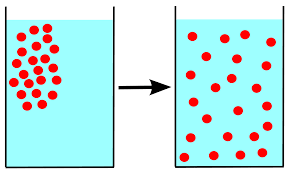
The picture below is an example of _________________.
a)
osmosis
b)
isotonic
c)
diffusion
d)
active transport
82.
Osmosis is the movement of _____ across a membrane.
a)
food
b)
energy
c)
oxygen
d)
water
83.
During osmosis
a)
water moves from high to low concentration
b)
large or oddly shaped molecules move across a cell membrane
c)
water moves when energy is used
d)
proteins are built
84.
When both inside and outside of a cell have the same amount of water it is said that the cell has reached a state of
a)
Osmosis
b)
Diffusion
c)
Equilibrium
85.
A person should never drink salty water because their cells would
a)
shrink
b)
expand
86.
If there is 5 percent water inside a cell and 5 percent water outside a cell
a)
more water will move inside the cell
b)
more water will move outside the cell
c)
There will be no movement of water cells
87.
Passive transport requires no
a)
concentration gradients
b)
osmosis
c)
motion
d)
energy
88.
The type of cellular transport that requires no energy.
a)
Active Transport
b)
Protein Pumps
c)
Passive Transport
d)
Endocytosis
89.
What condition occurs when too much water moves into the cell and the cell membrane bursts?
a)
Plasmolysis
b)
Exocytosis
c)
Endocytosis
d)
Cytolysis
90.
Which of the following modes of cellular transport does NOT require energy?
a)
Facilitated Diffusion
b)
Protein Pumps
c)
Endocytosis
d)
Exocytosis
91.
The process of engulfing food or liquid particles into the cell.
a)
Osmosis
b)
Exocytosis
c)
Endocytosis
d)
Diffusion
92.
Which type of cellular transport moves molecules from low concentrations to high concentrations?
a)
Osmosis
b)
Diffusion
c)
Passive Transport
d)
Protein Pumps
93.
The release of large particles, often waste materials from the inside of the cell to the outside of the cell.
a)
Osmosis
b)
Exocytosis
c)
Endocytosis
d)
Diffusion
94.
Condition that occurs if too much water leaves the cell and cell collapses.
a)
Plasmolysis
b)
Osmosis
c)
Cytolysis
d)
Exocytosis
95.
What type of transport involves the movement of water from high to low concentrations?
a)
Diffusion
b)
Active Transport
c)
Facilitated Diffusion
d)
Osmosis
96.
What happens to a plant cell that is placed into a hypotonic solution?
a)
It shrinks
b)
Plasmolysis
c)
It swells
d)
Cytolysis
97.
A cell with a 5% salt solution is placed into a beaker with a 10% salt solution.  This solution is considered to be _____ to the cell.
a)
Isotonic
b)
Hypertonic
c)
Hypotonic
d)
None of the Above
98.
A cell with a 5% salt solution is placed into a beaker with a 10% salt solution.  What will happen to the cell?
a)
It will shrink
b)
It will swell
c)
No change
d)
Cytolysis
99.
A plant cell with a 20% salt solution is placed into a beaker with a 10% salt solution.  What will happen to the plant cell?
a)
Cytolysis
b)
Plasmolysis
c)
It will shrink
d)
It will swell
100.

The smallest unit of a cell membrane that forms a bi-layer along with embedded proteins.

a)

phospholipids

b)

carbohydrate chains

c)

amino acids

d)

phosphates groups

101.

What would happen to an animal cell placed into pure water?

a)

It would shrink

b)

Cytolysis

c)

Plasmolysis

d)

It would not change shape

102.

Its function is to generate energy for cell operations and it take part in cellular respiration.

a)

The smoot and rough endoplasmic reticulum

b)

Mitochondria

c)

Cytoplasm

103.

Its function is to store water, nutrients or substances that it processes or needs. This organelle takes up 90% of the space in the cell.

a)

Nucleous

b)

Nucleolus

c)

Vacuoles

104.
Plant cell structures that turn energy from sunlight into food.
a)
Cell Wall
b)
Mitochondria
c)
Chloroplast
d)
Cytoplasm
105.

Additional layer around the outside of plant cells that protect and give shape

a)

Cell Wall

b)

Chloroplast

c)

Cell Membrane

d)

Golgi Complex

106.
Control center of the cell (like a brain)
a)
Nucleus
b)
Nucleolus
c)
Cytoplasm
d)
Endoplasmic Reticulum
107.
Transport system within the cell
a)
Endoplasmic Reticulum
b)
Nucleolus
c)
Cytoplasm
d)
Vacuole
108.
Supports the cell, allows cell parts to move
a)
Cytoplasm
b)
Nucleolus
c)
Chloroplast
d)
Mitochondria
109.
Controls cell reproduction and makes ribosomes
a)
Nucleolus
b)
Nucleus
c)
Golgi Complex (body)
d)
Chloroplast
110.

They are unique structures found in plant cells that specialize in converting sunlight into energy that plants can use. This process is called photosynthesis.

a)

Lysosomes

b)

Mitochondria

c)

Chloroplasts

111.

Its function is to store substances that make ribosomes.

a)

The smooth endoplasmic reticulum

b)

Golgi Body or Complex

c)

The rough endoplasmic reticulum

112.
What is the tube-like network that enables cell to transport material where it is needed?
a)
endoplasmic reticulum (ER)
b)
vacuole
c)
organelle
d)
nucleus
113.
This organelle makes the lipids that make the cell membrane
a)
Smooth ER
b)
Cell Wall
c)
Vacuole
d)
Mitochondria
114.

The _____________ holds the DNA, and controls the functions of eukaryotic cells.

a)

Nucleus

b)

Nuclear Membrane

c)

Mitochondria

d)

Chloroplast

115.

Organelles made of protein and RNA that direct protein synthesis in the cytoplasm

a)

Ribosome

b)

Mitonchondrion

c)

Endoplasmic Reticulum

d)

Golgi Apparatus

116.

Hollow tubes that are made of a protein that feeds cellulous and lignin to the cell wall

a)

Lysosome

b)

Cytoskeleton

c)

Microtubule

d)

Microfilament

117.

Organelles that are surrounded by a double membrane and contain their own DNA. There are several types of this organelle

a)

Centriole

b)

Cell Wall

c)

Central Vacuole

d)

Plastid

118.

Green pigment found in plants

a)

Chloroplast

b)

Thylakoid

c)

Chlorophyll

d)

Plastid

119.

Flattened membranous sacs that contain green pigment (chlorophyll)

a)

Chloroplast

b)

Thylakoid

c)

Chlorophyll

d)

Plastid

120.

Involved in the modification of carbohydrates attached to proteins synthesized and packaged in the er

a)

Plasma membrane

b)

Chloroplasts

c)

Dictysomes

121.

Different layers of cell wall are_____________

a)

Middle lamella and primary wall

b)

Middle lamella, Primary wall and secondary wall

c)

Primary wall and secondary wall

d)

Wall layers exclude middle lamella