wayground logo

Free Printable Worksheets

Font size

S
M
L
XL
Worksheets

AQUATIC ECOLOGY

Total questions: 120

Worksheet time: 2hrs 14mins

Name
Class
Date
1.

What is the chemical formula for water?

a)

HO

b)

2HO

c)

H2O

d)

HO2

2.

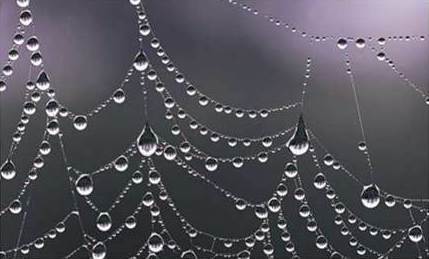
Refer to the picture; the water is sticking to the spider web because of:

a)

Adhesion

b)

Cohesion

3.

Describe COHESION.

a)

Water molecules attracted to other substances.

b)

Water molecules climbing upwards against the force of gravity.

c)

Water molecules dissolving many substances because of its polarity.

d)

Water molecules attracted to other water molecules.

4.

Describe ADHESION.

a)

Water molecules attracted to other substances.

b)

Water molecules climbing upwards against the force of gravity.

c)

Water molecules dissolving many substances because of its polarity.

d)

Water molecules attracted to other water molecules.

5.
What two elements make up water?
a)
Helium and oxygen
b)
Hydrogen and oxygen
c)
helium and carbon
d)
oxygen and carbon
6.

Attractions between water molecules are called

a)

Covalent bonds

b)

Ionic bonds

c)

Polar bonds

d)

Hydrogen bonds

7.

Why does ice float?

a)

As water freezes, the molecules move farther apart and its density decreases.

b)

As water freezes, it takes up more hydrogen from the atmosphere

c)

As water freezes, air becomes trapped between the water molecules.

d)

As water freezes, it takes up more oxygen from the atmosphere

8.
True or false water is a polar molecule? 
a)
True 
b)
False 
9.

Which end of the water molecule has a slightly positive charge?

a)

the oxygen end

b)

the hydrogen end

c)

both ends are slightly positive

d)

neither end is positive

10.

Which term refers to water having a slightly positive and a slighty negative charge on its ends?

a)

cohesion

b)

surface tension

c)

polar

d)

adhesion

11.

Why does water moderate temperature so well?

a)

It does not allow heat in between the hydrogen bonds.

b)

More energy is needed to break all the hydrogen bonds, or rebuild them, between water molecules.

c)

Water has high energy all the time, so it can't heat up any more.

d)

The polarity of the water molecule resists the added energy, causing water to stay the same temperature.
12.

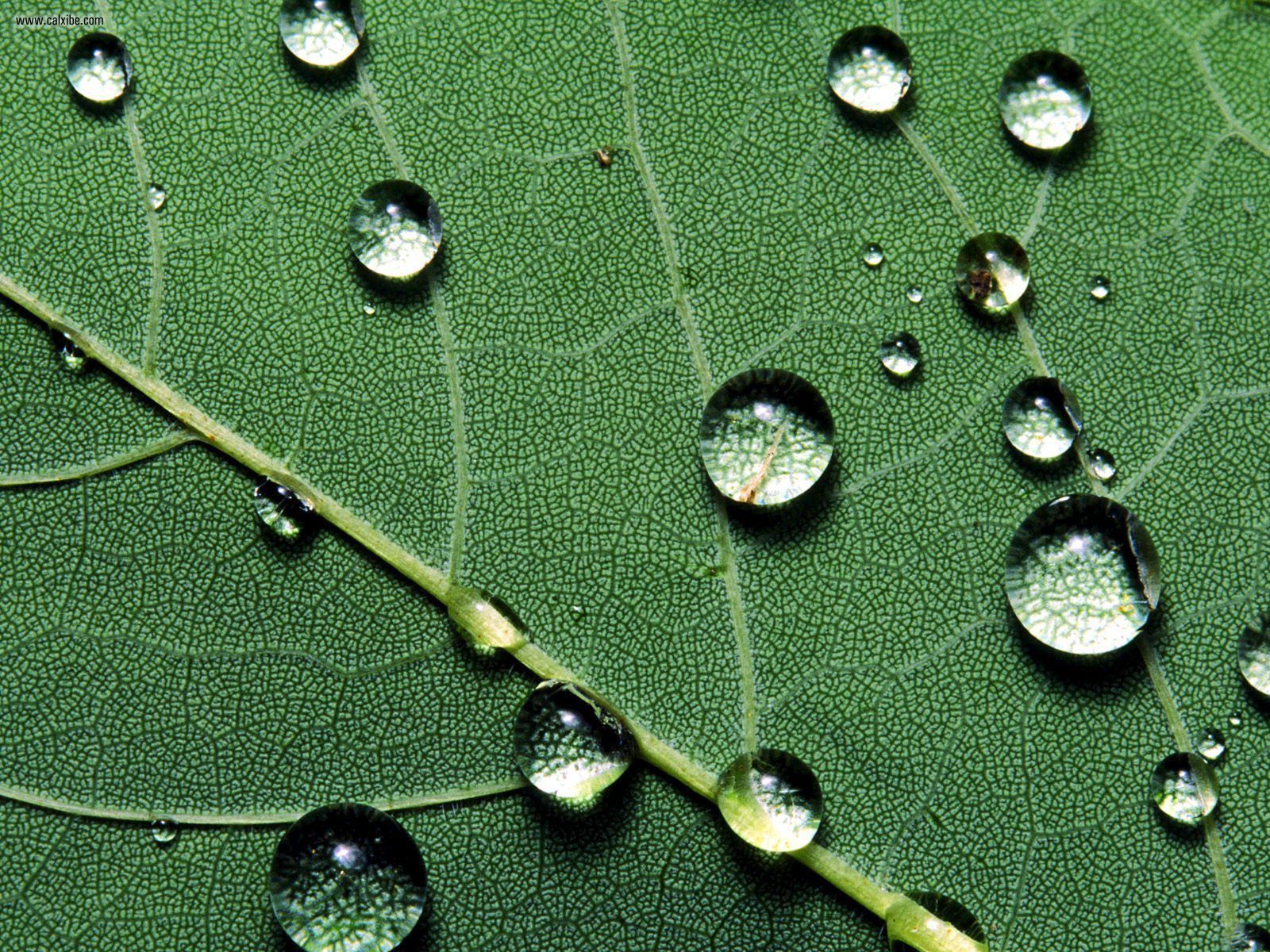
Refer to the picture; the water droplets are sticking to the leaf because of:

a)

Adhesion

b)

Cohesion

13.

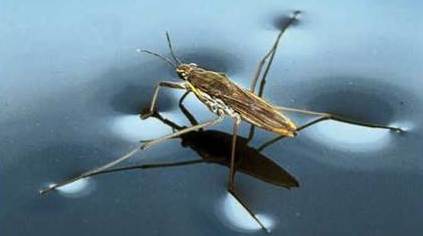
Refer to the picture; the insect is not falling through the water because of:

a)

Adhesion

b)

Cohesion

14.

Which end of the water molecule has a slightly negative charge?

a)

the oxygen end

b)

the hydrogen end

c)

both ends are slightly negative

d)

neither end is negative

15.
Surface tension is caused by ...
a)
strong cohesion between water molecules
b)
strong adhesion between the water molecules
c)
condensation
d)
water cycle
16.
Water droplets take a spherical shape (as pictured) because of ____________
a)
adhesion
b)
cohesion
c)
capillary action
d)
solubility
17.
tendency of molecules of the same kind to stick to one another
a)
cohesion
b)
adhesion
c)
solution
d)
polar molecule
18.
What is adhesion?
a)
Water's ability to stick to itself
b)
Water's ability to stick to other substances
c)
The strength of the cohesion of all the water molecules combined
d)
Tape, glue and other adhesives
19.
When a drop of water was placed between two glass slides, the slides stuck together and were difficult to separate.  Which term applies?
a)
cohesion
b)
adhesion
c)
capillary action
d)
surface tension
20.
What is A?
a)
Evaporation
b)
Condensation
c)
Precipitation
d)
Runoff
21.
What is B?
a)
Evaporation
b)
Condensation
c)
Precipitation
d)
Runoff
22.
What is C?
a)
Evaporation
b)
Condensation
c)
Precipitation
d)
Runoff
23.
The supply of freshwater under the Earth's surface.
a)
watershed
b)
mouth
c)
headwaters
d)
groundwater
24.
Where is most of the freshwater found on Earth?
a)
lakes
b)
glaciers
c)
oceans
d)
rivers
25.
Approximately what percentage of the water on Earth is freshwater?
a)
0.1%
b)
2.6%
c)
50%
d)
97%
26.
The change of water from a liquid to a gas.
a)
evaporation
b)
precipitation
c)
condensation
d)
transpiration
27.
Any type of moisture that falls to the Earth.
a)
evaporation
b)
precipitation
c)
condensation
d)
transpiration
28.
The release of moisture by living plants.
a)
evaporation
b)
precipitation
c)
condensation
d)
transpiration
29.
Approximately what percentage of Earth's water is SALT water?
a)
97 %
b)
71%
c)
30%
d)
3%
30.
Why do wetlands have a rich supply of nutrients? 
a)
Dead leaves & other plant and animal materials serve as natural fertilizers. They add nitrogen, phosphates, and other nutrients to the water and soil.
b)
The area round the swamp leads to the land and  area developments such as new houses.  
c)
The larger citites in the area produce many large amounts of trees and grasses that give nutrients to the swamp 
31.
What are the three common types of freshwater wetlands? 
a)
forest, swamp and marsh 
b)
bog swamp and forest
c)
marshes, swamps, and bogs
d)
tundra, boreal, grassland 
32.
Why are wetlands important to people?
a)
Wetlands are a critical part of our natural environment.
b)
They provide habitat for animals and plants and many contain a wide diversity of life, supporting plants and animals that are found nowhere else.
c)
Why are wetlands important to people?Wetlands act as natural water filters. They also help control floods by absorbing excess water after heavy rains. Wetlands are like giant sponges!
33.
How has agriculture affected the Everglades?
a)
Farming has caused more animals of one species to reproduce.
b)
farmers spraying chemicals on crops destroyed the Everglades
c)
It has not affected the Everglades. 
d)
Farming has produced more food for the area. 
34.
Why are coastal Wetlands unique?
a)
They contain BOTH fresh & salt water. For example, salt marshes & mangrove forests.
b)
About 40 percent of the wetlands in the lower 48 states are coastal wetlands and approximately 81 percent of coastal 
c)
Wetlands protect water supplies and provide habitat for fish and wildlife, including commercially important fish species.
d)
Each of these habitat types supports unique array of plant and animal species. Development of habitat in coastal wetlands depends on a variety of factors
35.
The changes to water when it cycles on the Earth-
a)
the moon cycle
b)
the sun cycle
c)
the hydrological cycle
36.
Most of the Earth's water is found---
a)
underground in aquifers.
b)
in rivers and lakes.
c)
in the oceans.
37.
The sun drives the water cycle by---
a)
heating the ocean.
b)
rotating on its axis.
c)
giving light to plants.
38.
What is the constant movement of water above and below the earth’s surface?
a)
water vapor
b)
water cycle
c)
water way
39.

Also known as "rainforest of the sea".

a)

Mangroves

b)

Marshes

c)

Wetlands

d)

Coral Reefs

40.

A type of wetland characterized by deep accumulation of incompletely decomposed organic matter.

a)

Swamps

b)

Salt marsh

c)

Peatland

d)

Floodplain

41.

Wetlands may be naturally occurring or constructed by man.

a)

TRUE

b)

FALSE

42.

WHAT ARE THE BENEFITS OF A WETLAND?

a)

THEY ENHANCE DISEASES AND TAKE UP LAND

b)

IMPROVED WATER QUALITY, FLOOD AND EROSION CONTROL, AND HABITAT ENHANCEMENT

c)

PROVIDE DRINKING WATER AND HEALTH BENEFITS

d)

THEY LOOK PRETTY

43.

HOW MANY STATES HAVE LOST OVER HALF OF THEIR WETLANDS SINCE THE 1970S?

a)

9

b)

17

c)

31

d)

22

44.

WHAT TYPES OF WATER ARE FOUND IN WETLANDS? (MORE THAN ONE CORRECT ANSWER)

a)

MINERAL WATER

b)

FRESHWATER

c)

SALTWATER

d)

SOFT WATER

45.

WHAT MAKES WETLANDS BIOLOGICALLY DIVERSE?

a)

PLANTS

b)

ANIMALS

c)

INSECTS

d)

LOCATION

e)

ALL OF THE ABOVE

46.

WETLANDS ARE PROTECTED BY THE LAW IN ALL STATES (TRUE OR FALSE)

a)

TRUE

b)

TRUE

47.

What best describes a Bog?

a)

it has Tamarack trees and many wildflowers

b)

it is where peat builds up and it is acidic

c)

it is manmade and a large hole in the ground

d)

it covers 6 percent of the earth surface

48.

_____________are wetlands where the most common types of plants are trees and shrubs.

a)

bogs

b)

swamps

c)

marshes

d)

lakes

49.

A _______________is a type of wetland that doesn’t have many trees or shrubs.

a)

bog

b)

swamp

c)

marsh

d)

ocean

50.

A type of wetland characterized by deep accumulation of incompletely decomposed organic matter.

a)

Swamps

b)

Salt marsh

c)

Peatland

d)

Floodplain

51.
Which type of wetland is best described as, "The plants growing here are grasses, reeds, sedges, and some shrubs."
a)
bogs
b)
fens
c)
swamps
d)
marsh
52.
Which type of wetland would be best described as "usually characterized by the growth of woody plants such as cypress and tupelo trees. "​ 
a)
bogs
b)
fens
c)
swamp
d)
marsh
53.

Wetlands store flood waters. How is this beneficial? Choose the best answer.

a)

Its not really beneficial because this may flood peoples homes.

b)

It releases the water is increments which will really increase the wildlife in that area.

c)

It releases the water in increments ( a little at a time) which slows the water down thus slowing erosion.

d)

Its really not beneficial because this will flood the habitats of the wildlife living there.

54.
Approximately what percentage of Earth’s water is fresh water?
a)
97%
b)
30%
c)
71%
d)
3%
55.
Water stored  in cracks and pores below the Earth's surface is called:
a)
Groundwater
b)
Bogs
c)
Water in the ground
d)
surface water
56.

A rock layer that allows groundwater to flow through it and collect?

(a)  

57.

Peatlands store ...... as much carbon as all the world’s forests combined.

a)

Three times

b)

Twice

c)

Just

d)

1%

58.

Wetland plants are called?

a)

Bryophytes

b)

Perennials

c)

Epiphytes

d)

Hydrophytes

59.

The region in North Dakota where most of the state's wetlands are found?

a)

The Badlands

b)

The Turtle Mountains

c)

The Prairie Pothole Region

d)

Red River Valley

60.

Where are wetlands found?

a)

Only in North Dakota

b)

Only next to the ocean

c)

On every continent on Earth

d)

In farm fields

61.

What is a wetland?

a)

An area devoid of life

b)

A mountain peak

c)

A corn field

d)

A low lying area that collects and holds water either permanently or seasonally

62.

What are the 3 elements that scientists use to identify wetlands?

a)

Water, plants, soil

b)

Water, wildlife, air temperature

c)

Water, water clarity, shoreline shape

d)

Water, if fish are present, smell

63.

Wetlands help replenish aquifers and groundwater supplies.

a)

True

b)

False

64.

Described as the wise use which determines that human exploitation is an essential aspect of wetlands but that pattern of development should protect the natural character of ecosystem

a)

Ramsar Convention

b)

Wetland Policy

c)

Stockholm Conference

65.

______________ is an essential for all living processes.

a)

Hydrogen

b)

Water

c)

Forests

66.
bottom of a pond or lake
a)
littoral zone
b)
benthic zone
c)
limnetic zone
67.
The Coriolis Effect is caused by
a)
Earth rotating around the sun
b)
Earth rotating on its axis
c)
The tides
d)
Gravity
68.
Temperature affects this greatly
a)
color
b)
density
c)
chlorine
d)
thermocline
69.
About how much of the Earth's surface is covered with water?
a)

29%

b)
92%
c)

71%

d)

50%

70.
The supply of freshwater under the Earth's surface.
a)
watershed
b)
mouth
c)
headwaters
d)
groundwater
71.
Which source of freshwater is not easily available for human use?
a)
oceans
b)
freshwater lakes
c)
rivers
d)
icecaps/glaciers
72.
Which of the following statements is true?
a)
Pressure and temperature both decrease with depth
b)
Temperature and pressure both increase with depth
c)
Temperature decreases and pressure increases with depth
d)
Temperature increases and pressure decreases with depth
73.
What is diffusion?
a)
when molecules move 
b)
when molecules move from a high concentration to a low.
c)
no movement 
d)
molecules move everywhere
74.

Solar radiation power per unit area is called…

a)

Insolarion or irradiation

b)

irradiance

c)

Sun power

d)

radiation

75.

What is a riparian zone?

a)

the animals that live along a waterway

b)

a place where snakes live

c)

the vegetation that grows along a waterway

d)

the submerged vegetation in a swamp

76.

How is a wetland different from a lake?

a)

wetlands can be periodically dry, lakes are always wet

b)

they have different animals

c)

lakes don't have vegetation growing along the edges and wetlands do

d)

lakes don't have currents in them and wetlands do

77.
What is the area underground where there is not any water?
a)
Zone of Saturation
b)
Zone of Aeration
c)
Water
78.
The name of the area that is the upper level of the zone of saturation:
a)
Zone of Saturation
b)
Zone of Aeration
c)
Water Table
79.
Water stored below the Earth's surface is called:
a)
Groundwater
b)
Bogs
c)
Water in the ground
80.
When water soaks the ground it becomes groundwater through what process?
a)
Runoff
b)
Infiltration
c)
Transpiration
81.
The amount of space between soil is:
a)
Porosity
b)
Permeability
82.
The ability of a liquid to flow through a substance is:
a)
Porosity
b)
Permeability
83.
A substance has a low permeability when:
a)
Water can flow through easily
b)
Water CAN'T Flow through easily
84.
What is an underground layer of rock or soil filled with water called?
a)
Aquifer
b)
Spring
c)
Well
d)
Reservoir
85.
What do we call the land area that supplies water to a river system?
a)
runoff
b)
recharge
c)
watershed
d)
valley
86.
An aquifer is a(n)
a)
well in which water rises because of pressure
b)
underground layer of rock or sediment that holds water
c)
type of hot spring from which the water periodically erupts
d)
place where groundwater bubbles or flows out of cracks in the rock
87.
Which types of aquifers are in the most danger of becoming contaminated by pollutants?
a)
aquifers confined by a permeable layer
b)
unconfined aquifers
88.
What is it called when plants give off water vapor as a waste product?
a)
condensation
b)
evaporation
c)
sublimation
d)
transpiration
89.
The build up of nutrients in a lake is a process called ________________.
a)
eutrophication
b)
volcanic eruption
c)
algae buildup
d)
pond death
90.
What is a chracteristic of karst topography
a)
sinking streams
b)
sinkholes
c)
caves
d)
all of the above
91.
Aquifers
a)
are like underground sponges
b)
can hold very large amounts of water
c)
take a long time to recharge
d)
all of these are correct
92.
Land subsidence and sinkholes are caused by
a)
acid rain
b)
aquifer depletion
c)
too much soil irrigation
d)
diverting surface waters
93.
The Benthic Zone is known as the 
a)
bottom area
b)
shallows
94.
Oligiotrophic lakes are
a)
nutrient rich
b)
nutrient poor
c)
in between
95.
Eutrophic lakes are
a)
nutrient rich
b)
nutrient poor
c)
in between 
96.
Mesotrophic lakes are
a)
nutrient rich
b)
in between
c)
nutrient poor
97.
An Estuary is where 
a)
fresh water meets ponds
b)
fresh water meets lakes
c)
fresh water meets streams
d)
fresh water meets salt water
98.
Which lake has high productivity?
a)
Eutrophic
b)
Mesotrophic
c)
Oligotrophic
99.
What is a reservoir?
a)
Natural or man-made lake
b)
A place to dump pollutants
100.
A water molecule is a ________ molecule, which has one oxygen that has a __________ charge and two hydrogens that have a ___________ charge.
a)
nonpolar, positive, negative
b)
polar, positive, negative
c)
polar, negative, positive
d)
nonpolar, negative, positive
101.
Which property of water will cause water to bead up on glass?
a)
Adhesion
b)
Cohesion
c)
Ability to dissolve substances
d)
High specific heat
102.

Water is special. Here's why:

a)

It is formed from ionic bonds

b)

It is a polar solvent

c)

It takes very little energy to change between states

d)

Hydrogen bonds encourage surface tension

103.

The solubility of oxygen in water (a)   when the temperature of that water increases.

104.

Adhesion is :

a)

Attraction force between 2 same substances

b)

Attraction force between different substances

105.

Water is a universal solvent because :

a)

Many substance dissolve in it

b)

Substances can’t dissolve in it

106.

What property of water helps in regulating temperature in the environment?

a)

High heat capacity

b)

High heat of vaporization

c)

Cohesive and adhesive properties

d)

Less density as a solid

107.

What is responsible for the surface tension of water?

a)

Adhesive forces

b)

Cohesive forces

c)

Gravity

d)

Temperature

108.

Why does ice float on water?

a)

Ice is denser than liquid water

b)

Ice is less dense than liquid water

c)

Ice has the same density as liquid water

d)

Ice is not affected by density

109.

What property of water allows nutrients to be transported against gravity in plants?

a)

High heat capacity

b)

High heat of vaporization

c)

Cohesive and adhesive properties

d)

Less density as a solid

110.

What property of water allows it to resist rupture when placed under tension or stress?

a)

Adhesion

b)

Cohesion

c)

Evaporation

d)

Condensation

111.
______________ are bottom-dwelling organisms of the ocean, often attached to hard surfaces.
a)
Benthos
b)
Nekton
c)
Plankton
d)
Decomposers
112.
This is the study of biotic and abiotic features of fresh water, especially lakes, ponds, and streams.
a)
Oceanography
b)
Limnology
c)
Geology
d)
Meteorology
113.
When a lake fills with Nitrogen and Phosphorus this process occurs.
a)
Photosynthesis
b)
Digestion
c)
Decomposition
d)
Eutrophication
114.
Which of these ocean zones receives the most sunlight?
a)
Midnight
b)
Pelagic
c)
Photic
d)
Benthic
115.

As water temperature increases, water density

a)

Increases

b)

Decreases

116.

This Friar is credited with creating a vital piece of limnological field equipment with his name attached to it

a)

Secchi

b)

Sonde

c)

Hutchinson

d)

Foure

117.
If a liquid has high viscosity, it probably has:
a)
strong resistance to flow
b)
weak resistance to flow
118.

Which of these factors affects Viscosity?

a)

Temperature

b)

Colour

c)

Taste

119.

What is fluid flow?

a)

Describes how fluids behave when frozen.

b)

Describes how fluids behave when heated.

c)

Describes how fluids behave in their surrounding environment.
120.

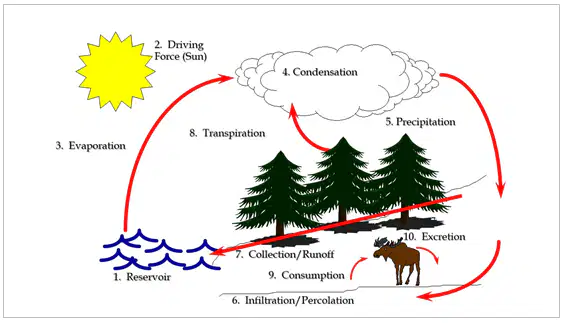
What cycle is represented here?

a)

Carbon cycle

b)

Nitrogen cycle

c)

Hydrologic cycle

d)

Phosphorus cycle