wayground logo

Free Printable Worksheets

NEW

Font size

S
M
L
XL
Worksheets

ALL waves unit

Total questions: 34

Worksheet time: 51mins

Name
Class
Date
1.

Radio Waves are an example of _________ waves.

a)

mechanical

b)

electromagnetic

c)

longitudinal

d)

high frequency

2.

The distance in between two waves.

a)

wave speed

b)

frequency

c)

wavelength

d)

amplitude

3.

Frequency is always measured in _________

a)

kilometers

b)

Hertz

c)

centimeters

d)

joules

4.

You're in your room blasting music with the door shut, your mom opens your door. Now your music is heard throughout your home. This is an example of _______

a)

interference

b)

diffraction

c)

reflection

d)

refraction

5.

When two waves overlap each other, this behavior is known as _______.

a)

interference

b)

refraction

c)

frequency

d)

diffraction

6.

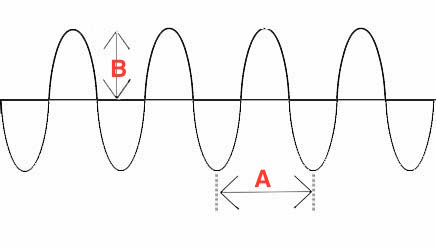
Look at this wave. "A" is which part of a wave?

a)

Crest

b)

Trough

c)

Resting Point

d)

Wavelength

7.

Which correctly describes frequency and wavelength?

a)

top wave has high frequency and long wavelength

b)

top wave has high frequency and short wavelength

c)

Bottom wave has a short wavelength and a high frequency

d)

Bottom wave has a short wavelength and a low frequency

8.
A wave carries...?
a)
energy only
b)
matter only
c)
the matter carries the energy
d)

energy and matter

9.
The action of a wave bouncing off a surface is called __________________.
a)
rarefaction
b)
refraction
c)
reflection
d)
diffraction
10.
What property of this wave is represented by the letter "A"
a)
amplitude
b)
crest
c)
trough
d)
wavelength
11.
When the frequency of a wave increases, what happens to the wavelength?
a)
The wavelength is not directly affected by the frequency of a wave.
b)
The wavelength increases.
c)
The wavelength decreases.
d)
More specific information is needed to form a conclusion about the wavelength.
12.
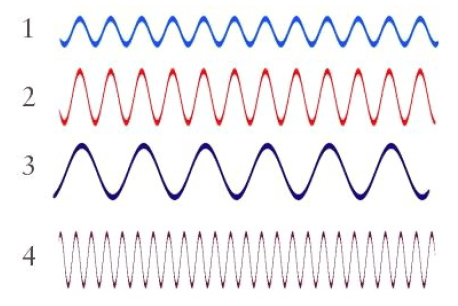
Which wave in the diagram has the greatest frequency?
a)
1
b)
2
c)
3
d)
4
13.
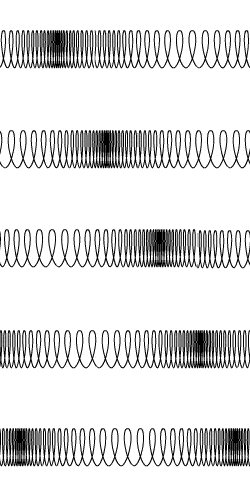
What type of wave is this?
a)
Longitudinal
b)
Transverse
c)

electromagnetic

d)

Mechanical

14.
Which part of a longitudinal wave is where particles are packed closely together?
a)
compression
b)
rarefaction
c)
crest 
d)
amplitude
15.
Which of the figures represents reflection?
a)
A
b)
B
c)
C
d)
D
16.
Refraction occurs when _____________
a)
the wave's speed changes by entering a new medium
b)
a wave bounces off of a boundary
c)
waves parts meet each other
d)
waves bend around a barrier
17.
a)
Constructive Interference
b)
Destructive Interference
c)
Refraction
d)
Diffraction
18.
What type of wave behavior is pictured above?
a)
Refraction
b)
Reflection
c)
Absorption
d)
Diffraction
19.
A leaf is green, what does this tell you about the light that is being absorbed?
a)
no light is being absorbed
b)
green is being refracted and all the colors are being absorbed.
c)
green is being absorbed and all the other colors are reflected
d)
green is being reflected and all the other colors are being absorbed
20.

Which statement is true about visible light?

a)

Humans cannot see any light from the electromagnetic spectrum.

b)

Visible light makes up a small part of the electromagnetic spectrum.

c)

Visible light has a frequency equal to that of gamma rays.

d)

Humans can see visible light only as white light.

21.
Which color absorbs all light?
a)
White
b)
Black
c)
Orange
d)
Green
22.

When light waves move from passing through air to passing through a glass lens when happens to them?

a)

They slow down and change direction

b)

They speed up and change direction

c)

They maintain the same speed and change direction

d)

They maintain their same speed and direction

23.
What medium does sound travel through slowest?
a)
gas
b)
solid
c)
liquid
d)
trees
24.
If a sound has a high amplitude then it also has a ____________!!!
a)
fast echo
b)
slow pitch
c)
high volume
d)
low volume
25.

Which of the following sound wave produces the highest pitch of sound?

a)
b)
c)
d)
26.
High frequency waves have _________ wavelength.
a)
varying
b)
high
c)
the same
d)
low
27.
A mechanical wave cannot travel through...
a)

a vacuum.

b)
water.
c)
air. 
d)
glass.
28.

Sound travels ________________.

a)
faster in gases than in solids.
b)
faster in solids than in gases.
c)

faster in liquids than in solids.

d)

faster in vacuums than in solids.

29.

How do we know that light does not need a medium in which to travel?

a)

I can see light from the bulb in the ceiling.

b)

I can see light that travels through outer space from the sun.

c)

When I hold up a piece of paper to a lit flashlight, I can still see the light.

d)

When I look into a pond, it looks like fish are closer to me than they really are.

30.
A wave in which the particles of the medium move perpendicularly to the direction the wave is traveling
a)
A. surface wave
b)
B. transverse wave
c)
C. electromagnetic  wave
d)
D. longitudinal wave
31.
Which of these waves cannot travel in a vacuum?
a)
light wave
b)
sound wave
c)
electromagnetic wave
d)
microwave
32.

An ambulance is driving towards you as you stand on the sidewalk. What happens to the pitch of the siren as it comes towards you?

a)

It increases

b)

It decreases

33.

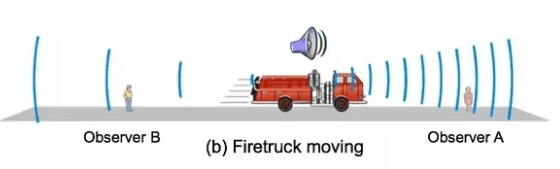
Look at the picture. Who is experiencing a higher pitched sound?

a)

Observer A

b)

Observer B

c)

There's no difference

34.

You are the observer looking at the jet. As the Jet takes off, what is happening to the wavelength of sound and the pitch of the sound?

a)

Longer wavelength and getting less loud

b)

Longer wavelength and getting louder

c)

Shorter wavelength and getting less loud

d)

Longer wavelength and getting louder