Wayground logo

Free Printable Worksheets

Font size

S
M
L
XL
Worksheets

Biology 3rd Review

Total questions: 49

Worksheet time: 1hrs 2mins

Name
Class
Date
1.

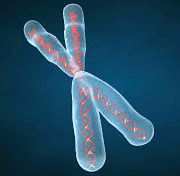
The n of human chromosomes is

a)
11
b)
12
c)
23
d)
46
2.

The 2n number of human chromosomes is

a)
23
b)
46
c)
92
3.

CROSSING OVER INCREASES

a)

LIFE SPAN

b)

GENETIC VARIATION

c)

THE NUMBER OF OFF-SPRING

d)

ALL ARE TRUE

4.

MEIOSIS

a)

REDUCES THE NUMBER OF CHROMOSOMES BY ONE HALF

b)

PRODUCES UNIQUE SEX CELLS-1N

c)

ALLOWS TRAITS TO BE PASSED TO OFFSPRING

d)

ALL ARE TRUE

e)

INCREASE GENETIC VARIATION

5.
Homozygous is when...
a)
the alleles are the same
b)
the alleles are different
c)
the alleles are absent
d)
the alleles are present
6.
Heterozygous is when...
a)
the alleles are the same
b)
the alleles are different
c)
the alleles are absent
d)
the alleles are present
7.
B = brown fur  b = white fur
In the punnett square, what is the probability for white fur? 
a)
0%
b)
25%
c)
50%
d)
75%
8.
Two brown eyed parents (Bb) have a baby. What is the chance the baby is blue eyed?
a)
0 %
b)
25%
c)
50%
d)
75%
9.

MEIOSIS PRODUCES 4 CELLS-THE CHROMOSOME NUMBER IS ...

a)

DIPLOID

b)

HAPLOID

10.

MEIOSIS PRODUCES 4 CELLS, THEY ARE

a)

N

b)

2N

c)

3N

11.
The different forms of a gene
a)
heredity
b)
genetics
c)
gene
d)
alleles
12.
If a father is AA and a mother is AB, what is the probability for a child with AB blood? 
a)
0%
b)
25%
c)
50%
d)
75%
13.
If two parents have type AB blood, what is the probability that their child will have type O blood?
a)
0%
b)
25%
c)
50%
d)
100%
14.
A heterozygous long-tusked elephant is crossed with a homozygous recessive short-tusked elephant. What is the probability of the offspring having short tusks?
a)
0%
b)
25%
c)
50%
d)
75%
15.
In mice, the homozygous mice are black and white. The heterozygous mice are gray. What pattern of inheritance is expressed in fur color in mice?
a)
complete dominance and recessiveness
b)
co-dominance
c)
incomplete dominance
d)
pleiotropy
16.
If this image were real, it would represent what type of inheritance?
a)
incomplete dominance
b)
codominance
c)
polygenic inheritance
d)
compete dominance
17.

Which of the following best illustrates natural selection?

a)

An organism with favorable genetic variations will tend to survive and breed successfully.

b)

A population monopolizes all of the resources in its habitat, forcing other species to migrate.

c)

A community whose members work together utilizing all existing resources and migratory routes.

d)

The largest organisms in a species receive the only breeding opportunities.

18.

Why are advantageous traits more likely to be passed onto offspring?

a)

Because they are more likely to survive and reproduce.

b)

Because they come from dominant alleles.

c)

Because they come from recessive alleles.

d)

Because the organism knew it needed that trait, survives, and passes it on.

19.

Mutations are a change in what?

a)

DNA

b)

tRNA

c)

protein

d)

rRNA

20.
The differences among a species, like different bird beaks, are called
a)
genes.
b)
variations.
c)
traits.
d)
theories.
21.
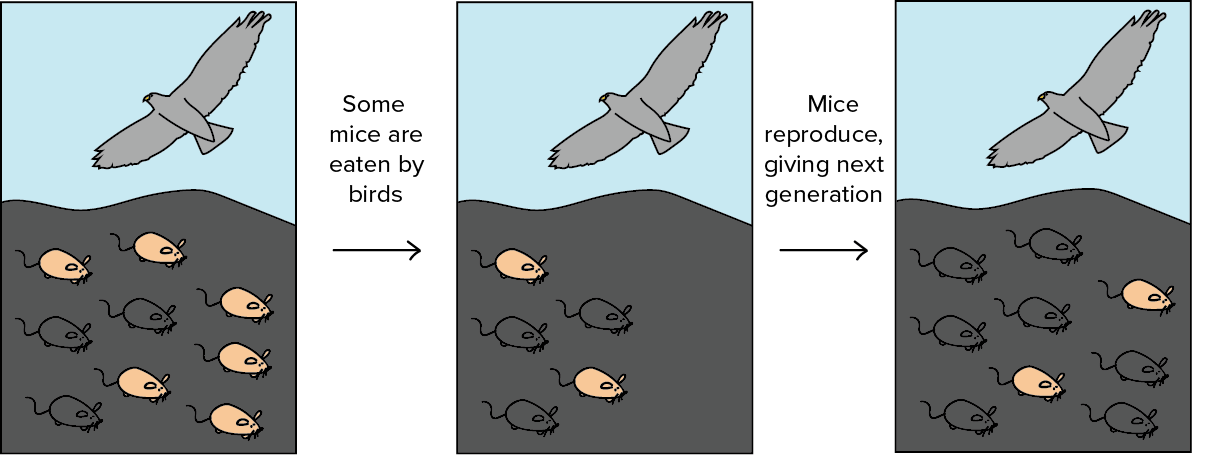
Why is the mouse population changing over time?
a)
The light mice can reproduce more successfully than the dark mice
b)
The hawks eat more dark mice than light mice because the dark mice taste better
c)
The hawks eat more light mice than dark mice because they can see the light mice more easily
d)
The hawks eat more dark mice than light mice because they can see the dark mice more easily
22.

Where do adaptations come from?

a)

The individual organism decides to adapt

b)

Mutations that give an organism an advantage in its environment

c)

Genetic recombination during meiosis

d)

Both mutations and genetic recombination are sources of adaptation

23.

"Organisms that are better adapted to the environment survive to pass traits to their offspring" is the definition of

a)

Natural Selection

b)

Evolution

c)

Selective Breeding

d)

Artificial Selection

24.

The variety of genes and alleles that exist in organisms

a)

independent assortment

b)

chromosomal abnormalities

c)

genetic diversity

d)

mutations

25.

This law describes how each member of a homologous pair is pulled randomly to one side or another in anaphase I

a)

Law of Segregation

b)

Law of Independent Assortment

c)

Law of Gravity

d)

Law of Mathematical Order

26.

This law describes how each homologous pair separates independently of any other pairs during Anaphase I of meiosis

a)

Law of Segregation

b)

Law of Independent Assortment

c)

Law of Gravity

d)

Law of Mathematical Order

27.
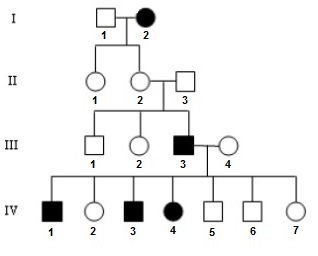
This pedigree represents the inheritance of hemophilia in this family. How many of the females have the hemophilia trait?
a)
8
b)
5
c)
2
d)
3
28.
What do half colored symbols represent?
a)
The individual is a carrier (heterozygous).
b)
The individual expresses the trait.
c)
The individual has both recessive alleles.
d)
The individual has both dominant alleles.
29.
Is this trait (the shaded individuals) dominant or recessive?
a)
dominant
b)
recessive
30.
If a trait SKIPS a generation, it is an indication that the trait is....
a)
dominant
b)
recessive
c)
incompletely dominant
d)
co-dominant
31.

In this pedigree, the shading represents people in the family with dark hair while the unshaded represents blondes. Is dark hair controlled by a dominant or recessive allele?

a)

Dominant

b)

Recessive

32.

Individuals that are shaded in have premature hair whitening. Is this trait dominant or recessive? How do you know?

a)

Dominant because it skips generations

b)

Dominant because it is present in every generation

c)

Recessive because it skips generations

d)

Recessive because it is present in every generation.

33.

When can an acquired mutation be passed from parent to offspring?

a)

only if the mutation occurs in sex cells

b)

only if the mutation occurs in the y-chromosome

c)

only if the parent has an acquired mutation in an autosomal chromosome

d)

only if neither of the parents has the mutation in sex cells.

34.

Which of the following is an example of a beneficial mutation?

a)

When an organism's lifespan becomes shorter.

b)

When an organism becomes unable to reproduce.

c)

When an organism's body becomes deformed.

d)

When an organism develops immunity to a disease.

35.
What percentage of the offspring will have this recessive disease?
a)
0%
b)
25%
c)
50%
d)
75%
36.

What do you call the type of reproduction in which the genetic materials from two different cells combine, producing an offspring?

a)

pollination

b)

sexual reproduction

c)

fertilization

d)

asexual reproduction

37.
T2 - Which law states that organisms inherit 2 copies of each gene and donate one to their offspring
a)
law of independent assortment
b)
law of segregation
c)
law of genetic linkage
d)
law of inheritance
38.

What caused the soot to cover the trees in Great Britain from 1780 to 1830?

a)

burning coal

b)

setting fires

c)

black wind

d)

dead moths

39.

Why did the number of white peppered moths decrease so much by 1895?

a)

they did not blend in with the trees and birds ate them

b)

they tasted better to the birds than the black moths

c)

they were easier to reach on the trees

d)

white moths flew away to find better trees to blend in with

40.
Why are advantageous traits more likely to be passed onto offspring?
a)
Because they are more likely to survive and reproduce.
b)
Because they come from dominant alleles.
c)
Because they come from recessive alleles.
d)
Because the trait is an acquired phenotype.
41.
Darwin said that the number of offspring an organism has ___________________
a)
stays the same
b)
is more than can survive
c)
is less than needed
42.

People are making antibiotic resistance worse by:

a)

Taking antibiotics only when they need them

b)

Not finishing the full course of prescribed antibiotics

c)

Not sharing antibiotics with others

d)

Taking antibiotics for when they have a virus

43.
What is antibiotic resistance?
a)
The ability for humans to resist antibiotics.
b)
The ability for humans to repel bacteria. 
c)
The ability for bacteria to resist antibiotics.
d)
The ability for bacteria to become weak from antibiotics.
44.

What number is the common ancestor of C and D

a)

1

b)

2

c)

3

d)

4

45.

From the picture above, What do the species all have in common?

a)

Back bone

b)

Same father

c)

Common ancestor

d)

Feathers

46.
From the table, which two animals are MOST CLOSELY related
a)
House Cate and Red Fox
b)
Red Fox and Dog
c)
Dog and Wolf
d)
Wolf and Gopher
47.
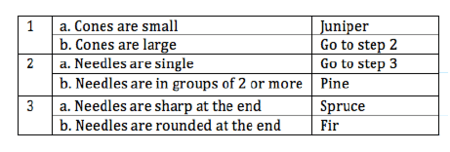
A dichotomous key for trees is provided. Hikers found a tree that has large brown cones and single sharp needles. What species of tree have the hikers found?
a)
Juniper
b)
Pine
c)
Spruce
d)
Fir
48.
The 8 levels of classification, most broad to most specific.
a)
Domain, Genus, Family, Order, Class, Phylum, Kingdom, Species
b)
Domain, Species, Kingdom, Genus, Phylum, Family, Class, Order
c)
Domain, Kingdom, Phylum, Class, Order, Family, Genus, Species
d)
Order, Kingdom, Species, Domain, Phylum, Family, Class, Genus
49.

Who discovered the difference between dominant and recessive traits?

a)

Charles Darwin

b)

Gregor Mendel

c)

Watson and Crick

d)

Rosalind Franklin