Wayground logo

Free Printable Worksheets

Font size

S
M
L
XL
Worksheets

Ionic AND Covalent Bonding

Total questions: 23

Worksheet time: 17mins

Name
Class
Date
1.
When an atom loses an electron, it becomes a:
a)
positive ion
b)
negative ion
c)
neutral ion
d)
neutral atom
2.
How are covalent bonds explained?
a)
When one atom takes the other atom's electron
b)
When the atom shares an electron with an another atom
c)
When the two nucleus merge
d)
When the neutrons leave the nucleus
3.
What is the correct formula for this molecule?
a)
NH
b)
N3H
c)
NH3
d)
NH4
4.
Ionic bonds exist between a metal with a non-metal.
a)
True
b)
False
5.
Magnesium (Mg) and Oxygen (O) form an ________ bond.
a)
Ionic
b)
Covalent
c)
Metallic
d)
Nothing
6.

Valence electrons are transferred

a)

Ionic bonds

b)

Covalent bonds

7.

Valence electrons are shared

a)

Ionic bonds

b)

Covalent bonds

8.

The chemical bond between a non-metal and another non-metal will be a ________ bond.

a)

metal

b)

ionic

c)

covalent

d)

polar

9.
Elements in Group 1 lose one electron to form ions with a(n) _________________ charge.
a)
1+
b)
2+
c)
0
d)
1-
10.
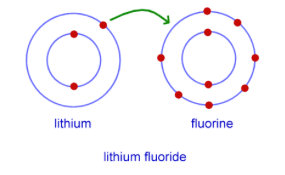
What type of bond is this?
a)
ionic
b)
covalent
11.
How many electrons are needed in the outer energy levels of an atom to be stable?
a)
2
b)
4
c)
6
d)
8
12.
What is a valence electron?
a)
The sum of neutrons and protons.
b)
The # of electrons in the last shell.
c)
A type of bond.
d)
A popular compound.
13.
Where are metals located on the periodic table?
a)
Blue
b)
Green
c)
Red
14.
Where are the nonmetals located on the periodic table? 
a)
Blue
b)
Red
c)
Green
15.
Atoms that gain electrons become...
a)
negatively charged
b)
positively charged
c)
remain neutrally charged
d)
21
16.

What type of bond involves the sharing of electrons between atoms?

a)

covalent bond

b)

ionic bond

c)

metallic bond

d)

transfer bond

17.

This could be the dot diagram of

a)

Mg

b)

Cl

c)

C

d)

O

18.

What is the goal of the Lewis Dot Structure?

a)

To determine the electron position.

b)

To show the element's valence electrons & bonding capabilities.

c)

To find the atomic mass of an element.

d)

To search for the number of electrons in an individual atom.

19.

How many valence electrons should Lithium have in its Lewis dot model?

a)

1

b)

2

c)

3

d)

4

20.

How many valence electrons should Oxygen have in its Lewis dot model?

a)

5

b)

6

c)

7

d)

8

21.

How many valence electrons should Magnesium have in its Lewis dot model?

a)

1

b)

2

c)

3

d)

4

22.
Which of the following is the correct Lewis dot structure for the molecule fluorine (F2)?
a)
A
b)
B
c)
C
d)
D
23.

Which is the correct molecular structure for carbon dioxide CO2?

a)
b)
c)
d)