
 Worksheets
Y12 Bio T5W4 quiz
Total questions: 21
Worksheet time: 19mins
Name
Class
Date
1.

The largest number of individuals that an environment can support long term is...
a)
carrying capacity
b)
emigration
c)
immigration
d)
population density
2.

What happens if a population grows past its carrying capacity?
a)
The population keeps growing
b)
The population starts to die off
c)
The entire species will go extinct
d)
The carrying capacity just increases
3.
This may cause a population to increase
a)
increase of food supply
b)
removal of predators
c)
removal of disease
d)
all of these
4.

Something that regulates the size of a population is called...
a)
a limiting measure
b)
a limiting factor
c)
carrying capacity
d)
biodiversity
5.

What is the carrying capacity of the graph?
a)
1000
b)
8000
c)
800
d)
600
6.
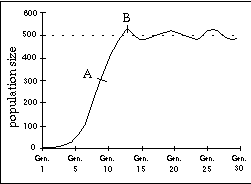
What is the carrying capacity of the graph?
a)
around 500
b)
more than 800
c)
less than 300
d)
around 700
7.

Use the phylogenetic tree. Which hypothetical organism is the most recent ancestor for Organisms A and G?
a)
1
b)
2
c)
3
d)
4
8.
What can a classification system show about an organism?
a)
absolute age of an organism
b)
what an organism is made of
c)
its relationship to other organisms
d)
which organisms are the strongest
9.
Which domain includes all multicellular plants and animals?
a)
Archaea
b)
Eukarya
c)
Eubacteria
d)
Protista
10.
Which taxonomic category is higher than the others?
a)
class
b)
genus
c)
order
d)
phylum
11.
Canis lupus, the scientific name for a wolf, is in which genus?
a)
Canis
b)
lupus
c)
Animalia
d)
mammalia
12.
Which two organisms are least closely related?
a)
two organisms from the same kingdom
b)
two organisms from the same order
c)
two organisms from the same family
d)
two organisms from the same genus
13.
Which is used most to determine a true common ancestor for a group of organisms?
a)
karyotype
b)
dichotomous key
c)
phylogenetic tree
d)
mRNA codon chart
14.

Examine the phylogenetic tree.
Which two organisms are most closely related?
Which two organisms are most closely related?
a)
wolves and sharks
b)
starfish and sharks
c)
protists and sharks
d)
gorillas and sharks
15.
Which can be inferred by viewing a phylogenetic tree?
a)
ancestral lineages
b)
color variation in species
c)
food choice of an organism
d)
probability of extinction in a population
16.

Examine the dichotomous key.
What features does a Platyspiza have?
What features does a Platyspiza have?
a)
stout and heavy beak with a curved lower beak
b)
long, slender beak with a flat and straight lower beak
c)
flat and straight beak with a bend in the lower edge of the upper beak
d)
long and slender beak with the lower edge of the upper beak being flat
17.
Which of the following shows the taxa in the correct order?
a)
kingdom-phylum-order-class-family-genus-species
b)
kingdom-class-order-family-phylum-genus-species
c)
kingdom-phylum-class-order-family-genus-species
d)
kingdom-phylum-family-order-class-genus-species
18.
Which of the following describes the importance of biodiversity to an ecosystem?
a)
a. People like to be able to see all the different plants and animals
b)
b. If there aren�t all the different species, there will be resources that aren�t being used
c)
c. Biodiversity is not as important as many people think
d)
d. Biodiversity can help minimize the effects of losing a species.
19.
A plant nursery only grew one type of tomato. All of their tomatoes died from the same disease. What was most likely true of the tomato plant population?
a)
a. It had too little biodiversity
b)
b. It had a lot of resistance to disease
c)
c. It had a few plants that were resistant to disease
d)
d. It had too much genetic variation
20.
Biodiversity includes 3 components, Ecosystem Diversity, Species Richness and Genetic Diversity
a)
True
b)
False
21.

According to the idea of "evenness" discussed in class, which sample is considered to be more even?
a)
Sample 1
b)
Sample 2
c)
They are both equally biodiverse
d)
None of the above
100 %

