
 Worksheets
QUIZ 1
Total questions: 40
Worksheet time: 40mins
Electromagnetic waves vary in
the speed they travel in a vacuum
wavelength and frequency
the way they reflect
the orientation of their electric and magnetic fields
Infrared rays have a shorter wavelength than
Ultraviolet ray
X-rays
gamma rays
radio waves
The full range of frequencies of electromagnetic radiation is called
visible light
the electromagnetic spectrum
radio waves
invisible radiation
The waves with the longest wavelengths in the electromagnetic spectrum
Infrared rays
gamma rays
radio waves
X-rays
What happens to frequency when the energy increases?
it increases
it stays the same
it decreases

What part of the wave is shown at letter A?
crest
wavelength
trough
frequency

Which part of the wave is shown at letter B?
crest
wavelength resting point
trough
normal line

Which part of the wave is shown at letter C?
crest
resting point
wavelength
amplitude
a form of electromagnetic radiation that doesn't require a medium to pass through
sound wave
transverse wave
light wave
compressional wave
Select the correct order of waves on the EMS from low to high energy
Radio wave, Microwave, Infrared, Visible, Ultraviolet, X-ray, Gamma
Visible, Microwave, Infrared, Ultraviolet, X-ray, Gamma, Radio wave
Gamma, X-ray, Ultraviolet, Visible, Infrared, Microwave, Radio wave
Microwave, Radio wave, Visible, Infrared, Ultraviolet, X-ray, Gamma
High frequency in EM waves equals
high energy and short wavelength
low energy and short wavelength
high energy and long wavelength
low energy and long wavelength
Which section of the spectrum is the ONLY one we can see?
X-rays
Gamma Rays
Visible Light
Ultraviolet Rays

Images in a plane mirror are
real
larger
same size
smaller
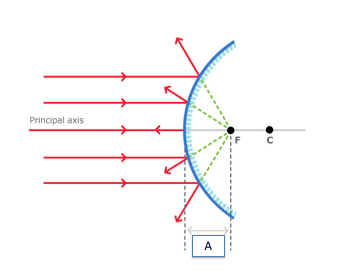
In the image, all the rays meet at F, What is F
focal length
focal point
center of curvature
reflection

Through which point on principal axis shall reflected ray pass in the following diagram of incident ray ?
point F
point C
point P
none of the above

In the diagram, which letter represents the angle of incidence?
A
B
C
D
Characteristics of a image formed by a plane mirror. Check all that applies.
inverted
same size as the object
laterally inverted
real

A student placed a pencil in a cup of water. The pencil appears broken because light
always travels in a straight line.
bends when it passes through water.
makes the water in the glass evaporate.
reflects the pencil on the water's surface.
When light passes at an angle to the normal from one medium into another in which its speed is higher
it is bent toward the normal.
it always lies along the normal.
it is unaffected.
it is bent away from the normal.
When light passes at an angle to the normal from one medium into another in which its speed is lower
it is bent towards the normal.
it always lies along the normal.
it is unaffected.
it is bent away from the normal.


Why is the spectrum of light separated into its components of color when white light is directed to a prism?
Because light reflects off the prism's surface
The incident white light refracts and separates into its constituent colors
The white light is absorbed by the prism, separating its colors
The light speeds up as it moves from air into the denser plastic material
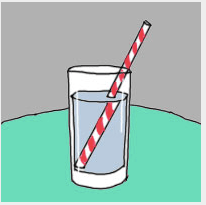
Why does the straw appear to be bent?
light is reflected
light is absorbed
light is turned
light is refracted
What do we call a material that light can travel through?
air
water
medium
pathway
Objects that reflect well are
Matte surfaces
Smooth, shiny surfaces
Dark coloured surfaces
Medium coloured surfaces
The law of reflection states that
Angle of incidence = Angle of reflection
Angle of incidence = Angle of incidence
Angle of reflection = Angle of translucence
Angle of reflection = Angle of reflection
This is the example of dispersion of light
sky looks bright orange in the evening
shadow
Pool seems shallower
rainbow
A concave mirror
Curves inwards
Curves outwards
Curves sideways
Curves in multiple directions
A convex mirror
Curves inwards
Curves outwards
Curves sideways
Curves in multiple directions
Refraction is
The bending of light as it passes through the one substance at an angle
A light beam shone in one end of an optical fibre and totally internally reflected at the other end
The bending of light as it passes from one substance to another at an angle
A type of convex object used in everyday life

