wayground logo

Free Printable Worksheets

NEW

Font size

S
M
L
XL
Worksheets

DNA and Protein Synthesis Test Review

Total questions: 42

Worksheet time: 42mins

Name
Class
Date
1.
How does RNA differ from DNA?
a)
RNA contains uracil and deoxyribose
b)
RNA contains ribose and thymine
c)
RNA contains uracil and ribose
d)
RNA contains adenine and ribose
2.
The process by which the genetic code of DNA is copied into a strand of RNA is called
a)
translation
b)
transcription
c)
transformation
d)
replication
3.
In messenger RNA, each codon specifies a particular
a)
nucleotide
b)
enzyme
c)
amino acid
d)
promoter
4.
The process of making proteins on the ribosome based on instructions from messenger RNA is called
a)
transcription
b)
transformation
c)
translation
d)
molecular biology
5.
RNA has how many strands?
a)
one
b)
two
6.

Carries the amino acid used to make a protein

a)

mRNA

b)

rRNA

c)

tRNA

7.

Factory for making a protein

a)

mRNA

b)

rRNA

c)

tRNA

8.
Which type of RNA takes the instructions from the nucleus to the cytoplasm?
a)
mRNA
b)
tRNA
c)
rRNA
d)
RNA polymerase
9.
How many nucleotides make a codon?
a)
1
b)
2
c)
3
d)
6
10.
A mutation that affect one specific location is called
a)
a mutagen
b)
a chromosomal mutation
c)
a point mutation
d)
translocation
11.

What best explains the interaction between tRNA and mRNA during translation?

a)

anticodons on the mRNA line up with complementary codons on the tRNA

b)

anticodons on the tRNA line up with complementary codons on the mRNA

c)

tRNA attach amino acids to the complementary mRNA sequence

d)

mRNA attach amino acids to the complementary tRNA sequence

12.

A polypeptide only becomes a functioning protein after it has folded into its exact 3D shape.

a)

True

b)

False

13.

codons are located on __________

a)

mRNA

b)

tRNA

c)

rRNA

d)

snRNA

14.

anti-codons are located on __________

a)

mRNA

b)

tRNA

c)

rRNA

d)

snRNA

15.

How many codons: AAU GCG AUG

a)

9

b)

1

c)

3

d)

15

16.
The codon CCU codes for what amino acid?
a)
Isoleucine
b)
Stop
c)
Methionine
d)
Proline
17.
Which amino acid pairs with the codon AGA
a)
Thr
b)
Arg
c)
Ala
d)
Glu
18.

When using your codon chart, what sequence can you use to find the correct amino acid?

a)

DNA

b)

mRNA

c)

tRNA

d)

Any of these will do

19.

What organelle reads the mRNA and finds the correct amino acid?

a)

DNA

b)

Nucleus

c)

Ribosome

d)

Chloroplast

20.
When there is one less base on the mRNA strand than the DNA strand it is a _________ mutation
a)
missense
b)
nonsense
c)
deletion
d)
insertion
21.
DNA molecule segment is : TTACGCAAG
The mutated DNA segment is TTCGCAAG. This is an example of ___ mutation.
a)
Substitution
b)
Deletion
c)
Insertion
d)
Inversion
22.

Point mutation involves

a)

deletion

b)

insertion

c)

duplication

d)

changes in single base pair

23.
What are the nucleotides made of?
a)
Sugar, Phosphate, nitrogen base
b)
Phosphate, Adenine, nitrogen base
c)
Thymine, Adenine, Cytomine
d)
Phosphate, Nitrogen, Adenine
24.
Which of the following best describes a DNA molecule?
a)
double helix
b)
contains ribose
c)
made of amino acids
d)
contains Uracil
25.
Which of the following units are repeatedly joined together to form a strand of DNA? (This is the MONOMER of DNA.) 
a)
amino acids
b)
nucleotides
c)
fatty acids
d)
polysaccharides
26.
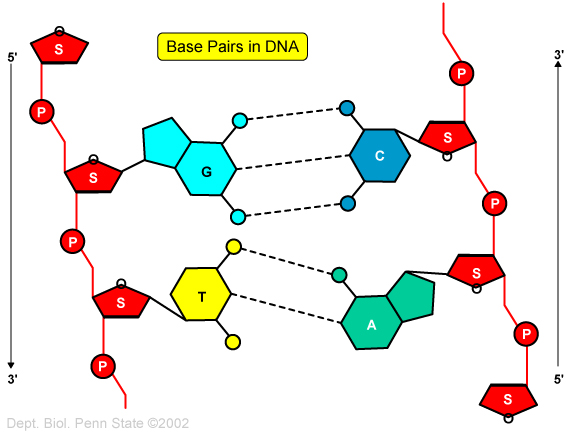
Adenine bonds with ______________.
a)
Guanine
b)
Thymine
c)
Cytosine
d)
Adenine
27.
Guanine bonds with ______________.
a)
Adenine
b)
Guanine
c)
Cytosine
d)
Thymine
28.
Which sequence of DNA bases would pair with this partial strand
ATG TGA CAG
a)
ATG TGA CAG
b)
TAC ACT GTC
c)
GTA AGT GAC
d)
CAT TCA CTG
29.
Nitrogenous bases are joined by which type of bond?
a)
polar bonds
b)
ionic bonds
c)
covalent bonds
d)
hydrogen bonds
30.
The sugar in DNA is ?
a)
sucrose
b)
glucose
c)
deoxyribose
d)
fructose
31.
Which 2 molecules form the sides (backbone) of the DNA ladder?
a)
deoxyribose sugar and adenine
b)
deoxyribose sugar and a hydrogen bond
c)
deoxyribose sugar and the nucleus
d)
deoxyribose sugar and phosphate
32.
Which of the following is not a nitrogen base found in DNA?
a)
Thymine
b)
Uracil 
c)
Guanine
d)
Adenine
33.
The enzyme that unzips the DNA to prepare for replication
a)
helicase
b)
replicase
c)
polymerase
d)
synthase
34.
DNA replication results in two DNA molecules,
a)
each one with two original strands
b)
each one with two new strands
c)
each one with one new strand and one original strand
d)
one with two new strands and the other with two original strands
35.
In what phase of the cell cycle does DNA replication take place?
a)
G1
b)
S
c)
G2
d)
M
36.
What is responsible for holding the two strands of the DNA double helix together?
a)
hydrogen bonds
b)
alleles
c)
London dispersion forces
d)
deoxyribose sugars
37.
Which enzyme is responsible for adding nucleotides ("The Builder")?
a)
Topoisomerase
b)
DNA Polymerase
c)
Ligase
d)
Primase
38.
Why is it crucial that living things are able to replicate their DNA?
a)
Each cell must have its own DNA
b)
Less copies of DNA are needed when a new cell is created
c)
A cell needs multiple copies of DNA
d)
Only muscle cells need DNA 
39.

The two strands of DNA are

a)

Parallel

b)

Antiparallel

c)

Perpendicular

d)

At Right Angles

40.

This is an example of -

THE DOG HID THE TOY (ORIGINAL)

THE DOG HIM THE TOY (NEW)

a)

addition

b)

deletion

c)

substitution

41.

This is an example of -

THE DOG HID THE TOY (ORIGINAL)

THE DOG SHI DTH ETO Y??

a)

addition

b)

deletion

c)

substitution

42.

This is an example of -

THE DOG HID THE TOY (ORIGINAL)

THE DOH IDT HET OY? (NEW)

a)

addition

b)

substitution

c)

deletion