
 Worksheets
Muscle Physiology Review
Total questions: 66
Worksheet time: 1hrs 6mins
How do muscles produce movement?
Muscles contract by pushing bones
Muscles contract by pulling bones
Muscles contract by pushing and pulling bones
Muscles do not produce movement
Which of the following is NOT a function of the muscular system?
Maintain posture
Stabilize joints
Generate heat
Filter toxins and excess waste from blood
Which of the following is NOT a type of muscle tissue?
Smooth
Rough
Cardiac
Skeletal
TRUE OR FALSE: Every muscle is its own organ with its own blood vessels, nerves, and connective tissues.
True
False
Which of the following is the correct order of muscle structures going from largest to smallest
Muscle --> Muscle fascicles --> Muscle fibers --> Myofibrils --> Sarcomeres
Sarcomeres --> Myofibrils --> Muscle fibers --> Muscle fascicles --> Muscles
Muscle --> Muscle fibers --> Muscle fascicles --> Sarcomeres --> Myofibrils
Muscle fibers --> Muscle fascicles --> Muscle --> Myofibrils --> Sarcomeres
Which of the following is also known as a muscle cell?
Muscle
Myofibril
Sarcomere
Muscle fiber
Which connective tissue wraps around the entire outside of the muscle?
Perimysium
Epimysium
Endomysium
Which connective tissue wraps around the entire outside of each fascicle?
Perimysium
Epimysium
Endomysium
Which connective tissue wraps around the entire outside of each muscle fiber?
Perimysium
Epimysium
Endomysium

Which structure is A? (Hint: largest structure)
Muscle
Epimysium
Muscle fiber
Myofibril
Which structure is B?
Muscle
Epimysium
Muscle fiber
Myofibril
Which structure is C? (hint: whole bundle)
Muscle fiber
Fascicle
Epimysium
Perimysium
Which structure is D? (hint: tissue)
Muscle fiber
Fascicle
Epimysium
Perimysium
Which structure is E?
Muscle fiber
Fascicle
Epimysium
Perimysium
Which structure is F? (hint: tissue)
Muscle fiber
Endomysium
Epimysium
Perimysium
Which structure is G?
Muscle fiber
Endomysium
Sarcomere
Perimysium
Which structure is H?
Muscle fiber
Myofibril
Sarcomere
Perimysium
Which structure is I?
Myosin
Myofibril
Sarcomere
Actin
Which structure is J?
Myosin
Myofibril
Sarcomere
Actin
A flat, sheetlike fibrous tissue that connects muscle or bone to other tissues
muscle fiber
fascicle
sarcolemma
aponeurosis
agonist
The ability to contract or shorten
agonist
antagonist
contractility
extensibility
irritability
The ability to be stretched
agonist
antagonist
contractility
extensibility
irritability
A type of contraction that results in the shortening of a muscle
concentric
eccentric
isometric
peristalsis
agonist
A type of contraction accompanied by the lengthening of a muscle
concentric
eccentric
isometric
peristalsis
agonist
A type of contraction that involves no change in muscle length
concentric
eccentric
isometric
peristalsis
agonist
A wave of symmetrical squeezing of the digestive tract walls that occurs during digestion
concentric
eccentric
isometric
peristalsis
agonist
Which of the following muscle types is involuntary?
Skeletal
Smooth
Cardiac
About how many muscles are there on the body?
350
450
550
650
the functional contractile unit within a muscle fiber is called the
sarcomere
fascia
sarcoplasm
tendon
the cordlike connective tissue that attaches a muscle to a bone is called
a tendon
a ligament
a sarcomere
a fascicle
the cytoplasm of a muscle cell is called the
myosin
actin
fascia
sarcoplasm

Structure B is known as the thin filaments of the sarcomere, what is another name for the thin filaments?
myosin
actin
fascia
myofibril

Structure C is known as the thick filament of the sarcomere, it is also known as
myosin
actin
fascia
myofibrils

Structure A is on either side of the sarcomere, it is called the
A band
I band
Z disc
fascia

The unit between A and A is called
a sarcomere
The I band
the Z disc
fascia
The heads of the myosin filaments are called ___ when they link the thin and thin filaments together
Connections
Cross-connections
Cross-bridges
Power stroke
What is the function of Ca++ during a skeletal muscle contraction?
Connecting to nebulin
Connecting to tropomyosin
Connection to myosin
Connecting to troponin
The protein that covers the binding site on actin when a muscle is relaxed is called
Troponin
Nebulin
Tropomyosin
Myosin
The A band contains which type of filaments
Only thick
Only thin
Both thick and thin
Which of the following occurs When ATP binds to the myosin head?
Myosin head detaches from actin
Myosin head forms cross-bridge
Myosin undergoes power stroke
Myosin releases calcium
Which of the following decreases during muscle contraction?
M line
A band
H zone
Z line
Ca++ will be released from the sarcoplasmic reticulum when
the action potential reaches the neuromuscular junction
ATP binds to sarcoplasmic reticulum
Acetylcholine enters the synaptic cleft
Action potential travels along T tubules
The power stroke will occur when
ATP binds to the myosin head
The myosin head hydrolyses ATP into ADP and Pi
The myosin head releases Pi
The myosin head releases ADP

What starts a muscle contraction?
Release of Calcium Ions
Attachment of Myosin-Heads
An Action Potential
Release of ADP
What binds to the Myosin Head to cause it to detach from the Actin?
ATP
ADP
CNS
ETC
What causes the muscle to stop contracting?
Lack of effort
Myosin-Heads fail to attach
Calcium Ions are pumped away
Muscle fibre tears

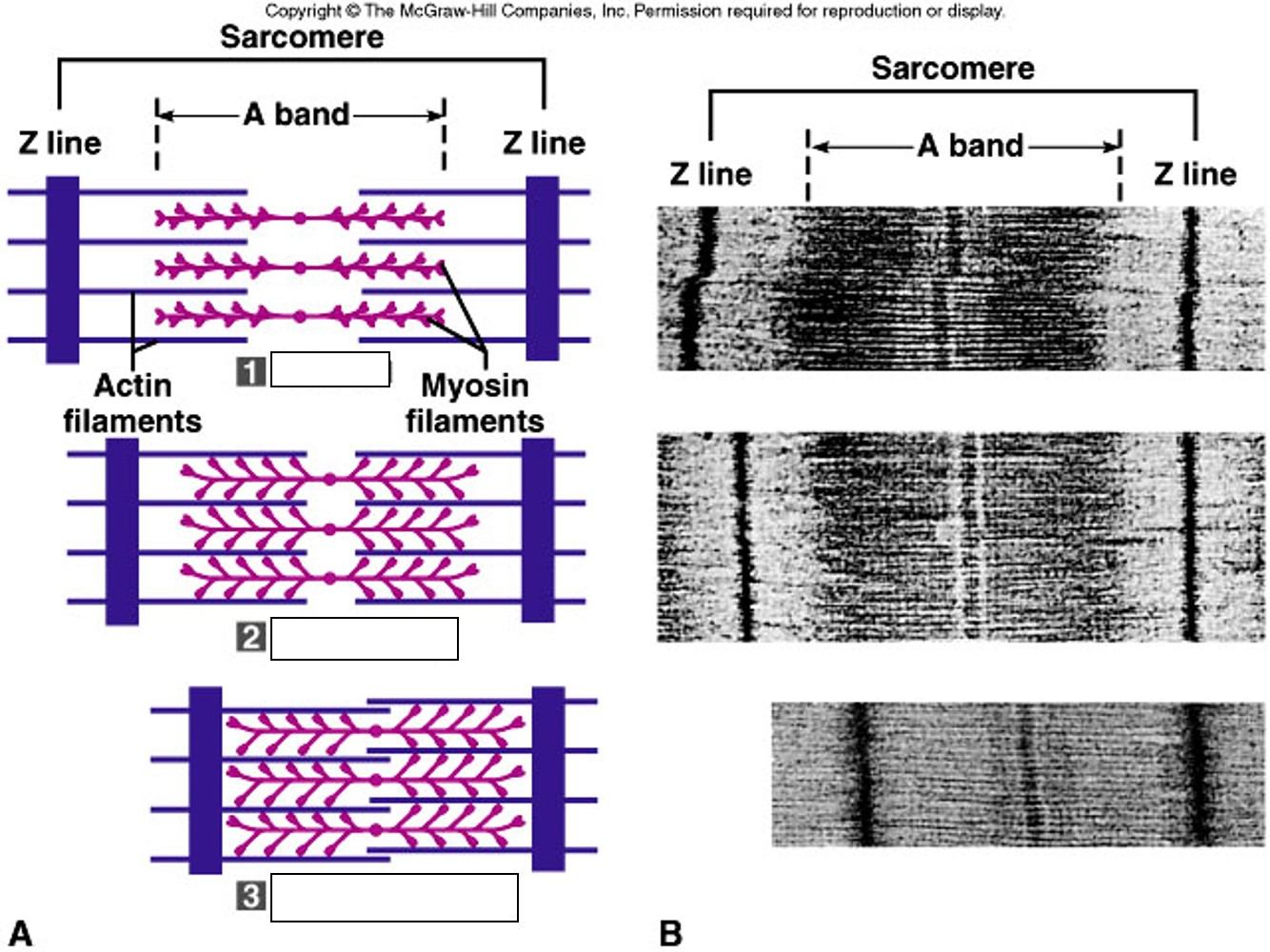
Higher Questioning: Whats happens to the A band during contraction?
It grows in size
It stays the same
It shrinks in size

Higher Questioning: Do the lengths of the thick and thin filaments change during contraction?
Yes
No
Direct phosphorylation uses this as its main energy source
creatine phosphate
glucose
lactic acid
pyruvic acid
Direct phosphorylation energy lasts approximately
15 seconds
hours
30-60 seconds
as long as the muscle is contracting
Aerobic respiration uses this as its main energy source
creatine phosphate
glucose
lactic acid
pyruvic acid
Aerobic respiration occurs here
mitochondria
cytoplasm
muscle
blood stream
Muscle fatigue is...
when the muscle is unable to contract
when you are too tired to exercise
when the muscle is contracted more than 30 secondsd
when O2 comes from direct phosphorylation
What is the correlation between muscle fatigue and oxygen debt?
When O2 decreases, muscle fatigue increases
When O2 increases, muscle fatigue decreases
When O2 is obtained, muscle fatigue decreases
The lesser the oxygen debt, the lesser the muscle fatige
What is the correlation between lactic acid, ATP, and muscle contractions?
increase in lactic acid, decrease ATP, decrease in muscle contraction
increase in lactic acid, decrease ATP, increase in muscle contraction
increase in lactic acid, increase in ATP, decrease in muscle contraction
increase in lactic acid, increase in ATP, increase in muscle contraction
Oxygen debt is paid back when...
during exercise
before exercise
after exercise
body reaches homeostasis
The all-or-none response means
all of the muscles in a region contract together
all of the muscle fibers within a muscle contract together
when a muscle fiber contracts, it contracts completely
when a muscle fiber contracts, all of its ATP is changed to ADP
Muscle fatigue is most likely due to an accumulation of
citric acid
lactic acid
creatine
myosin

