wayground logo

Free Printable Worksheets

Font size

S
M
L
XL
Worksheets

Angle Relationships

Total questions: 40

Worksheet time: 42mins

Name
Class
Date
1.
complementary, supplementary, or neither?
a)
Complementary
b)
Supplementary
c)
Neither
2.
What are supplementary angles?
a)
Angles that add up to 180°
b)
Angles that add up to 90°
c)
Angles that are equal to each other
d)
Angles that are opposite of each other when lines intersect
3.
Vertical angles are always
a)
acute
b)
total 180 degrees
c)
congruent (equal measures)
d)
adjacent angles
4.
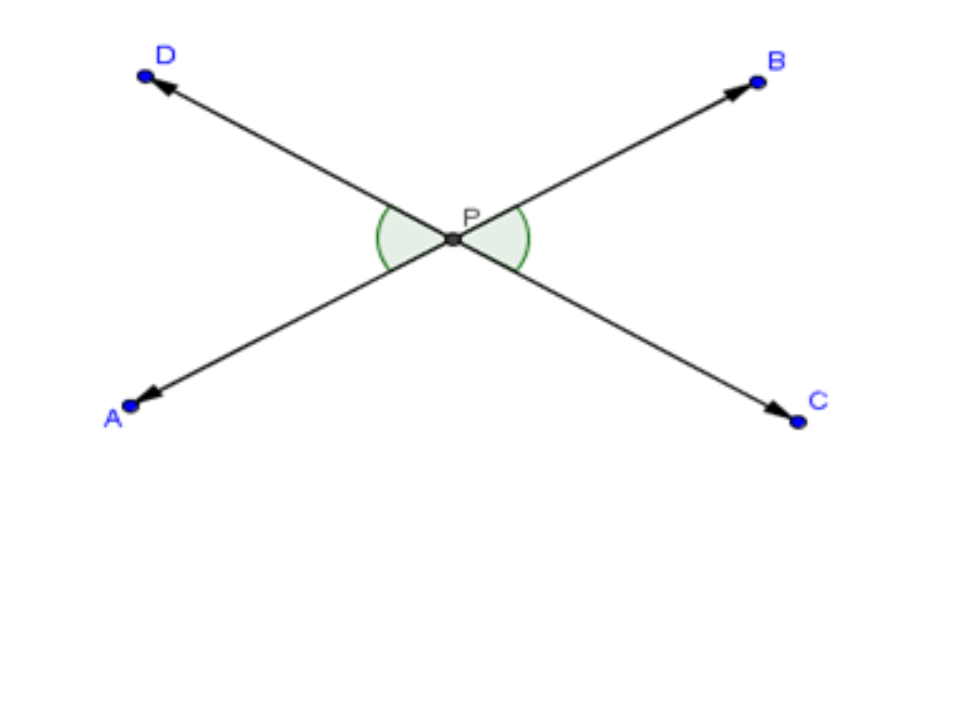
What angle pair is pictured?
a)
Alternate Interior Angles
b)
Supplementary Angles
c)
Vertical Angles
d)
Corresponding Angles
5.
Supplementary Angles measure _____ degrees.
a)
180
b)
55
c)
100
d)
90
6.
What is the complement angle to 12°?
a)
78°
b)
68°
c)
168°
d)
90°
7.
What is the measure of ∠2?
a)
38
b)
58
c)
71
d)
142
8.
What are complementary angles?
a)
Angles that add up to 180°
b)
Angles that add up to 90°
c)
Angles that are equal to each other
d)
Angles that are opposite of each other when lines intersect.
9.
What are vertical angles?
a)
Angles that are adjacent to each other
b)
Angles that add up to 180°
c)
Angles that are opposite of each other when lines intersect
d)
Angles that add up to 90°
10.

What is the definition of acute angles?

a)

Angles that measure less than 90⁰

b)

Angles that measures exactly 90⁰

c)

Angles that measure more than 90⁰

d)

Angles that measures exactly 180⁰

11.

What is the definition of right angles?

a)

Angles that measure less than 90⁰

b)

Angles that measures exactly 90⁰

c)

Angles that measure more than 90⁰

d)

Angles that measures exactly 180⁰

12.

What is the definition of obtuse angles?

a)

Angles that measure less than 90⁰

b)

Angles that measures exactly 90⁰

c)

Angles that measure more than 90⁰

d)

Angles that measures exactly 180⁰

13.

What is the definition of straight angles?

a)

Angles that measure less than 90⁰

b)

Angles that measures exactly 90⁰

c)

Angles that measure more than 90⁰

d)

Angles that measures exactly 180⁰

14.
Angles that are exactly 90 degrees are called _____ ______.
a)
tight angles
b)
acute angles
c)
obtuse angles
d)
right angles
15.
Which angle type is pictured?
a)
Acute
b)
Right
c)
Obtuse
d)
Straight
16.
Which angle type is pictured?
a)
Acute
b)
Right
c)
Obtuse
d)
Straight
17.
Which type of angle is pictured?
a)
Acute
b)
Right
c)
Obtuse
d)
Straight
18.
Classify this angle.
a)
Right
b)
Straight
c)
Obtuse
d)
Acute
19.
What type of angle is shown?
a)
acute
b)
obtuse
c)
right
d)
straight
20.

Supplementary angles always add up to

(a)  

21.
What kind of angles are shown?
a)
complementary
b)
supplementary
c)
adjacent
d)
corresponding
22.
If m∠1 = 30°, then m∠3 = 
a)
30°
b)
60°
c)
150°
d)
undetermined
23.
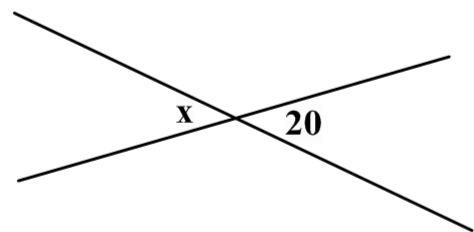
Find the missing angle.  Find x.
a)
20o
b)
70o
c)
160o
d)
180o
24.
complementary, supplementary, or neither?
a)
Complementary
b)
Supplementary
c)
Neither
25.
angles that are next to each other but do not overlap
a)
vertical
b)
supplementary
c)
complementary
d)
adjacent
26.

This is a supplementary angle. Find the measure of the missing angle.

a)
154 degrees
b)
26 degrees
c)
180 degrees
d)
64 degrees
27.

The angle relationship shown are -

a)

complementary angles

b)

supplementary angles

c)

vertical angles

d)

Vertex

28.

This is a complementary angle. Determine the degrees of the missing angle.

a)

43°

b)

47°

c)

57°

d)

67°

29.

If an angle measures 22°, what is the measure of it's complement?

a)

22°

b)

68°

c)

158°

d)

90°

30.

If an angle measures 2°, what is the measure of its supplement?

a)

178°

b)

c)

88°

d)

180°

31.

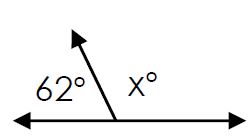
If this is a supplementary angle, solve for x

a)

x = 118°

b)

x = 108°

c)

x = 28°

d)

x = 58°

32.

If this is a Complementary Angle, solve for x

a)

x = 24°

b)

x = 66°

c)

x = 156°

d)

x = 90°

33.
What is the supplement of 12°?
a)
78°
b)
180°
c)
168°
d)
90°
34.

Calculate the missing measurement for these adjacent angles.

a)

85 degrees

b)

20 degrees

c)

65 degrees

d)

45 degrees

35.

If m∠1 = 39°, then m∠2 = 

a)

141°

b)

39°

c)

d)

51°

36.

Complementary angles always add up to

(a)  

37.

Acute angles are (a)   than 90 degrees.

38.

Obtuse angles are (a)   than 90 degrees.

39.

Straight angles are (a)   to 180 degrees.

40.

Right angles are (a)   to 90 degrees.