
 Worksheets
Invertebrate Review
Total questions: 76
Worksheet time: 57mins
Which body form of cnidarians is a tube or vase shaped with tentacles on top of body surrounding the mouth?
Polyp
Medusa

This picture is an example of which group of pore filled invertebrates?
Segmented worms
Fish
Sponges
Arthropods

I have tentacles with stinging cells and a radial symmetry. I am a sea anemone. Which Phylum do I belong to?
Arthropod
Cnidarian
Echinoderm
Mollusk

I have a digestive cavity with one opening, and have stinging tentacles. I am a hydra. What phylum am I in?
Echinoderm
Cnidarian
Arthropod
Mollusk

This is a planaria, which is a type of flat worm. Which phylum is it placed in and why?
Nematoda, because it is round.
Annelida, because it is segmented.
Playhelminthes, because its flat.
Which of the following belong to the Phylum Platyhelminthes?
Tapeworms, Fluke, Planarian
Tapeworm, Annelids, Leech
What is the body of an arthropod, such as a grasshopper, covered with?
moist skin
scales
a hard exoskeleton
fur
What is the largest group of arthropods?
jellyfish
scorpions
insects
mammals.
Which animal is NOT a mollusk?
clam
slug
spider
snail
Which animal is not a stinging animal within the phylum Cnidaria?
jellyfish
sea anemone
coral
clam
Animals that do not have a backbone are called__.
vertebrates
invertebrates
Animals with jointed appendages and a hard exoskeleton for protection and support are called___. (Ex. ant, spider, crab, millipede)
fish
arthropods
mollusk
A starfish is an __ because it has tough, spiny skin.
echinoderm
mammal
mollusk
cnidarian
This group of animals has soft bodies and may have one shell, two shells, or no shell. (examples: slugs, snails, clams, scallops)
echinoderms
arthropods
platyhelminthes
mollusk
Some flatworms, such as tapeworms, must live inside of a host organism in order to survive. Because of this, tapeworms are considered __________.
parasites
free-living
beneficial
All animals are _______, _____ and ____.
prokaryotic, single-celled and heterotrophs
eukaryotic, multi-celled and autotrophs.
eukaryotic, multi-celled and heterotrophs.
prokaryotic, multi-celled and autotroph

What type of symmetry do cnidarians have?
asymmetrical
radial
bilateral

The hard "skeleton" structures in a sponge are called...
Spongin
Spicules

What phylum has two different body forms that exist called the medusa and the polyp?
Phylum Porifera
Phylum Cnidaria

Cnidarians can reproduce...
sexually only
asexually only
both sexually and asexually
What kingdom do invertebrates such as the Porifera and Cnidaria belong?
Plantae
Animalia
Fungi

Porifera and Cnidaria can reproduce asexually through a process called...
replication
fission
budding
What part of the sponge body are the openings along the sponge's body that allow in water?
spicules
collar cells
pores
Sessile means an organism _____.
floats from place to place
lives attached to an object their whole life

A planarian has ________ symmetry.
Flatworms were the first to have sense organs and the nervous system within the _____ region.
tail
head
Members of the animal kingdom are ......
Which is not a type of flatworms?
tapeworm
nematode
liver fluke
planarian
Planarians are free-living. They do not need a host to survive.
True
False
Roundworms are officially known as...
Nematoda
Platyhelminthes
Annelida
Arthropoda
This type of parasitic flatworm lives inside the intestines after it is consumed in undercooked meats.
Planarian
Schistosomiasis
Tapeworm or Trichinella
Roundworms are in the Phylum
Nematoda
Platyhelminthes

What phylum?
Platyhelminthes
Nematoda
Cnidaria
Porifera

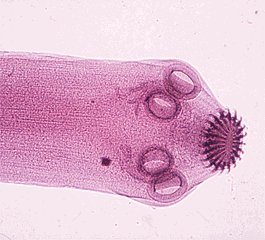
This proglottid has both male and female sex organs. This means it is a _____.
hermaphrodite
dendrite
nematocyst
Which of these is a common way that parasitic worms can be transmitted?
enter thru cuts in skin
eating infested undercooked meat
consuming contaminated food or water
all of these are ways you can get worms!
External bristles on an earthworm are also known as ___________.
cilia
setae
flagella
Which phylum do leeches and earthworms belong to?
Nematoda
Porifera
Annelida

Open without blood vessels
Closed with blood vessels

Which annelid has developed the ability to suck blood from other organisms?
Earthworms
Bristle worms
Leeches
Roundworms
An invertebrate animal with a soft body and a mantle is a _________?
Mollusk
Echinoderm
Annelid
Arthropod
Which one is a bivalve?
Clam
Squid
Snail
Lobster
This mollusk group has a two part shell.
Gastropods
Bivalves
Cephalopods
Echinoderm
This invertebrate group has spiny skin. (ex. starfish, sea urchin)
Arthropods
Echinoderms
Annelids
Mollusks
Cephalopods, gastropods and bivalves belong in what Phylum?
Mollusks
Annelids
Arthropods
Which class of Mollusks includes squid, cuttlefish, and octopus?
Gastropods
Bivalves
Cephalopods
Which class of Mollusks includes snails, slugs, conchs, and whelks?
Cephalapods
Bivalves
Gastropods
Which class of Mollusks includes clams, oysters, and mussels?
Gastropods
Bivalves
Cephalopods
They all have two body sections and eight legs. Some of them are predators with fangs or a stinger; others are parasites. None of them have antennae. What are they?
Crustaceans
Arachnids
Insects
Millipedes

The word 'arthropod' means...
eight foot
jointed foot/appendages
flexible foot
hard foot


Echinoderms have ___ symmetry.
asymmetrical
radial
bilateral
spherical

Annelid
Cephalopod
Bivalve
gastropod
crustacean

annelid
arachnid
insect
crustacean
cephalopod

annelid
arachnid
cephalopod
Crustacean

arachnid
annelid
insect
mollusk

Crustacean
Mollusk
Cephalopod
Bivalve
Echinoderm

