wayground logo

Free Printable Worksheets

Font size

S
M
L
XL
Worksheets

Thermodynamics and Heat

Total questions: 40

Worksheet time: 37mins

Name
Class
Date
1.
The total energy of a system equals 
a)
its heat and temperature
b)
its work and temperature
c)
its heat and work
d)
its heat
2.
The _____ Law of Thermodynamics says that heat always flows from an object with a higher temperature to an object of lower temperature naturally
a)
Zeroth
b)
First
c)
Second
d)
Third
3.
An ice cube is placed on a table and begins to melt.  The following conclusion can be made.
a)
Energy is being absorbed by the table which causes the cube to melt.
b)
Energy is being transferred from the table to the ice cube.
c)
Energy is being created by the air and table and making the cube heat up.
d)
Energy  is being created by the ice cube and is being released to the air
4.
Which law of thermodynamics states that absolute zero cannot be reached?
a)
1st
b)
2nd
c)
3rd
d)
Zeroth
5.
It is possible to reach absolute zero
a)
true
b)
false
6.
Energy is created by....
a)
running
b)
boiling ice
c)
touching slime
d)
none of them
7.
The first law of thermodynamics states that the change in the internal energy of a system is equal to the difference in energy transferred to or from the system as heat and
a)
mass
b)
work done
c)
force
d)
pressure
8.
The first law of thermodynamics is a restatement of the
a)
Zeroth law of thermodynamics
b)
law of heat addition
c)
principle of entropy
d)
conservation of energy
9.
What does the "U" stand for the formula ∆U = Q + W
a)
Heat
b)
Temperature
c)
Work
d)
Internal energy
10.

When you place the metal in boiling water, heat flows from the _________ to the _______.

a)

metal to the boiling water

b)

bottom of the metal to the top half of the metal

c)

bottom of the water to the top of the water

d)

boiling water to the metal

11.

DON'T RUSH, YOU HAVE TIME.

Water droplets condensing on the inside of a window on a cold day. Is this process exothermic or endothermic?

a)

Gases condense to form liquids. Gases are moving faster than liquids, the air around the window has a higher temperature/kinetic energy. Releasing energy to get water droplets, which is is Exothermic

b)

Gases condense to form liquids. Gases are moving faster than liquids, the air around the window has a higher temperature/kinetic energy. Releasing energy to get water droplets, which is is Endothermic

c)

Gases condense to form liquids. Gases particles are moving slower than liquids. Releasing energy to get water droplets, which is is Endothermic

d)

Gases condense to form liquids. Gases particles are moving slower than liquids. Releasing energy to get water droplets, which is is Exothermic

12.

Specific Heat is..

a)

the temperature initial minus temperature final

b)

the amount of heat/energy required to raise 1 gram of a substance by 1°C (or K) aka "C"

c)

the temperature final minus temperature initial

d)

the item in a system with given weight in grams
13.
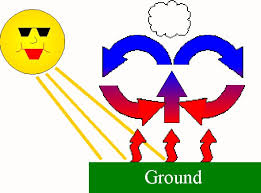
What is the transfer of heat by movement of liquids or gases?
a)
Radiation
b)
Convection
c)
Conduction
d)
Heat
14.
What are waves that can transfer heat through the vacuum of empty space?
a)
Electromagnetic waves
b)
Convection
c)
Conduction
d)
Heat
15.
What is the transfer of heat by direct contact?
a)
Convection
b)
Electromagnetic waves
c)
Radiation
d)
Conduction
16.
What is a substance that does NOT conduct heat well?
a)
Conductor
b)
Insulator
c)
Convector
d)
Radiator
17.
What is a substance that DOES conduct heat well?
a)
Conductor
b)
Insulator
c)
Convector
d)
Radiator
18.
What is the transfer of kinetic energy from one substance to another?
a)
Heat
b)
Energy
c)
Thermal energy
d)
Temperature
19.
What is the energy of the movement of particles in a substance?
a)
Potential energy
b)
Kinetic energy
c)
Thermal energy
d)
Temperature
20.
Warm air rises and the cool air sinks. This is...
a)
conduction
b)
convection
c)
radiation
21.
Heat transfers from an area of ________temperature to an area of ______ temperature.
a)
high to low
b)
low to high
c)
high to high
22.
Warm water from the ocean moves to the north while cool waters moves to the south. This is an example of.. 
a)
Conduction
b)
Convection
c)
Radiation
23.
If an object has particles that are moving very quickly, the object 's temperature is probably _____.
a)
cold
b)
slow
c)
big
d)
hot
24.
When the temperature of matter decreases the particles ...
a)
speed up and move farther apart
b)
speed up and move closer together
c)
slow down and move farther apart
d)
slow down and move closer together
25.
Phase change from a solid to a liquid...
a)
melting
b)
freezing
c)
evaporation
d)
condensation
26.
Phase change from a liquid to solid?
a)
Melting
b)
Condensation
c)
Evaporation
d)
Freezing
27.
If I am adding thermal energy to a liquid it will turn into _______. 
a)
Solid
b)
Liquid
c)
Gas
d)
Melt
28.
A chair is several feet from a fireplace. The side of the chair facing the fireplace gets warm due to
a)
conduction
b)
convection
c)
radiation
29.
"Lava lamps" contain colored liquids. These liquids form globs that rise to the top due to
a)
conduction
b)
convection
c)
radiation
30.
Near the ceiling of a room the air is warmer; the warm air rises because of
a)
conduction
b)
convection
c)
radiation
31.
A house burns down. The vinyl siding of the house next door warps due to
a)
conduction
b)
convection
c)
radiation
32.
What are waves that can transfer heat through the vacuum of empty space?
a)
Electromagnetic waves
b)
Convection
c)
Conduction
d)
Heat
33.

A microwave oven uses which of the following to heat foods?

a)

Microwave elves

b)

Radiation

c)

Convection

d)

Conduction

34.

Specific latent heat is the amount of energy required to change the state of 1 kg of a substance without changing its (a)   .

35.

Select the state changes that latent heat of fusion applies to.

a)

melting

b)

evaporating

c)

freezing

d)

condensing

e)

sublimation

36.

Select the state changes that latent heat of vaporisation applies to.

a)

melting

b)

evaporating

c)

freezing

d)

condensing

e)

sublimation

37.

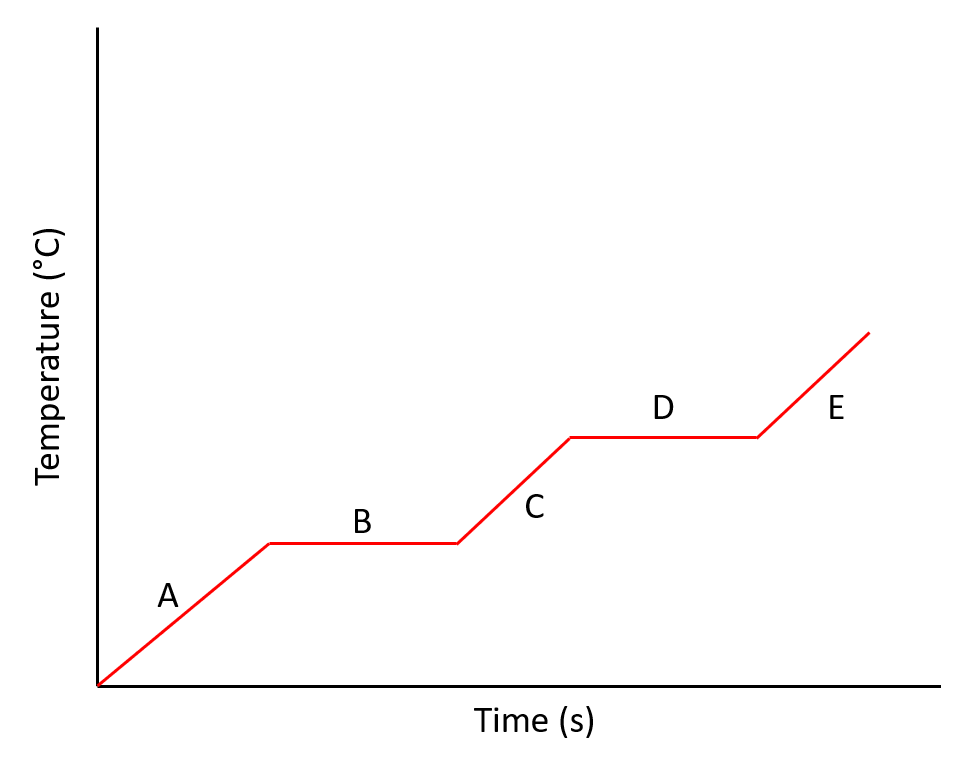
The diagram shows a heating curve for ice. Which line represents the ice in a liquid state (water)?

a)

A

b)

B

c)

C

d)

D

e)

E

38.

Find the energy released by a copper block when it is cooled from 100°C to 20°C. Given that the heat capacity of the block is 770 J°C-1.

a)

7.70x10⁴ J

b)

8.61x10⁴ J

c)

6.16x10⁴ J

d)

5.02x10⁴ J

39.

The heat absorbed by melting a solid is known as

a)

latent heat of fusion

b)

latent heat of solid

c)

latent heat of liquid

d)

latent heat of vaporisation

40.

the symbol for specific latent heat is

a)

c

b)

L

c)

Q

d)

m