wayground logo

Free Printable Worksheets

Font size

S
M
L
XL
Worksheets

Evolution

Total questions: 50

Worksheet time: 1hrs 19mins
Name
Class
Date
1.
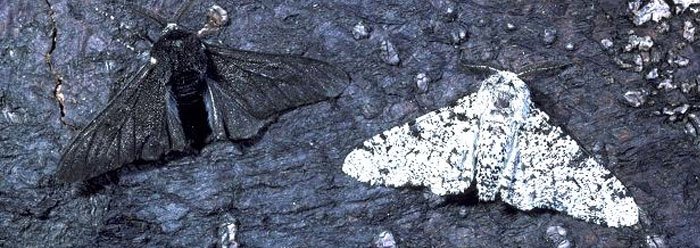
The trees these moths used to live on were white, but have been covered in soot from coal factories. Which moth will be more successful in this environment?
a)
Dark moth
b)
Light moth
c)
Both will be equally successful
d)
Neither will be successful
2.
Structures with the same parts have different functions; suggests that organisms share a common ancestry
a)
vestigial structures
b)
homologous structures
c)
adaptive radiation
d)
fossil
3.

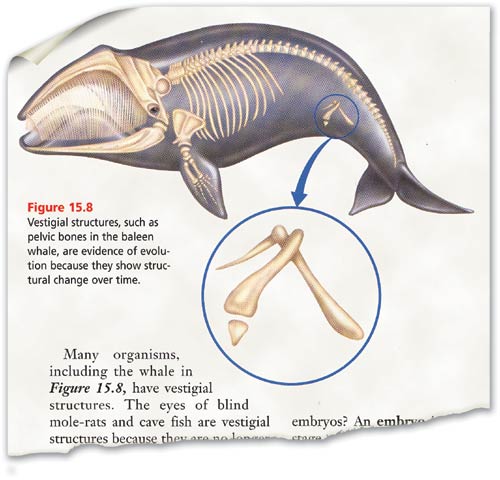
Whales are aquatic mammals that contain a pelvis (hip) bone. Even though it does not aid in its movement, the function must have been used by a common ancestor of the whale. Thus, the pelvis is referred to as a(n)

a)

vestigial structure

b)

analogous structure

c)

homologous structure

d)

heterozygous

structure

4.
The ability of an organism to survive and reproduce in its specific environment 
a)
diversity.
b)
evolution
c)
adaptation
d)
 fitness
5.
Genetic differences between organisms of the same species
a)
Variation
b)
Adaptation
c)
Behavior
d)
Environment
6.
Finches on the Galapagos Islands had different beaks in order to help them do what?
a)
Build nests
b)
Fight off predators
c)
Collect food sources
d)
Compete with rivals
7.
This scientist came up with the idea of natural selection.
a)
Jean Baptiste Lamarck
b)
Gregor Mendel
c)
Charles Darwin
d)
Thomas Malthus
8.
Farmers breed cows to produce high amounts of milk. This is an example of...
a)
Natural Selection 
b)
Variations in a species 
c)
Selective Breeding 
d)
inbreeding
9.
what did Charles Darwin observe in finch populations of the Galapagos Islands off the coast of South America?
a)
different species on different islands
b)
all species on one of the islands
c)
identical species on all the islands
d)
the same species as North America
10.

What unique animals did Darwin find on the islands? (choose all that apply)

a)

Tortoises

b)

Iguanas

c)

Finches

d)

Frogs

11.

What was the name of the book Darwin published?

a)

How it is we evolved.

b)

What is evolution?

c)

The Origin of Species.

d)

The Starting Point of All Life.

12.
speciation
a)

Formation of new species

b)

when species reproduce

c)

Formation of old species

d)

none of the above

13.

What is genetic drift?

a)

the changes in allele frequencies (genes) ,in a population, happening due to random events/circumstances.

b)

It is an example of primary succession

c)

Genetic drift are different organisms in a population due to inherited traits from their parents

d)

It is part of symbiotic relationships such as mutualism, commensalism, parasitism

14.

The apparatus in the Miller-Urey experiment was used to mimic what?

a)

proteins

b)

Earth's present conditions

c)

early Earth's conditions

d)

they didn't mean to mimic anything in particular

15.
Miller/Urey and other scientists have shown that:
a)
 Life on early Earth required material from space
b)
Cells survived in the primitive atmosphere
c)
Amino acids could be produced from inorganic molecules 
d)
Simple cells can be produced in a laboratory
16.

What islands did Darwin do most of his research on?

a)

Hawaiian Islands

b)

Malta Islands

c)

Galapagos Islands

d)

Indonesia Archipelagos

17.
What was the name of the ship Charles Darwin sailed on?
a)

HMS Titanic

b)

HMS Beagle

c)

HMS Britannia

d)

HMS Bulldog

18.
What animals did Charles Darwin study when at the Galapagos Islands?
a)
Giraffes
b)
Seagulls
c)
Seals
d)
Finches
19.

What country is closest to the Galapagos Islands?

a)

Spain

b)

Ecuador

c)

Mexico

d)

Colombia

20.

Draw the path of the HMS Beagle from start to finish

21.

Genes that are beneficial to the species will....

a)

evolve a new species

b)

will not be passed down to its' offspring

c)

become more common over time

d)

cause the extinction of a species

22.

Which one does not increase variation?

a)

Gene flow

b)

Migration

c)

Mitosis

d)

Crossing Over

23.

What is the study of prehistoric life through the fossil record?

a)

Embryology

b)

Paleontology

c)

Morphology

d)

Biogeography

24.

What is the study of chemical processes in living things?

a)

Biochemistry

b)

Paleontology

c)

Morphology

d)

Biogeography

25.

Binomial nomenclature is a 2-name naming system based on

a)

Family genus

b)

Class order

c)

genus species

d)

Genus species

26.

Who would have stated "acquired traits" such as a giraffe needing a long neck so they stretch it over time

a)

Darwin

b)

Lamarck

27.
What is survival of the fittest?
a)
It is where the fittest die out and therefore reproduce and pass on their genes
b)
It is where the fittest die out and therefore can't reproduce and pass on their genes
c)
It is where the fittest don't die out and therefore can't reproduce and pass on their genes
d)
It is where the fittest don't die out and therefore reproduce and pass on their genes
28.

Sent Darwin and essay with similar ideas as what Darwin proposed.

a)

Malthus

b)

Hutton

c)

Lyell

d)

Lamarck

e)

Wallace

29.
Father of evolution
a)
Darwin
b)
Lamarck
c)
Lyell
d)
Wallace
30.
Which part of the theory of evolution suggests that all living things evolved from a single ancestor?
a)
gradualism
b)
multiplication of species
c)
common descent
d)
perpetual change
31.
Small, incremental changes accumulating over time
a)
gradualism
b)
speciation
c)
natural selection
d)
common descent
32.
Which of the following is an example of a vestigial structure?
a)
the wings of a red-tailed hawk
b)
the hind limbs of a house cat
c)
the fins of sharks
d)
the tailbone of a human
33.
The diagram shows fossils in different rock layers. Which of these statements about the age of these fossils is most likely correct?
a)
Fossil A and C are the same age
b)
Fossil B is older than fossil C
c)
Fossils A is older than fossil B
d)
Fossil D is older than fossil C
34.
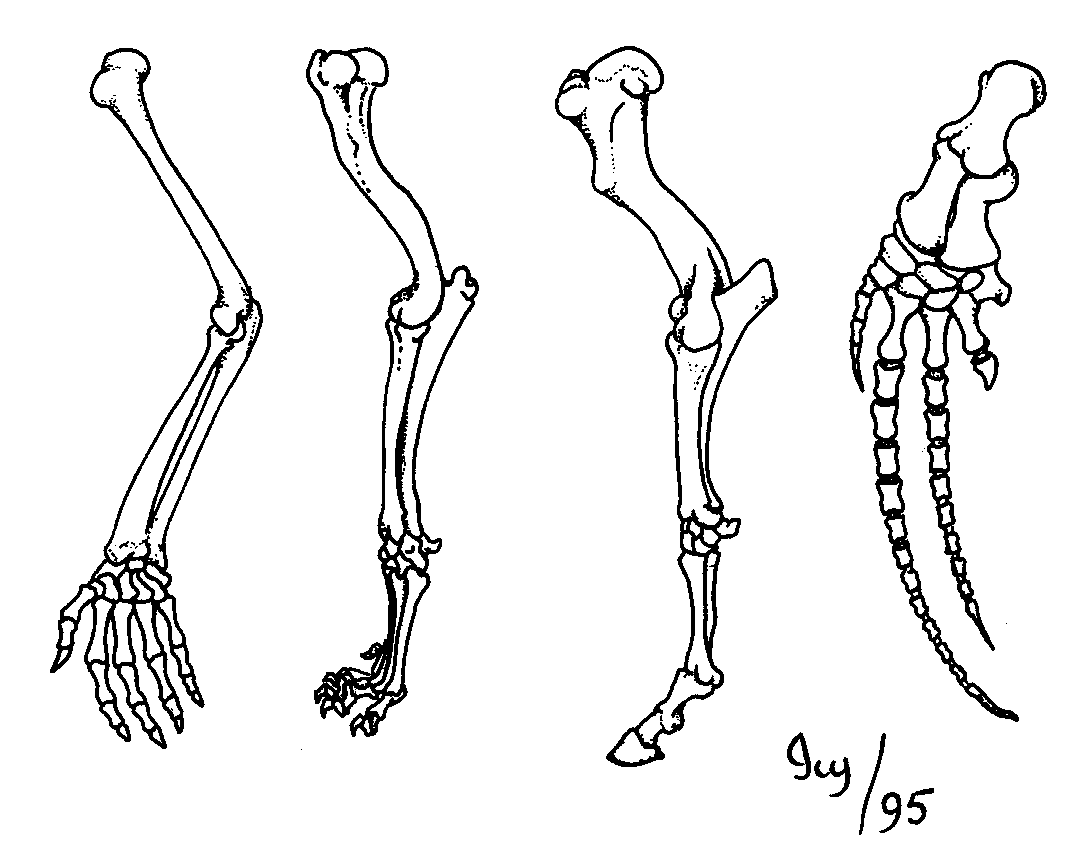
This picture is best known as
a)
homologous structures
b)
analogous structures
c)
vestigial structures
d)
embryology
35.
The Table below shows the # of differences in amino acids in a protein called “Cytochrome C” when comparing humans to other organisms. 
List the 4 closest human relatives based on this biochemical comparison.
a)
chimpanzee, horse, rattlesnake, snapping turtle
b)
chimpanzee, gorilla, rhesus monkey, horse
c)
fruit fly, bread mold, tuna fish, snapping turtle
d)
gorilla, rhesus monkey, rattlesnake, gorilla
36.
According to the diagram, which bird has the most similar DNA to a large tree finch?
a)
small tree finch
b)
medium tree finch
c)
large ground finch 
d)
green warbler finch
37.
Which three animals are most distantly related?
a)
The elephant, Manatee, and Yellow Frog
b)
The Yellow Frog, Salamander, and Bird
c)
The Lungfish, Crocodile, and Bird
d)
The Elephant, Lungfish, and Crocodile
38.
What is the process of which humans breed organisms for certain traits?
a)
artificial selection
b)
descent without modification
c)
inheritance of acquired characteristics
d)
natural selection
39.
Which of the following are examples of evidence for evolution?
a)
Fossils and Cellular Structure
b)
Biological Structures 
c)
Genetics/DNA
d)
All of the Above
40.
Only populations can evolve.
Individuals can not evolve.
a)
True
b)
False
41.
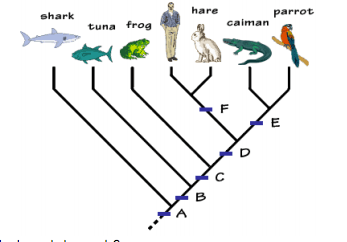
On the cladogram, which organism is the closest relative of the human?
a)
Frog
b)
Hare
c)
Caiman
d)
Parrot
42.

Why would a fox's fur be brown in the summer and white in a winter?

a)

The fox like to change fur colours.

b)

The changing colour of the fur help the fox blend with the surroundings

c)

The fox learn from its parents

d)

The fox like to do that

43.

Changes in anatomy, phylogeny, ecology, and behavior that take place in clades larger than a single species.

a)

Microevolution

b)

Macroevolution

c)

Coevolution

d)

Convergent Evolution

44.

How many finch species are on the islands?

a)

1

b)

5

c)

13

d)

28

45.

How did so many species come to be on the islands?

a)

One ancestral bird came to the islands

b)

13 different finch species came to the islands

c)

2 or more finch species came to the islands

d)

magic

46.

Which organism is most closely related to the cat?

a)

Fish

b)

Frog

c)

Salamander

d)

Goose

e)

Human

47.

this type of evolution happens on a small scale, typically within a single population

a)

microevolution

b)

macroevolution

c)

natural selection

d)

artificial selection

48.

Genetic differences between organisms of the same species.

a)

variation

b)

behavior

c)

adaptation

d)

environment

49.

In finches (birds), what is the biggest advantage of having different shaped beaks?

a)

to look different from other species

b)

to protect itself from predators

c)

to be able to eat the food readily available in the environment

d)

to protect itself against prey

50.

A mutation is defined as:

a)

A change in the cell's structure

b)

Anything that changes in an embryo

c)

Any change in the physical features of a human

d)

A change in the DNA sequence