
 Worksheets
Review Semester 2 Test Grade 7 Chemistry
Total questions: 60
Worksheet time: 30mins

A pollen grain in a beaker of still water is viewed through a microscope. Which diagram shows the most likely movement of the pollen grain?
A
B
C
D
A student makes an observation using a microscope. He observed some particles which were moving in a zig-zag way. What particles could these NOT be?
Smoke particles in air
Dust particles in a room
Pollen grains in water
Molecules in a solid bar of steel
Which of these is under greater pressure?


Why do weather balloons increase in size as they climb the atmosphere?
Because the gas pressure inside the balloon is higher than outside. This pushes its walls towards the outside.
Because the gas pressure inside the balloon is lower than outside. This pushes its walls towards the outside.
Because the gas pressure inside the balloon is lower than outside. This pushes its walls towards the inside.
Because the lower temperature at high altitudes causes the balloon's latex body to expand
The temperature of gas is held constant, while its volume is decreased. The pressure exerted by the gas on the wall of the container increases, because its molecules
Strike the walls with higher velocities
Strike the walls with more force
Strike the walls more frequently
Are in contact with the walls for a shorter time
Which key term describes the movement of particles from a high to low concentration?
How does the rate of diffusion change with an increase in temperature?
What TWO factors will increase the pressure produced? A - Higher temperature B - Lower Temperature C - Higher volume D - Lower volume


Hydrogen bromide gas, HBr, reacts with ammonia gas, NH3, to form solid ammonium chloride. Molecules of HBr is heavier than NH3. The apparatus is set up as shown. After a few minutes, solid ammonium chloride forms where the two gases meet.
A
B
C
D
Which element is INCORRECTLY matched with its symbol?
Cu / copper
Pb / lead
K / potassium
B / bismuth
The vertical columns of the periodic table are called...
Periods
Families
Chemical Symbols
Groups
Name this group: These elements, also known as inert gases, tend to be nonreactive.
Alkali metals
Alkaline Earth metal
Noble gases
Halogen gases


What does this illustrate
Elements
Compunds
Mixture of Elements and Compunds
Mixture of Compounds
Which of the following is matched incorrectly.
Air: compound
Steel alloy: homogeneous mixture
Glucose (C6H12O6): compound
Cookies & Cream: heterogenous mixture
There are _____ elements in C6H12O6 (Sugar) ?
24
20
3
6
The property of metal by which it can be drawn into wires is...
sonority
ductility
malleability
conductivity
All of the following would classify an element as a metal except?
Dull
Luster
Malleable
Ductile
When an object changes shape when struck by a hammer.
luster
malleable
brittleness
ductile
magnesium sulfuride
magnesium sulfur oxide
calcium sulfate
calcium nitrate
What is the name of the compound Mg3N2?
manganese nitride
magnesium nitride
magnesium nitrogen
magnesium nitrate
The correct formula for "Dinitrogen pentoxide" is...
N2O5
N2O
NO5
NO
Molecules below which has 5 atoms is...
NH4NO3
Mg(OH)2
KI
AlPO4
used to separate magnetic materials from nonmagnetic materials.
MAGNETIC SEPARATION
MANUAL PICKING
DECANTATION
SIEVING
FILTERING
separates soluble solids in a solution by evaporating the liquid component leaving the solid component behind
EVAPORATION
DISTILLATION
FRACTIONAL DISTILLATION
SIEVING
FILTERING

What seperation process is this?
Evaporation
Distillation
Filtration
Condensation

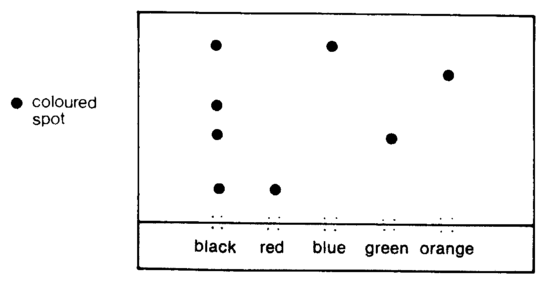
How many components is this dye made of?
2
3
4
5
Which process would you use to separate solid particles from larger particles in a mixture with filter paper in a funnel to trap solids so that the liquids will pass through.
Chromatography
Magnetic Attraction
Filtration
Flotation
A substance is soluble if it can be dissolved.
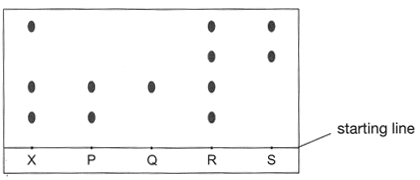
In paper chromatography, the most soluble solute _____________________ .
does not move from the start point
stays closest to the start point
travels furthest away from the start point
can be found in the middle of the chromatogram

Which substance is least soluble at 0 ºC?
KI
KNO3
KClO3
Ce2(SO4)3

Which solute is most likely a gas?
NH3
NaNO3
KCl
NaCl
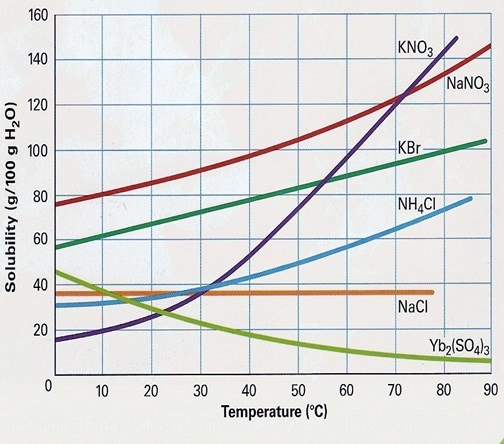
Identify how many grams of KNO3 is required to make a saturated solution at 40'C.
50 g
45 g
55 g
33 g

What combination would dissolve a solid solute the fastest?
high temperature, no stirring
no heat, no stirring
sugar cube, no heat
high temperature, stirring
Which of the properties of alkaline substance is NOT TRUE?
taste bitter
slippery
turn red litmus paper to blue
turn blue litmus paper to red
The reaction between acid and alkali known as
Titration
Neutralisation
Halogenation
Addition

When hydrochloric acid titrated into sodium hydroxide and achieved end point of neutralisation.
Which of the followings will be the mixture inside conical flask
Sodium nitrate and water
Sodium sulphate and water
Sodium chloride and water
Toothpaste will help to reduce acidity on tooth surface produced by bacteria.
This means toothpaste is
Alkaline
Acidic
Amphoteric
Neutral
Potassium hydroxide + Y -> potassium sulphate + water
What Y will be?
Nitric acid
Hydrochloric acid
Sulphuric acid
Which of the following is neutral?
Water
Acid
Salt
Alkali
The pH of pure water
5.6
7.0
8.1
0.0
The color of universal indicator in pure water:
Red
Blue
Purple
Green
Acids taste .....
sour
bitter
sweet
umami
Which pH levels indicated a strong acid?
1-3
4-6
8-11
12-14
Strong acids and alkalis are...
Sour
Sweet
Corrosive/Caustic
Burn litmus paper
A gas was tested by bringing a glowing/burning splint close to it. A pop sound was heard afterwards. What gas was tested?
Oxygen
Nitrogen
Hydrogen
Carbon dioxide
Carbon dioxide is tested by passing the gas through lime water. The gas turns lime water milky/cloudy.
True
False
Sulphuric acid + sodium carbonate
-->

