Wayground logo

Free Printable Worksheets

Font size

S
M
L
XL
Worksheets

MP3 9 Weeks Review

Total questions: 40

Worksheet time: 52mins

Name
Class
Date
1.
What two specific continents fit together most noticeably?
a)
Africa and North America
b)
South America and Europe
c)
South America and Africa
d)
 Antartica and Africa
2.
Who is the person credited with developing the theory of continental drift?
a)
Harry Hess
b)
Galileo
c)
Alfred Wegener
d)
Newton
3.
What is this a picture of?
a)
plate tectonics
b)
continental drift
c)
pangea
d)
glacier scaring
4.
The theory of continental drift named a key part of this idea Pangaea. What is Pangaea?
a)
One of the ancient animals that helped Wegener prove that fossils from different continents originally came from the same location
b)
 supercontinent that existed in Earth's distant past
c)
The underwater ocean range in the middle of the ocean
d)
The hot spot which gave rise to the Hawaiian Islands, among others
5.
What evidence did Wegener have for his theory of continental drift?
a)
He had no good evidence.
b)
He knew that plant and animal fossils as well as rock layers matched up in South America and Africa.
c)
He explained how the continents moved
6.

The movement of the tectonic plates is caused by

a)

the rotation of the Earth.

b)

convection currents in the Asthenosphere

c)

the gravity of the iron-nickel core.

d)

the Moho discontinuity.

7.
There are three types of plate boundaries. Which choice is NOT a type of plate boundary?
a)
convergent
b)
thrust
c)
divergent
d)
transform
8.

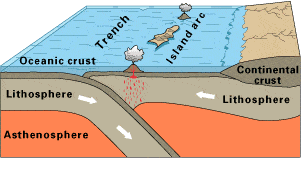
Observe this diagram of a plate boundary. One statement BEST describes what is happening. It is that

a)

the oceanic crust is melting.

b)

the denser ceanic crust is subducting under the less dense oceanic crust

c)

volcanic islands are forming.

d)

the tectonic plates are moving away from each other.
9.
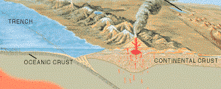
What geological forces might be responsible for this range of mountains?
a)
diverging tectonic plates
b)
erosion of the land by the ocean
c)
converging tectonic plates
d)
deposition of sediments by the ocean
10.

Where are earthquakes MOST LIKELY to occur?

a)

close to the equator

b)

close to the center of tectonic plates

c)

at divergent or convergent plate boundaries

d)

at transform plate boundaries

11.

Where would sea floor spreading most likely occur?

a)

At convergent boundaries (oceanic vs. oceanic)

b)

At convergent boundaries (oceanic vs. continental)

c)

At divergent plate boundaries (oceanic vs. oceanic)

d)

At transform plate boundaries

12.

Huge pieces of lithosphere that slowly move on the asthenosphere and consist of the crust and the rigid, uppermost part of the mantle

a)

tectonic plates

b)

North American Plate

c)

Eurasian Plate

d)

African Plate

13.

A tectonic plate division of the lithosphere that includes the continental crust of Greenland, North America, Siberia, and the surrounding oceanic crust.

a)

tectonic plates

b)

African Plate

c)

North American Plate

d)

South American Plate

14.

A tectonic plate division of the lithosphere, including most of the landmasses of Europe and Asia.

a)

South American Plate

b)

North American Plate

c)

Eurasian Plate

d)

African Plate

15.

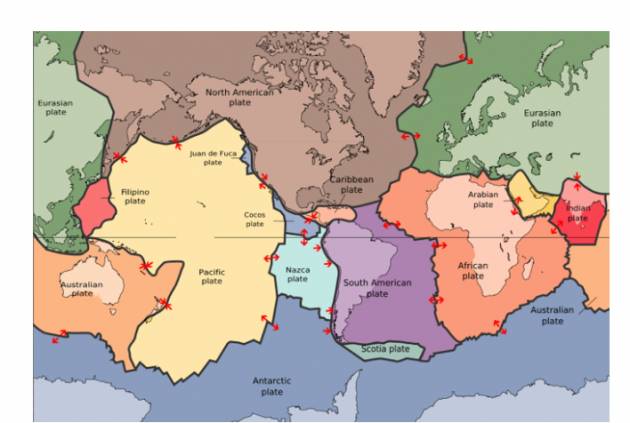
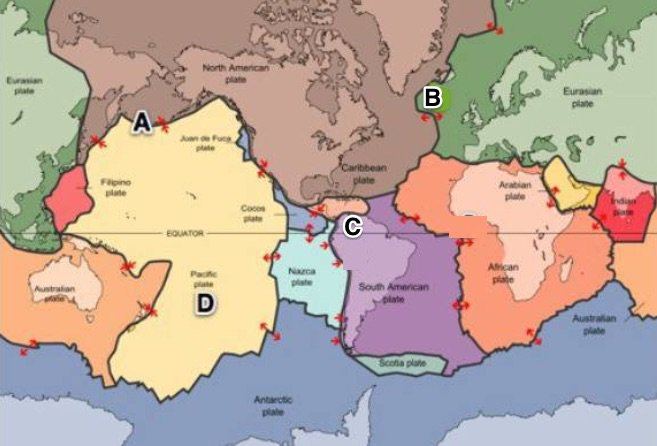
What is this major plate?

a)

African

b)

South American

c)

Eurasian

16.

What is this major plate?

a)

Indo-Australian

b)

Pacific

c)

Eurasian

17.

What is this major plate?

a)

African

b)

South American

c)

Indo-Australian

18.

What is this major plate?

a)

North American

b)

Eurasian

c)

Pacific

19.

What is this major plate?

a)

Pacific

b)

Antarctic

c)

Indo-Australian

20.

Weather Patterns

a)

Conduction

b)

Convection

c)

Radiation

21.

Sun Bathing

a)

Conduction

b)

Convection

c)

Radiation

22.

Mantle

a)

Conduction

b)

Convection

c)

Radiation

23.

Feet on Hot Sand

a)

Conduction

b)

Convection

c)

Radiation

24.

Lava Lamp

a)

Conduction

b)

Convection

c)

Radiation

25.

Sally is researching the differences that exist in each layer of the Earth. Which of the following best describes Earth's crust?

a)

Solid, rocky

b)

Liquid, metallic

c)

Semisolid, convecting

d)

Dense, extremely hot

26.

Which of Earth's layers is best described as liquid metal?

a)

crust

b)

mantle

c)

outer core

d)

inner core

27.

The layers of Earth can be classified by their thickness, composition, and state. Which of Earth's layers is best described as a molten state of medium density made of mostly silicon and oxygen?

a)

crust

b)

outer core

c)

mantle

d)

inner core

28.

The two types of crust are continental crust and ________ crust.

a)

continental

b)

oceanic

c)

plates

d)

mantle

29.
In which layer of the Earth is the athenosphere located?
a)
inner core
b)
mantle
c)
outer core
d)
crust
30.
What are the 3 major types of rocks?
a)
Igneous, Metamorphic, Sedimentary
b)
Metamorphic, Igneous, Cementation
c)
Brown, Red, Gray
d)
Streak, Hardness, Breakage
31.
This rock was formed when molten rock cooled into a solid. What type of rock is it?
a)
Igneous Rock
b)
Metamorphic Rock
c)
Sedimentary Rock
32.
When sediments are pressed together tightly, this is called ____________.
a)
Compaction
b)
Cementation
c)
Weathering
d)
Erosion
33.
The process by which igneous rocks are formed...
a)
heat and pressure
b)
melting and cooling
c)
weathering and erosion
34.
The process by which metamorphic rocks are formed...
a)
heat and pressure
b)
erosion and deposition
c)
melting and cooling
35.

Shale, Limestone, and Sandstone all contain layers . These types of rock are most likely classified as.....

a)

igneous rock

b)

sediment

c)

sedimentary rock

d)

metamorphic rock

36.
What is the most abundant element found in the earth's atmosphere?
a)
Oxygen
b)
Sulfur
c)
Nitrogen
d)
Argon
37.
This element occurs in large amount in the atmosphere and small amount in living things.
a)
Nitrogen
b)
Oxygen
c)
Argon
d)
Carbon
38.
Which of the following are the elements found in the solid part of the Earth?
a)
Calcium and Oxygen
b)
Oxygen and Silicon
c)
Iron and Oxygen
d)
Potassium and Silicon
39.

Look at the data table. Which graph below best represents the most abundant elements in the Earth's crust?

a)
b)
c)
d)
40.

The Earth's crust is primarily made up of which two elements?

a)

nitrogen and hydrogen

b)

oxygen and carbon

c)

silicon and oxygen