wayground logo

Free Printable Worksheets

NEW

Font size

S
M
L
XL
Worksheets

Atoms Quiz Review

Total questions: 39

Worksheet time: 38mins

Name
Class
Date
1.

All matter is made of what

a)

energy

b)

atoms

c)

electrons

d)

compounds

2.

The positive particles of an atom are

a)

electrons

b)

positrons

c)

neutrons

d)

protons

3.

The central region of an atom where its neutrons and protons are is its

a)

nucleus

b)

electron cloud

c)

core

d)

center

4.

An atom with atomic number 6 would have how many protons

a)

6

b)

12

c)

3

d)

cannot be determined

5.

Particles in an atom that are neutral and have no charge are

a)

negatrons

b)

electrons

c)

neutrons

d)

protons

6.

What is the atomic number for an element with 3 protons?

a)

2

b)

1

c)

3

d)

6

7.

A particle that moves around the nucleus is a(n)...

a)

Proton

b)

Neutron

c)

Electron

d)

Quark

8.

In the modern periodic table, elements are arranged by:

a)

atomic mass

b)

atomic number

c)

valence electrons

d)

number of isotopes

9.

What does the 1.00794 stand for?

a)

Hydrogen

b)

atomic number

c)

atomic mass

d)

atomic explosion

10.

What subatomic particles would you find in the nucleus of an atom?

a)

Protons only

b)

Protons and Neutrons

c)

Neutrons and Electrons

d)

Protons and Electrons

11.

If an atom has 10 protons, 10 neutrons, and 10 electrons, what is the mass of the atom?

a)

10

b)

20

c)

30

12.

What particle uniquely identifies an element?

a)

Number of Valence Electrons

b)

Number of Protons

c)

Number of Electrons

d)

Atomic Mass

13.

Most of the mass in an atom is concentrated in the...

a)

electrons

b)

nucleus

c)

protons

d)

empty space

14.

Electrons are___________

a)

Extremely small even in comparison to protons.

b)

part of the nuclues.

c)

Super Positive, like cheerleaders!

d)

very large

15.

An atoms overall charge is

a)

positive

b)

depends on its mood

c)

neutral

d)

negative

16.
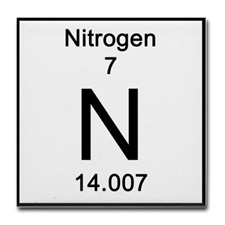
What is the number of protons that the element in this image contain?
a)
14
b)
7
c)
15
d)
18
17.
What is the atomic mass of "F"
a)
9
b)
18
c)
17
d)
19
18.
What are the 3 particles that make-up the atom?
a)
protons, neutrons, and isotopes
b)
neutrons, isotopes, and electrons
c)
positives, negatives, and electrons
d)
protons, neutrons, and electrons
19.
John Dalton stated:
a)
elements are made of atoms
b)
atoms of a given element are identical
c)
atoms cannot be subdivided, created, nor destroyed
d)
all of the above
20.
The scientist responsible for "discovering" the nucleus is:
a)
Bohr
b)
Rutherford
c)
Schroedinger
d)
Einstein
21.
The nucleus of an atom can be described as:
a)
spacious and negatively charged
b)
dense and positively charged
c)
spacious and positively charged
d)
dense and negatively charged
22.
Electrons are not factored into atomic mass because:
a)
They are so small their mass is negligible
b)
They're not in the nucleus
c)
They're too big
d)
They move so quickly their mass is zero
23.
How did Rutherford discover the proton?
a)
Cathode tube ray experiment
b)
Gold Foil Experiment
c)
Planetary Model
d)
Plum Pudding Model
24.
True or False: The majority of an atom is made up of empty space
a)
True
b)
False
25.
The smallest unit of a pure substance that has the properties of that substance
a)
element
b)
atom
c)
neutron
d)
compound
26.
What scientist is best known for his "Plum Pudding" model of the atom?
a)
J.J. Tomson
b)
Ernest Rutherford
c)
John Dalton
d)
Democritus
27.
Place the following scientists in order, from earliest to latest: 
A) Ernest Rutherford
B) J.J. Thomson
C) John Dalton
a)
B,C,A
b)
C,A,B
c)
A,C,B
d)
C,B,A
28.
Value representing the number of protons in an element
a)
Atomic Mass
b)
Mass Number
c)
Valence Electrons
d)
Atomic Number
29.
Measure mainly of the nuclear particles: protons + neutrons
a)
Subatomic Particles
b)
Atomic Number
c)
Atomic Mass
d)
Gluons
30.
Proposed the Modern Electron Cloud Model of the atom
a)
Schrodinger & Heisenberg
b)
Dalton
c)
Chadwick
d)
Rutherford
31.
Created the Planetary Model of the atom
a)
Bohr
b)
Dalton
c)
Rutherford
d)
Chadwick
32.
Discovered the electron within the atom
a)
Thomson
b)
Chadwick 
c)
Schrodinger & Heisenberg
d)
Dalton
33.
Calculation used to find the number of neutrons in an atom
a)
Atomic Mass - Atomic Number
b)
Atomic Number - Atomic Mass
c)
Atomic Mass - Electrons
d)
none of these
34.

How many valence electrons does Hydrogen have?

a)

1

b)

2

c)

3

d)

4

e)

5

35.

How many valence electrons does Beryllium have?

a)

1

b)

2

c)

3

d)

4

e)

5

36.

How many valence electrons does Chlorine have?

a)

4

b)

5

c)

6

d)

7

e)

8

37.

How many valence electrons does Iodine have?

a)

4

b)

5

c)

6

d)

7

e)

8

38.

How many valence electrons does Argon have?

a)

4

b)

5

c)

6

d)

7

e)

8

39.

Valence electrons are located...

a)

inside the nucleus

b)

in outer space

c)

on the outermost orbit of an atom