wayground logo

Free Printable Worksheets

NEW

Font size

S
M
L
XL
Worksheets

3.4 IB Pedigrees

Total questions: 20

Worksheet time: 25mins

Name
Class
Date
1.

Which best explains why individual IV-7 has colorblindness?

a)

Because her mom is a carrier and her dad has the gene

b)

Because her dad has it.

c)

Because her siblings have it.

d)

Because her uncle has it.

2.
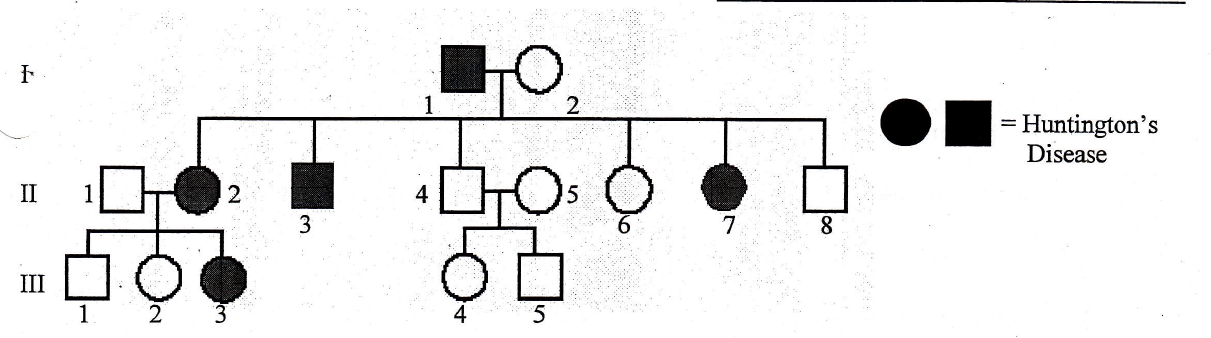
If the affected female in Generation 3 mates with an affected male. What will be their offspring's genotype? 
a)
50% Hybrid/50% Purebred
b)
100% Homozygous Dominant 
c)
100% Homozygous Recessive 
d)
100% Heterozygous 
3.
There are no carriers for Huntington's Disease - you either have it or you don't. Is Huntington's disease caused by a dominant or recessive trait?
a)
Dominant
b)
Recessive
c)
Co-dominant
d)
Incompletely dominant
4.
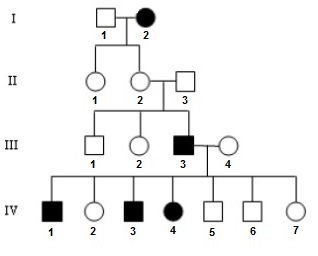
Is it possible for individual IV-2 to be a carrier? Why?
a)
No, because her parents don't have the trait.
b)
No, because she doesn't have the trait.
c)
Yes, because her siblings have it.
d)
Yes, because her parents are carriers.
5.

Give the genotype for person II-1, for this autosomal trait.

a)

GG

b)

Gg

c)

gg

d)

we cannot be 100% sure of the genotype
6.

If hemophilia is a sex-linked recessive trait, what genotype would individual III-3 have?

a)

XhX

b)

XhXh

c)

XhYh

d)

XhY

7.
The pedigree chart below shows the blood types of three members of a family.  What could be the blood types of individuals 1 and 2?
a)
1= A     2= AB
b)
1=AB    2=A
c)
1=O     2=AB
d)
1=B     2=A
8.
The blood groups of a mother and 4 children are indicated on the pedigree chart below.  What are the possible blood groups of the father?
a)
Group A only
b)
Group A or B only
c)
Group AB only
d)
Group A, B or AB only
9.
What type of inheritance is shown in this pedigree chart?
a)
X-linked dominant
b)
Y-linked dominant
c)
X-linked recessive
d)
Y-linked recessive
10.
What evidence is given in the pedigree chart below to establish that the condition is caused by a dominant allele?
a)
Two unaffected parents have unaffected children
b)
Two affected parents have affected children
c)
An affected parent and an unaffected parent have affected children
d)
Two affected parents have an unaffected child
11.
What is the mode of inheritance shown here?
a)
Autosomal Dominant
b)
Autosomal Recessive
c)
Sex Linked Recessive
12.
What is the mode of inheritance shown here?
a)
Autosomal Dominant
b)
Autosomal Recessive
c)
Sex Linked
13.

What type of inheritance is shown in this pedigree?

a)

Autosomal dominant

b)

Autosomal recessive

c)

Sex-linked dominant

d)

Sex-linked recessive

14.

What type of inheritance is shown?

a)

Sex linked dominant

b)

Sex linked recessive

c)

Autosomal dominant

d)

Autosomal recessive

15.

What type of inheritance is shown?

a)

Sex linked dominant

b)

Sex linked recessive

c)

Autosomal dominant

d)

Autosomal recessive

16.

What type of inheritance is shown?

a)

Sex linked dominant

b)

Sex linked recessive

c)

Autosomal dominant

d)

Autosomal recessive

17.

What type of inheritance is shown?

a)

Sex linked dominant

b)

Sex linked recessive

c)

Autosomal dominant

d)

Autosomal recessive

18.

If the trait is depicted by the letters T and t, what is the genotype of individual III-2?

a)

TT

b)

Tt

c)

tt

d)

TT or Tt

19.

What is the genotype of the F1 male?

a)

XRY

b)

XrY

c)

XRYr

d)

XRYR

e)

XrYr

20.

What is the genotype for individual III-7?

a)

gg

b)

GG

c)

XGXG

d)

XgXg