
 Worksheets
CJH Plate Tectonics (TEKS 6.10C 6.10D)
Total questions: 35
Worksheet time: 22mins
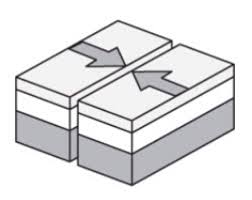


Which layer of the Earth is solid iron and nickel?
Mantle
Crust
Inner Core
Outer core

A map is provided that presents information on a certain region of the Earth. Based on the information on the map, at which location are mountains most likely to form?
A
B
C
D

A map is provided that shows the location of the Aleutian Islands in comparison to some of Earth’s tectonic plates is provided. Based on the information provided, which of the following is most likely a feature of the Aleutian Islands?
The climate is getting older.
They were formed by volcanic activity.
These islands are the oldest on Earth.
Earthquakes do not occur there

Peru and Chile are part of South America, which sits on the South American tectonic plate. The Nazca plate is moving toward the South American plate. It is pushed downward, which causes it to slide under the South American plate. Based on this information, what feature could we expect to see off the coast of Peru and Chile?
new Continent formation
Poor fishing conditions
Deep ocean trench
Severe tropical storms

This is the type of boundary that occurs when tectonic plates move apart.
convergent
divergent
transform
none of the above

When one piece of crust gets pushed under another one, it called:
radial fracture
lingering
subduction
leverage

The tectonic plate labeled with the letter G is the ___________ plate.
Indo-Australian
African
Pacific
South American

What is the name of plate #5?
Cocos
South American
Juan de Fuca
Pacific

What is the name of plate #1?
Cocos
African
Juan de Fuca
Eurasian

What is the name of plate #6?
Antarctic
Arabian
Australian
Pacific

What is the name of plate #2?
Antarctic
Arabian
North American
South American

What is the name of plate #4?
Antarctic
Arabian
North American
African

What is the name of plate #7?
Eurasian
Antarctic
Philippine
Scotia

What is the name of plate #3?
Eurasian
Pacific
Philippine
Scotia

What is the name of plate #8?
Eurasian
Indian
North American
Scotia

What is the name of plate #5?
Cocos
Indo-Australian
Juan de Fuca
Pacific

What is the name of plate #1?
Cocos
Indo-Australian
Juan de Fuca
Pacific

What is the name of plate #6?
Antarctic
Arabian
North American
Pacific

What is the name of plate #2?
Antarctic
Arabian
North American
South American
What is the name of plate #4?
Antarctic
Arabian
North American
South American
What is the name of plate #7?
Eurasian
African
Philippine Sea
Scotia
What is the name of plate #3?
Eurasian
Nazca
Philippine Sea
Scotia

