
 Worksheets
AP Chem Term 3 Review
Total questions: 100
Worksheet time: 3hrs 43mins
How are the exponents n and m determined?


step 2: O3 + O → 2 O2
The oxygen atom (O) is considered to be a(n)...

If 5.00 grams of water (specific heat = 4.18 J/gC) is cooled from 65.2 °C to 35.6 °C, what is the heat change?
If 2.50 grams of a solute are added to 50.0 grams of water, the temperature increases by 4.5 °C. Assuming the specific heat of the solution is the same as that of water (4.18 J/gC), what is the heat of reaction?
H2 (g) + F2 (g) → 2HF (g) ∆H° = -542.2 kJ
2H2 (g) + O2 (g) → 2H2O (l) ∆H° = -571.6 kJ calculate the value of ∆H° for the reaction: 2F2 (g) + 2H2O (l) → 4HF (g) + O2 (g)
C4H9OH+6O2 → 4CO2+5H2O
What is the sign for the heat of reaction and why?
remaining constant
SO2(g) + O2(g) <−> SO3(g)
If the concentration of SO2(g) is increased, the equilibrium of the reaction will ___________.
SO2(g) + O2(g) <−> SO3(g)
If the equilibrium shifts to the right, the concentration of O2(g) will ___________.
Removing O2(g) will
2SO2(g)+O2(g) ⇌ 2SO3(g) + Heat
Increasing the temperature will...
shift equilibrium right
shift equilibrium left
increase pressure
have no change
Given the reaction: N2 (g) + 3H2 (g) <--> 2NH3 (g) + heat
If the temperature is increased, the concentration of N2 will
decrease
increase
remain the same
N2 (g) + 3 H2 (g) <=> 2 NH3 (g)
If the pressure in the system is increased, which substance(s) will increase in concentration?
H2 (g) + Cl2 (g) ↔ 2HCl (g) + heat
If the temperature is cooled, the _________ reaction will be favored.
Which change would alter the value of the equilibrium constant (Kp) for this reaction?
2SO2(g) + O2(g) ⇌ 2SO3(g)
Increasing the total pressure of the system.
Increasing the concentration of sulfur trioxide.
Increasing the concentration of sulfur dioxide.
Increasing the temperature
Pressure, temperature, and concentration changes are all stresses that cause a shift in equilibrium. The only one that changes the value of the equilibrium constant, K, is __________________.
pressure
temperature
concentration
The equilibrium constant, Kc, for the following reaction is 6.44 x 10⁵ at 230°C 2NO(g) + O2(g) ↔ 2NO2(g)
Calculate the equilibrium constant for: 2NO2(g) ↔ 2NO(g) + O2(g)
6.44 x 10⁵
1.55 x 10⁻⁶
3.22 x 10⁵
For the reaction A(g) ↔ B(g) + C(g), the equilibrium constant, Kp, is 2 x 10⁻⁴ at 25 °C. A mixture of the three gases at 25 °C is placed in a reaction flask and the initial pressures are PA = 2 atmosphere, PB = 0.5 atmosphere, and PC = 1 atmosphere. At the instant of mixing, which of the following is true for the reaction as written?
ΔG < 0
ΔG > 0
How many moles of NaF must be dissolved in 1.00 liter of a saturated solution of PbF2 at 25 °C to reduce the [Pb2+] to 1 x 10⁻⁶ molar? (Ksp of PbF2 at 25 °C = 4.0 x 10⁻⁸)
0.020 mole
0.040 mole
0.20 mole
0.40 mole
In which of the following systems would the number of moles of the substances present at equilibrium NOT be shifted by a change in the volume of the system at constant temperature?
CO(g) + NO(g) ↔ CO2(g) + ½ N2(g)
N2(g) + 3 H2(g) ↔ 2 NH3(g)
N2(g) + 2 O2(g) ↔ 2 NO2(g)
NO(g) + O3(g) ↔ NO2(g) + O2(g)
Which of the following must be true for a reaction that proceeds spontaneously from initial standard state conditions?
ΔG° > 0 and Keq > 1
ΔG° > 0 and Keq < 1
ΔG° < 0 and Keq > 1
ΔG° < 0 and Keq < 1
The solubility of CuI is 2 × 10⁻⁶ molar. What is the solubility product constant, Ksp, for CuI?
1.4 × 10⁻³
2 × 10⁻⁶
4 × 10–12
2 × 10–12
PCl3(g) + Cl2(g) ↔ PCl5(g) + energy
Some PCl3 and Cl2 are mixed in a container at 200°C and the system reaches equilibrium according to the equation above. Which of the following causes an increase in the number of moles of PCl5 present at equilibrium?
Decreasing the volume of the container
Raising the temperature
Adding a mole of He gas at constant volume
Raising the temperature and adding a mole of He gas at constant volume
4 HCl(g) + O2(g) ↔ 2 Cl2(g) + 2 H2O(g)
Equal numbers of moles of HCl and O2 in a closed system are allowed to reach equilibrium as represented by the equation above. Which of the following must be true at equilibrium?
The [HCl] must be less than [Cl2].
The [O2] must be greater than [HCl].
The [Cl2] must equal [H2O].
The [O2] must be greater than [HCl] and [Cl2] must equal [H2O].
2 SO2(g) + O2(g) ↔ 2 SO3(g) When 0.40 mole of SO2 and 0.60 mole of O2 are placed in an evacuated 1.00-liter flask, the reaction represented above occurs. After the reactants and the product reach equilibrium and the initial temperature is restored, the flask is found to contain 0.30 mole of SO3. Based on these results, the expression for the equilibrium constant, Kc, of the reaction is


W(g) + X(g) ↔ Y(g) + Z(g)
Gases W and X react in a closed, rigid vessel to form gases Y and Z according to the equation above. The initial pressure of W(g) is 1.20 atm and that of X(g) is 1.60 atm. No Y(g) or Z(g) is initially present. The experiment is carried out at constant temperature. What is the partial pressure of Z(g) when the partial pressure of W(g) has decreased to 1.0 atm?
0.20 atm
0.40 atm
1.0 atm
1.2 atm
What is the molar solubility in water of Ag2CrO4? (The Ksp for Ag2CrO4 is 8 × 10–12.)
8 × 10–12 M
2 × 10–12 M


When a 2.04 g sample of an unknown hydrate of magnesium carbonate, MgCO3 · xH2O(s), is heated, H2O (molar mass 18 g) is driven off. The mass of the anhydrous MgCO3(s) (molar mass 84 g) that remains is 1.68 g. The value of x in the hydrate is
NO Calculator :)
1
The sample is a monohydrate
MgCO3 · H2O
2
The sample is a dihydrate
MgCO3 · 2H2O
5
The sample is a pentahydrate
MgCO3 · 5H2O
10
The sample is a decahydrate
MgCO3 · 10H2O

A mixture of O2(g) and H2(g) is placed in a container, as shown. A reaction occurs, forming H2O(g). Which of the following best represents the contents of the box after the reaction has proceeded as completely as possible?
NO Calculator :)


Give the net ionic equation for the reaction
Pb(NO3)2 + Li2SO4 → PbSO4 + 2LiNO3
I) Pb2+(aq) + 2(NO3)1-(aq) + 2Li1+(aq) + SO42-(aq) → PbSO4(s) + 2LiNO3(s)
II) 2Li1+(aq) + 2(NO3)1-(aq) → 2LiNO3(s)
III) Pb2+(aq) + SO42-(aq) → PbSO4(s)
IV) Li1+(aq) + (NO3)1-(aq) → LiNO3(s)
NO Calculator :)
I)
II)
III)
IV)

Based on the information for two different reactions given, which of the following gives the quantities needed to calculate the enthalpy change for the reaction represented by the overall equation below?
2NO(g)+O2(g) → N2O4(g)
NO Calculator :)
ΔH1 + ΔH2
ΔH1 + (−ΔH2)
(−ΔH1) + ΔH2
ΔH1 + (2×ΔH2)
The oxidation of carbon monoxide can be represented by the chemical equation
2 CO(g) + O2(g) → 2 CO2(g) ΔHrxn = -613kJ/molrxn
Which of the following best represents the energy absorbed or released when 168grams of CO is oxidized?
-1839kJ
1839kJ
-3678kJ
3678kJ
When two aqueous solutions are mixed together in a closed container. A precipitate forms and the temperature increases. Which of the following indicates the correct signs for ΔG, ΔH, and ΔS for the process?
-ΔG
-ΔH
-ΔS
+ΔG
-ΔH
-ΔS
-ΔG
+ΔH
+ΔS
+ΔG
+ΔH
+ΔS
Rate=[A]2[B]1

(CH3)3CBr(aq) + OH-(aq) → (CH3)3COH(aq) + Br-(aq)
What will the initial rate (in mol/L*s) be in Experiment 4?


Does this show an endothermic or an exothermic reaction?
Endothermic
Exothermic

Which letter shows the activation energy, Ea?
A
B
C
D
E
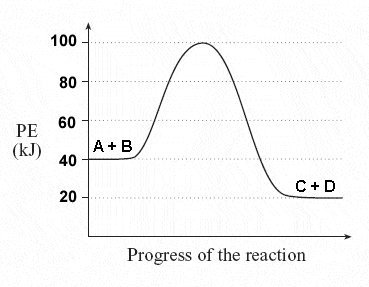


The following data were measured for the reaction BF3(g) + NH3(g) —> F3BNH3(g)
What is the rate law for the reaction?
R=K[NH3]
R=K[BF3]2[NH3]
R=K[BF3][NH3]
R=K[BF3][NH3]2

The reaction
2ClO2(aq) + 2OH-(aq) —> ClO3(aq) + ClO2-(aq) + H2O(l) was studied with the following results:
Calculate the rate constant with proper units.
230 M/S
230 M-1s-1
230 M-2-s-1
R=K[ClO2][OH-]
What is collision theory?
Molecules must collide in the correct orientation with enough energy to bond.
Molecules need enough energy to collide and react.
Atoms constantly collide and react.
The minimum energy needed for atoms to react
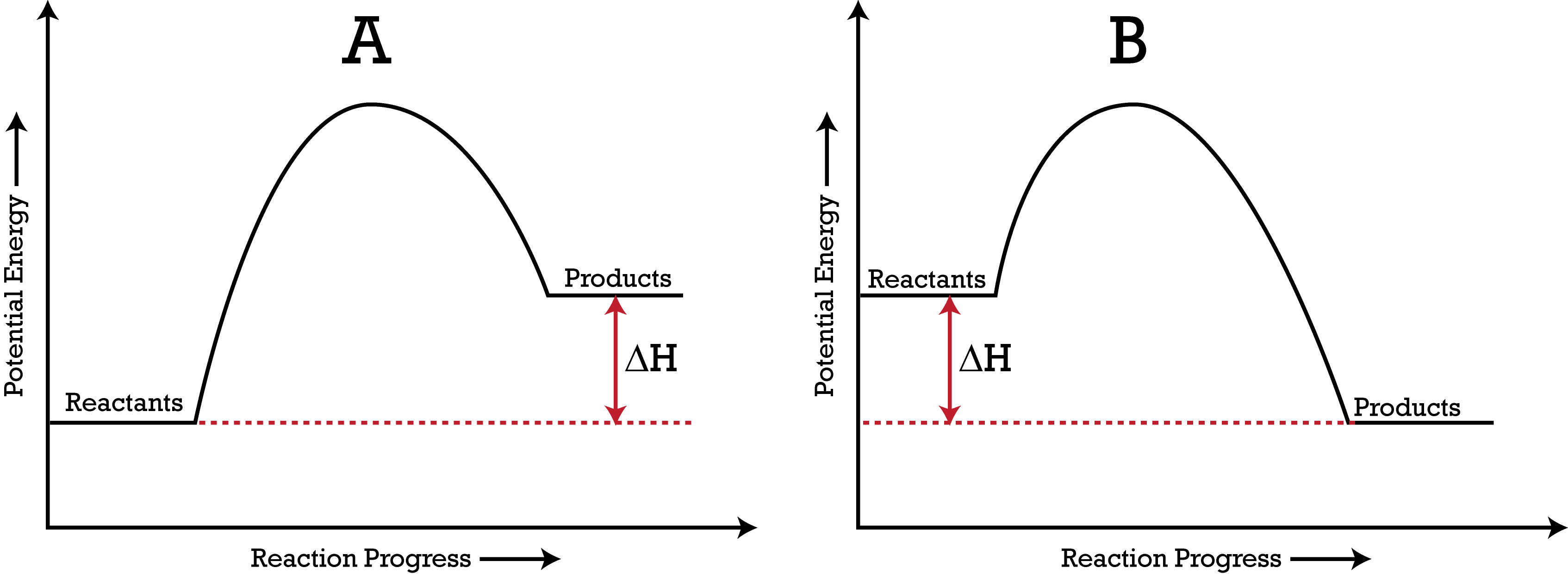
Which PE Diagram represents an endothermic reaction?
A
B
Decreasing the concentration of a substance will usually........
Slow down the reaction
Speed up the reaction
Have no affect on the reaction
How does surface area affect reaction rate?
Larger surface areas increase reaction rate
Smaller surface areas increase reaction rate
Reaction rate is not affected by surface area.
What happens to the catalyst at the end of a reaction?
It is used up in the reaction and becomes part of the product
It remains unchanged at the end of a reaction
It is usually decomposed in the reaction and is reformed elsewhere
It usually undergoes a double displacement reaction and is reformed elsewhere.

The addition of a catalyst to this reaction would cause a change in which of the indicated energy differences?
I
II
III
I and II
A reaction has both positive ∆S° and ∆H° values. From this information alone, you can conclude that the reaction
can be spontaneous at any temperature.
cannot be spontaneous at high temperatures.
can be spontaneous only at low temperatures.
can be spontaneous only at high temperatures.

Consider this hypothetical reaction (at 375 K). The free energies in kJ/mol at this temperature are given below each substance in parentheses. What is the value of Gibbs free energy for the reaction at this temperature? Is the reaction spontaneous?
-300.0 kJ; spontaneous
0.00 kJ; at equilibrium
300.0 kJ; non-spontaneous
600.0 kJ; non-spontaneous
A certain non-spontaneous reaction has ∆H of 12.3 kJ and a ∆S of 42 J/K. At approximately what temperature would the reaction become spontaneous?
-20°C
0°C
20°C
100°C
Which of the following is true when ice melts?
∆H<0 ∆S<0
∆H=0 ∆S=0
∆H<0 ∆S>0
∆H>0 ∆S>0
Which of the following is true for the condensation of benzene, C6H6?
∆H°>0, ∆S°>0
∆H°>0, ∆S°<0
∆H°<0, ∆S°>0
∆H°<0, ∆S°<0

In which of the following four processes is there an increase in entropy?
all of the above
I and II only
I and IV only
III and IV only
It is observed that the reaction producing KCl from its elements goes essentially to completion. Which of the following statements must be true about the thermodynamic favorability of the reaction?
The reaction is favorable and enthalpy-driven.
The reaction is favorable and entropy-driven.
The reaction is favorable and driven by both the enthalpy and entropy changes.
The reaction is unfavorable due to unfavorable changes in enthalpy and entropy.

Which processes are spontaneous at all temperatures?
I only
II only
III only
IV only
The process which must be nonspontaneous at all values of temperature is
I.
II.
III.
IV.
Which of these four processes is nonspontaneous at low temperature but becomes more spontaneous as the temperature rises?
I.
II.
III.
IV.
_____ is a measure of the average kinetic energy of all the particles that make up an object.
Density
Conduction
Radiation
Temperature
The rate of reaction will be large if:
ΔGo is a large negative number
ΔSo is a large negative number
ΔHo is a large negative number
None of these determine rate
For a certain chemical reaction, ΔHo = -35.4 kJ and ΔSo = 85.5 J/K. Calculate the equilibrium constant for this process at standard conditions.
2.97 x 10⁴
3.47 x 10⁻⁵
4.69 x 10¹⁰
54.8
What volume does .0685 mol of gas occupy at STP?
0.3707 mol
0.7515 mol
1.53 L
3.06 L
Calculate the molar mass of a gaseous substance if 0.125 g of the gas occupies 93.3 mL at STP.
30.0 g/mol
30.2 g/mol
30.4g/mol
30.6 g/mol
None of the above
How does a catalyst speed up a reaction?
Adding more reactant
Providing a pathway that has a lower activation energy
Increasing the activation energy
Increasing binding energy
___________ are produced in one step and used up in a later step and __________________ are present and unchanged in the reactants and the products
intermediates, catalysts
catalysts, intermediates
What is the rate law for the reaction with this slow elementary step? A + 2B --> D + C
rate = k[A]2
rate = k[A][B]2
rate = k[A][B]
rate = k[A]


What is the value for the reaction N2(g) + 2O2(g) ↔ N2O4(g) in terms of the K values for the following reactions:
1/2 N2(g) + 1/2 O2(g) ↔ NO(g) K1
2 NO(g) + O2(g) ↔ N2O4(g) K2
K1 + K2
K12 + K2
2 K1 x K2
K12 x K2
What is the molarity of a solution that contains 125 g NaCl in 4.00 L of solution?
0.535 M NaCl
2.14 M NaCl
8.56 M NaCl
31.3 M NaCl

Which term correctly describes a solution containing 50 g KCl/100g H2O at 60°C?
subsaturated
saturated
supersaturated
unsaturated
Which of the following compounds will not disassociate in water?
(Hint: check your solubility rules)
NaCl
PbCl2
MgNO3
Na2SO4
B2H6 + 3O2 -->2 HBO2 + 2 H2O
What mass of O2 will be needed to burn 36.1 g of B2H6?
13.8 g O2
3.86 mol of O2
123.8 g O2
12.4 g O2

