
 Worksheets
Static Electricity
Total questions: 58
Worksheet time: 37mins
If an object has the same number of positive & negative charges, its electrical charge is...
positive
negative
neutral or no charge
opposite
If two charges repel each other, the two charges could be
Positive & neutral
Positive & negative
positive & neutral
negative & negative

Walking across a carpet is an example of charge being transferred by
friction.
induction.
contact.
Electric charges that are alike _______ each other.
Attract
Repel (move away)
Neutrons have
positive charge
negative charge
no charge
opposite charge

Electric force is described as
The force between charged objects.
A buildup of charges on an object.
Electric charges flow through a substance
Parts of an atom
An electric FIELD is
The area inside an electric fence
The region around a charged object where the object’s electric force is exerted on other charged objects
The same thing as electric force
The neutral region in an area
Static electricity occurs because...
of thunder
of humid air
of neutral particles adding up
of a buildup of charges on an object.
The loss of static electricity as electric charges transfer from one object to another.
Static Discharge
Negative Charge
Positive Charge
Neutral Charge
A method of redistributing the charge on an object by means of the electric field of another object
Conduction
Induction
Convection
Electricity
Which of the following is an example of a conductor?
plastic
copper
glass
rubber

If the balloon has a negative charge, the hair must have what charge?
negative
positive
neutral
For an object to have a positive charge, it must ____.
lose electrons
gain electrons
lose protons
gain protons
All of the following are examples of static electric discharge EXCEPT:
lightning
getting shocked by a doorknob
the crackle sound as you pull clothes from the dryer apart
when your hair stands on end as you jump on the trampoline

Two balloons are hanging from a stick.
Both balloons have a positive charge.
How would you expect the balloons to move?
there would be no movement
towards each other
away from each other

Two balloons are hanging from a stick.
One balloon has a positive charge and the other has a negative charge.
How would you expect the balloons to move?
there would be no movement
towards each other
away from each other

The ball on the string is being repelled (pushed away) by the metal bar.
What must be the charge on the ball?
postivie
neutral
negative
Read the following statements about electric force. Which statement is NOT CORRECT?
The smaller the distance between 2 charged particles, the stronger the electric force.
The higher the charges involved, the stronger the electric force.
The greater the distance between 2 charged particles, the weaker the electric force.
The smaller the distance between 2 charged particles, the weaker the electric force.

Look at the set of objects to the right. We could
increase the electric force between Object A and
Object B by each of the following EXCEPT:
Pushing them farther apart.
Increasing the difference between their charges.
Moving them closer together.
Adding lots of negative charges to Object A.

The picture shows a comb that was used on a cold, dry day. Which of the following is the best
explanation of why some of the paper bits were attracted to the combs while others were not.
Protons moved more easily in the paper that was attracted to the comb.
Electric force gets weaker the farther away objects are from each other.
Some paper had iron in it and some didn’t.
Magnetic force gets weaker the farther away objects are from each other.
In a neutral atom, the number of electrons is equal to the number of _______.
Neutrons
Protons
Orbits
Subatomic Particles
An object becomes positively charged by
losing protons
gaining electrons
losing electrons
gaining protons
An object becomes negatively charged by
losing protons
gaining electrons
losing electrons
gaining protons
Select the materials that are electrical conductors.


Select the materials that are electrical insulators.


The overall charge on an object is ________ when both numbers of electrons and protons are equal.
Neutral
Positive
Negative
No charge
Which of the following activity can create static electricity?
When we rub our hair with a balloon.
When we comb our dry hair.
When we rub the glass rod with a woolen cloth
All of the choices
What happens to an object if it has excess protons?
It becomes a positively charged object
It becomes a negatively charged object
It becomes a neutrally charged object
None of the choices
Which of the following does not show a static electricity reaction?
The girl combs her hair while the small piece of paper is attracted to the comb.
The boy rubbed the balloon on his hair.
The boy put the magnet on the refrigerator
The kid rubbed his pencil with a cloth and the styrofoam ball is attracted to the pencil.

What are all substances made from?
atoms
cells


Lightning occurs because ___.
the negative charges at the bottom of clouds are attracted to the positive charges on the ground.
the positive charges at the bottom of clouds are attracted to the negative charges on the ground.
the positive and negative charges inside clouds are attracted to each other
All of these reasons are correct.
What factors effect the strength of static electricity?
mass and distance
the amount of charge and distance between objects
positive and negative charge
size of the objects
Cheng rubs a balloon on a wool sweater and then holds it next to another balloon. The other balloon moves away from the balloon he is holding. What question might Cheng be testing?
Where does electric charge go when it is transferred out of a wool sweater?
What happens when a charged balloon is placed near another charged balloon?
How much electric charge can a balloon hold?
Can electric charge be transferred from one balloon to another?
Socks cling together after going through the dryer due to electric forces. Read the questions below. Which question can be answered using socks from the dryer?
Does the strength of electric forces increase with gravity?
Does the strength of electric forces increase with the distance between objects?
Does the strength of electric forces increase with electric charge?
None of the above.
True or False:
In static electricity, charges build up on an object, but they do not flow continuously.
True
False
A negatively charged object has lost protons
What happens when you touch a metal doorknob after rubbing your shoes on the carpet?
The doorknob sends a burst of electric current into your body
Millions of electrons go from your finger into the doorknob
The doorknob sends millions of electrons into your finger
Your finger becomes negatively charged
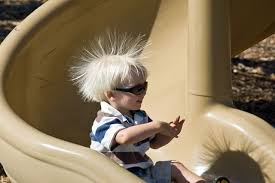
When someone's hair is charged by the person holding onto the Van de Graaf generator, you are observing ___.
friction
conduction
induction

