
NEW
Font size
S
M
L
XL
 Worksheets
Nuclear equations
Total questions: 17
Worksheet time: 51mins
Name
Class
Date
1.

What particle completes this reaction?
a)
alpha particle
b)
beta particle
c)
gamma particle
d)
neutron
2.
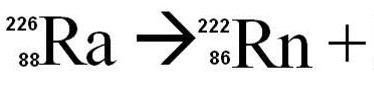
Complete the nuclear equation and determine the type of decay that is occurring in this reaction.
a)
alpha
b)
beta
c)
gamma
d)
none
3.
Solve this equation for alpha decay.
20985At = ___ + 42He
20985At = ___ + 42He
a)
20583Bi
b)
20986Rn
c)
20781Tl
d)
20885At
4.
Solve this equation for alpha decay.
22688Ra = ___ + 42He
22688Ra = ___ + 42He
a)
22286Rn
b)
22689Ac
c)
22484Po
d)
22588Ra
5.
Solve this equation for beta decay.
6027Co = ___ + 0-1e
6027Co = ___ + 0-1e
a)
5625Mn
b)
6028Ni
c)
5823V
d)
5927Co
6.
Solve this equation for beta decay.
146C = ___ + 0-1e
146C = ___ + 0-1e
a)
104Be
b)
147N
c)
102He
d)
136C
7.
The following is an example of what type of reaction?
24395Am → 23993Np + 42He
24395Am → 23993Np + 42He
a)
alpha decay
b)
beta decay
c)
gamma decay
8.
What is the missing isotope that will balance the following nuclear equation?
94Be + 11H → _____ + 42He
94Be + 11H → _____ + 42He
a)
105B
b)
105Ne
c)
63Li
d)
63C
9.
What is the symbol for an alpha particle?
a)
42He
b)
0-1e
c)
0+1 e
d)
10n
10.
The three main types of nuclear radiation are alpha, beta, and gamma. Which of the following lists these types of radiation from highest penetrating power to lowest penetrating power?
a)
alpha, gamma, beta
b)
beta, alpha, gamma
c)
beta, gamma, alpha
d)
gamma, beta, alpha
11.
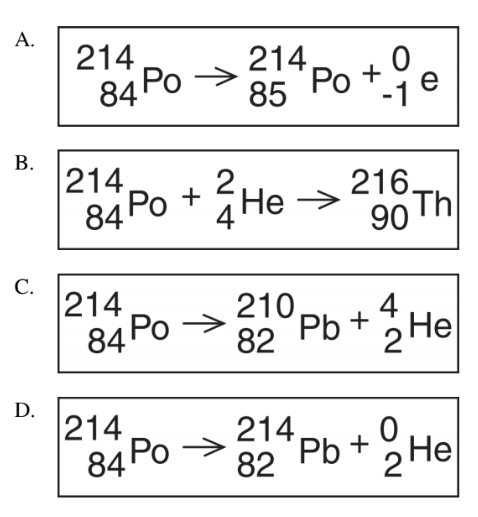
Which equation correctly represents the alpha decay of polonium-214?
a)
A
b)
B
c)
C
d)
D
12.
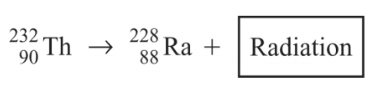
This equation shows the radioactive decay of thorium (Th). Which of the following particles is released in this reaction?
a)
alpha
b)
beta
c)
neutron
d)
gamma
13.

a)
alpha particle
b)
beta particle
c)
neutron
d)
proton
14.

a)
A
b)
B
c)
C
d)
D
15.

a)
A
b)
B
c)
C
d)
D
16.
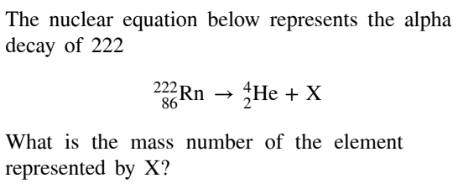
a)
it's 88 because element X gains 2 protons
b)
it's 218 because element X loses 2 protons and 2 neutrons
c)
it's 220 because element X loses 2 neutrons
d)
it's 226 because element X gains 2 protons and 2 neutrons
17.
What particle completes this reaction?
a)
alpha particle
b)
beta particle
c)
gamma particle
d)
neutron
Reset

