wayground logo

Free Printable Worksheets

Font size

S
M
L
XL
Worksheets

Year 11 Biology Quiz - Inference Concepts

Total questions: 50

Worksheet time: 44mins

Name
Class
Date
1.

The amount of space something takes up is called the....

a)

Surface area

b)

Perimeter

c)

Volume

d)

Weight

2.

High Surface area to volume ratio allows cells to do what quickly?

a)

Move materials around inside the cell

b)

Move materials in and out of the cell

c)

Communicate to other cells

d)

Divide

3.
This image shows how materials move into various sized cells in a given amount of time.... why does one square cell have more pink coloring than the others? 
a)
The surface area was too larger to get through
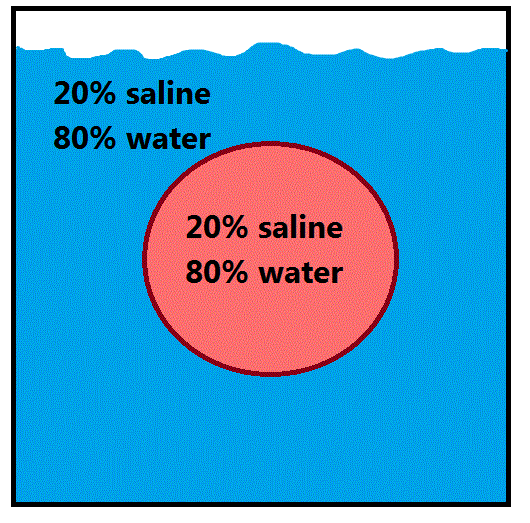
b)
The volume of the other cells was too large for the dye to get through
c)
There was not enough surface area for the dye to get through
d)
The volume was too low for the dye to stay in the square
4.
Microvilli are tiny projections that extend off the cell to increase the Surface Area.  What purpose might that serve? 
a)
Increased absorption
b)
Better communication among cells
c)
Maintain homeostasis 
d)
Decreased oxygen use
5.

Which type of cube would have the largest surface area to volume ratio?

a)

the small cube

b)

the large cube

c)

the medium sized cube

6.

Which cells are more efficient at obtaining nutrients?

a)

Small Cells

b)

Medium Size Cells

c)

Large Cells

d)

X-Large Cells

7.
The amount of nutrients needed is determined by...
a)
The cell's volume
b)
The cell's surface area
c)
The cell's Rough ER
d)
The cell's Smooth ER
8.

Which Graph shows that an enzyme works best at a pH of 4?

a)
b)
c)
d)
9.

Which Graph shows that an enzyme works best at a pH of 7?

a)
b)
c)
d)
10.

Which graph shows that an enzyme works best at 15 degrees?

a)
b)
c)
d)
11.

Which line shows that an enzyme works best at a pH pf 9?

a)

A

b)

B

c)

C

12.

Which line shows that an enzyme works best at an ACIDIC pH?

a)

A

b)

B

c)

C

13.

Which Enzyme works best at a temperature of 37?

a)

Enzyme A

b)

Enzyme B

14.

Which Enzyme works best at a pH of 7.5?

a)

Enzyme A

b)

Enzyme B

15.

Which Enzyme works best at warmer temperatures?

a)

Enzyme A

b)

Enzyme B

16.

What can we conclude from the graph? At a temperature of 62 ...

a)

Enzyme activity is highest

b)

Enzyme activity is low but working

c)

Enzyme is denatured

17.

What can we conclude from the graph? At a a pH of 10...

a)

Enzyme A works best

b)

Enzyme B works best

c)

Both enzymes are denatured

18.

Most enzymes are composed of .....

a)

Lipids

b)

Carbohydrates

c)

Proteins

d)

Nucleic Acids

19.

What happens to an enzyme when it denatures?

a)

The activation energy of the reaction is doubled.

b)

The activation energy of the reaction is lowered.

c)

It's optimal conditions for temperature of the enzyme are doubled.

d)

The shape of the enzyme molecule is changed.
20.
Where do substrates bind on an enzyme?
a)
voltage-gated channels
b)
surface receptor
c)
calcium channels
d)
active site
21.
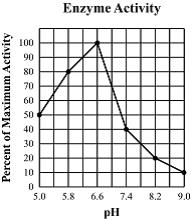
Which of the following conclusions can be drawn from this graph?
a)
The optimum pH of the enzyme is 6.6.
b)
The optimum pH of the enzyme is 5.8
c)
The enzyme’s activity increases as pH increases 5.0 to 9.0
d)
The enzyme’s activity is greater around pH of 8.0 .
22.

Which 2 factors can affect the rate of enzyme activity?

a)

Light intensity

b)

Temperature

c)

pH

d)

Oxygen concentration

23.
If an enzyme becomes over heated what effect, if any, will the heat have on the enzymatic activity? 
a)
The enzyme will not store much chemical energy.
b)
The enzyme will not be able to catalyze reactions.
c)
The enzyme will lose its net electrical charge.
d)
The enzyme will lose stored genetic information.
24.
What is the purpose  of an enzyme?
a)
give permission for the reaction
b)
raise activation energy
c)
speed up reactions
d)
control how many reactions occur
25.

Function of enzyme in human body.

a)

Digestion of food

b)

Destroying toxins

c)

Building muscles

d)

All of the above

26.
How do enzymes affect chemical reactions?
a)
Increased activation energy
b)
Decreased activation energy
c)
Increased energy change
d)
Decreased energy change
27.
Osmosis is the movement of _____ across a membrane.
a)
food
b)
energy
c)
oxygen
d)
water
28.
During osmosis
a)
water moves from high to low concentration
b)
large or oddly shaped molecules move across a cell membrane
c)
water moves when energy is used
d)
proteins are built
29.
What is the definition of  Selective Permeability?
a)
The movement of materials across the cell membrane that requires NO ENERGY from the cell.
b)
The movement of materials through (or across) the cell membrane
c)
The ability of the cell membrane to allow some things to pass through while preventing other things from passing through.
d)
The movement of molecules from an area of high concentration to a area of low concentration 
30.
In the given scenario what will happen to the organism: salt is poured onto eggplant.
a)
Water will move out of the eggplant cells and the cells will shrink.
b)
Water will move out of the eggplant cells and the cells will swell.
c)
Water will move into the eggplant cells and the cells will swell.
31.
An animal cell placed in a hypertonic (salty) solution will
a)
Shrink
b)
Swell
c)
Stay the same
32.
Which way will the water molecules move during osmosis?
a)
Out of the cell, so the cell shrinks.
b)
Out of the cell, so the cell swells.
c)
Into the cell, so the cell shrinks.
d)
Into the cell, so the cell swells.
33.
Water will move INTO a cell in a(n) _______ solution
a)
Hypertonic
b)
Hypotonic
c)
Isotonic
d)
Gravy
34.
Ideally, your cells should be in a(n) _______ solution
a)
Hypertonic
b)
Hypotonic
c)
Isotonic
d)
Cola
35.
An animal cell that is surrounded by fresh water will burst because the osmotic pressure causes
a)
water to move into the cell.
b)
water to move out of the cell.
c)
solutes to move into the cell.
d)
solutes to move out of the cell.
36.
What information could be added to make this diagram a more complete model of osmosis in red blood cells?
a)
Information about the temperatures of the cell and of the solution.
b)
The relative concentrations of solute inside and outside the cell.
c)
Show that energy is required for the osmosis to occur.
d)
Show the cell holding its shape as osmosis occurs.
37.

 If the volume of a cell 

increases when it is placed 

in a solution, that solution is

 said to be __________ to the 

cell
a)
 hypertonic
b)
subatomic
c)
 isotonic
d)
 hypotonic 
38.
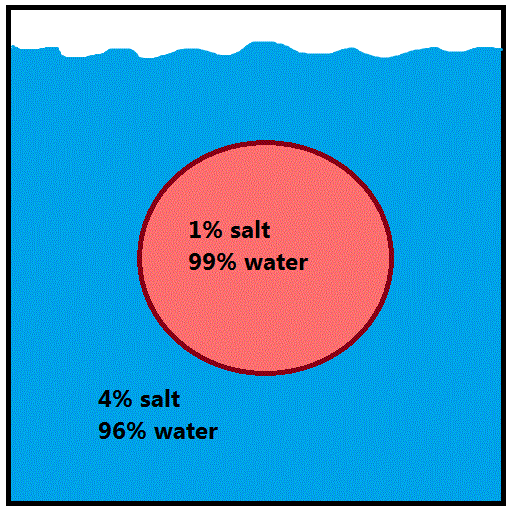
Where will the water go?
a)
Into the cell
b)
Out of the cell
c)
Equally in & out - it's isotonic
d)
There is no water
39.
A blood cell is placed into the jar, as seen. Where will the water go?
a)
Into the cell
b)
Out of the cell
c)
Equally in & out - it's isotonic
d)
The water is a lie
40.
When both inside and outside of a cell have the same amount of water it is said that the cell has reached a state of ___________.
a)
osmosis
b)
equilibrium
c)
diffusion
d)
hypertonic
41.
If you looked at red blood cells under a microscope and saw the blood cells exploded, what would you say happened?
a)
The cells were placed in a hypotonic solution.
b)
the solution was isotonic.
c)
The solution was hypertonic.
42.

what will happen to red blood cells (0.9% NaCl) if they are placed in Flask X (0.5% NACl)?

a)

shrink

b)

swell

c)

remains normal

43.

what will happen to red blood cells (0.9% NaCl) if they are placed in Flask Y (0.9% NACl)?

a)

shrink

b)

swell

c)

remains normal

44.

what will happen to red blood cells (0.9% NaCl) if they are placed in Flask Z (1.5% NACl)?

a)

shrink

b)

swell

c)

remains normal

45.
The mouth contains salivary glands which produce
a)
polysaccharides
b)
amylases
c)
proteases
d)
lipases
46.
Protein digestion begins in the
a)
mouth
b)
esophagus
c)
stomach
d)
liver
47.
Pepsin is an enzyme that acts on
a)
lipids
b)
proteins
c)
carbohydrates
d)
nucleic acids
48.
Digestion is COMPLETED in the
a)
stomach
b)
liver
c)
small intestine
d)
large intestine
49.

Where in the body would Hydrochloric Acid be found?

a)

Mouth

b)

Esophagus

c)

Liver

d)

Stomach

50.

digests starches in the mouth

a)

bile

b)

pepsin

c)

salivary amylase

d)

pancreatic lipase