wayground logo

Free Printable Worksheets

Font size

S
M
L
XL
Worksheets

Unit 1 Marathon Runner (LE)

Total questions: 60

Worksheet time: 53mins

Name
Class
Date
1.

Which of the following is an example of positive feedback?

a)

Thermoregulation

b)

Blood Pressure

c)

Childbirth

d)

Blood Sugar Levels

2.
Homeostasis
a)
allows for a wildly fluctuating internal environment
b)
is impossible in vertebrates
c)
is the maintenance of a relatively stable internal environment and often incorporates a form of feedback regulation
d)
is the maintenance of a relatively stable external environment and often incorporates a form of feedback regulation
3.
When you get cut, your skin cells release hormones that signal platelets to come and stop the bleeding. Platelets then release more hormones that signal even more platelets to help stop bleeding. The hormone signals continue until the cut is closed.
a)
Positive Feedback Response
b)
Negative Feedback Loop 
4.

Which body system controls the body to maintain homeostasis?

a)

excretory

b)

nervous

c)

circulatory

d)

skeletal

5.
The maintenance of an organism’s internal environment is called:
a)
compensating
b)
homeostasis
c)
balancing
d)
routine
6.
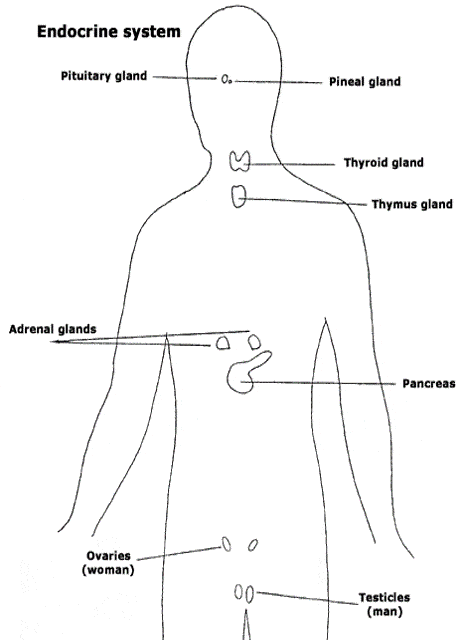
a body system that controls growth and homeostasis by secreting hormones from glands.
a)
skeletal system
b)
nervous system
c)
endocrine sytem
d)
integumentary system
7.
organ of the endocrine system that secretes hormones.
a)
heart
b)
gland
c)
brain
d)
skin
8.
chemical made by glands that tell cells to make something or respond in some way.
a)
acid
b)
enzyme
c)
perspiration
d)
hormone
9.
What is the endocrine system?
a)
senses the hormone levels in the blood
b)
controls all other endocrine glands
c)
A group of glands that work together with the nervous system to coordinate all body functions
d)
decreases bone calcium levels
10.
Negative Feedback Loops:
a)
amplify processes
b)
prevent small changes from getting larger
c)
are initiated during childbirth
d)
are found only in plants
11.

The ultimate cause of death

a)

Over Heating

b)

Diabetes

c)

Bad Hair

d)

Loss of Homeostasis

12.
Name the levels of organization in the human body in order from smallest to largest:
a)
Tissue, organ, organ system
b)
Organ system, tissue, organs, cells
c)
Cells, tissue, organs, organ system
d)
Cells , organs, tissue, organ system
13.
Which of the following is NOT the system that regulate the blood sugar level?
a)
Circulatory system
b)
Muscle system
c)
Endocrine system
d)
Digestive system
14.
What is the name of the receptor that detect the rise and fall of body temperature?
a)
Thermoreceptor
b)
Osmoreceptor
c)
Baroreceptor
d)
Chemoreceptor
15.

When the body temperature drop below normal ranges, blood vessels in the skin will

a)

dilate to allow less blood to flow to skin surface

b)

constrict to allow less blood to flow to skin surface

c)

dilate to allow more blood to flow to skin surface

d)

constrict to allow more blood to flow to skin surface

16.

When blood sugar level is high, which hormone is secreted by the pancreas?

a)

insulin

b)

glucagon

c)

glycogen

d)

glucose

17.
Failure in the production, secretion and intake of insulin by target cells can cause
a)

kidney stones

b)

hyponatremia

c)

fever

d)

diabetes

18.

Insulin will cause conversion of excess

a)
glucose to glucagon
b)
glucagon to glucose
c)
glucose to glycogen
d)
glycogen to glucose
19.
Which of the hormone control blood osmotic pressure?
a)
TSH
b)
aldosterone
c)
ADH
d)
FSH
20.

When blood sugar level is low, which hormone is secreted by the pancreas?

a)

insulin

b)

glucagon

c)

glycogen

d)

glucose

21.

what is osmoregulation?

a)

Control of water and salt in the body

b)

Control of blood pressure in the body

c)

Control of blood glucose in the body

22.
The cell below is in a _________ solution.
a)
Hypotonic
b)
Hypertonic
c)
Isotonic
23.

If a person's blood cells shrivel (shrink) their blood is likely ____ in comparison to the cell.

a)

isotonic

b)

hypotonic

c)

hypertonic

24.

During osmosis

a)

water moves from high to low concentration

b)

large or oddly shaped molecules move across a cell membrane

c)

water moves when energy is used

d)

proteins are built

25.

Osmosis is the movement of _____ across a membrane.

a)

food

b)

energy

c)

oxygen

d)

water

26.

Maintaining stable internal conditions despite changes in the external environment

a)

Homeostasis

b)

Metabolism

c)

Protein Synthesis

d)

Adaptation

27.
What type of solution is this cell in?
a)
Isotonic
b)
Hypertonic
c)
Hypotonic
d)
diffused
28.
What type of solution is this cell in?
a)
Isotonic
b)
Hypertonic
c)
Hypotonic
d)
diffused
29.

Nemo and other ocean dwelling fish cannot survive in freshwater because......

a)

freshwater is hypertonic to Nemo's cells and will result in water leaving them causing the cells to shrink

b)

freshwater is hypotonic to Nemo's cells and will result in water leaving them causing the cells to shrink

c)

freshwater is hypertonic to Nemo's cells and will result in water entering them causing the cells to swell and burst

d)

freshwater is hypotonic to Nemo's cells and will result in water enter them causing the cells to swell and burst

30.

An organism that produces its own body heat is called...

a)

Poikilotherm

b)

Homeotherm

c)

Endotherm

d)

Ectotherm

31.

Which of the following ISN'T a thermoregulatory strategy for warming up?

a)

vasoconstriction

b)

shivering

c)

sweating

d)

extra layers of blubber (fat)

32.

Low temperatures can cause

a)

hypothermia

b)

hyperthermia

c)

euthermia

d)

sweating

33.

When we are cold we

a)

shiver

b)

sweat

c)

stretch out

d)

put on a jumper

34.

When you breathe, your lungs take in ___ and remove ___.

a)

air/oxygen

b)

oxygen/carbon dioxide

c)

carbon dioxide/waste

d)

waste/air

35.

The air sacs that are covered with capillaries where gas exchange takes place

a)

bronchi

b)

lungs

c)

oxygen

d)

alveoli

36.

What is the site of gas exchange?

a)

alveoli

b)

bronchus

c)

nose

d)

trachea

37.

What adaptations does the alveoli have for efficient gas exchange?

a)

thick walls

b)

thin walls

c)

small surface area

38.

what is found around alveoli?

a)

capillaries

b)

pleura

c)

lymphatic nodes

d)

saliva

39.

What is sign for brain to send impulse for breathing?

a)

high CO2 level

b)

low CO2 level

c)

high O2 level

d)

high blood concentration

40.

During gas exchange what enters from alveoli to the capillaries?

a)

CO2

b)

CO

c)

O2

d)

nitrogen

41.

The organ which releases hormones in response to changes in blood glucose concentration is

a)

The pancreas

b)

The liver

42.

Insulin production is increased in response to what?

a)

Blood glucose concentration rising

b)

Blood glucose concentration falling

43.

If blood glucose concentration falls, which hormone is released?

a)

Insulin

b)

Glucagon

44.

What do cells need glucose for?

a)

photosynthesis

b)

respiration

c)

protein synthesis

d)

combustion

45.

Insulin causes which organ to remove glucose from the blood?

a)

liver

b)

pancreas

c)

brain

d)

kidneys

46.
Which of the following is an example of homeostasis?
a)
taking out the trash
b)
drinking water
c)
sweating on a hot day
d)
taking a shower
47.
Which body system gets oxygen from the environment and removes carbon dioxide and other wastes from the body?
a)
Circulatory
b)
Respiratory
c)
Digestive
d)
Skeletal
48.
Which system transports materials from the digestive system and respiratory system to the cells?
a)
circulatory
b)
respiratory
c)
digestive
d)
skeletal
49.
Which of these 3 systems work together to get the body the oxygen and sugar that it needs to make ATP(energy)?
a)
Digestive - Cardiovascular -Urinary
b)
Cardiovascular - Respiratory - Reproductive
c)
Respiratory - Digestive - Lymphatic
d)
Cardiovascular - Digestive - Respiratory
50.

What 2 systems: Absorb and deliver the digested nutrients to the cells

a)

Digestive and muscular

b)

Muscular and lymphatic

c)

Digestive and circulatory

d)

Nervous and skeletal

51.
What is the correct equation for cellular respiration?
a)
6O2 + C6H12O6 -> 6CO2 + 6H2O + Energy
b)
6O2 + C6H12O6 + Energy -> 6CO2 + 6H2O
c)
6CO2 + 6H2O -> 6O2 + C6H12O6 + Energy
d)
6CO2 + 6H2O + Energy -> 6O2 + C6H12O6
52.
Cellular Respiration's goal is to
a)
make water
b)
make ATP
c)
make glucose
d)
make  oxygen
53.
What are the products of aerobic respiration?
a)
Glucose and oxygen
b)
Carbon dioxide and water
c)
Lactic acid
d)
Carbon monoxide
54.

Which organelle performs aerobic cellular respiration?

a)

Chloroplast

b)

Mitochondria

c)

ribosomes

d)

vacuoles

55.
The energy in ATP is stored 
a)
in the bond between the second and third phosphate
b)
in the bond between the first and second phosphate
c)
in the bond between the adenosine and the first phosphate
d)
I like turtles
56.

Which of the following is a product of cellular respiration?

a)

Radiant Energy

b)

Oxygen

c)

Glucose

d)

Water

57.
What does it mean for something to be anaerobic?
a)
It requires CO2
b)
It does not require CO2
c)
It requires oxygen
d)
It does not require oxygen
58.

Which of the below is a benefit of increased heart rate?

a)

Blood % to organs 20%

b)

Increased oxygen & nutrient delivery to the muscles

c)

SV Increases

59.

Which of the below is a consequence of lactic acid production?

a)

Increased flexibility of muscles

b)

Increased strength

c)

Increased muscular pain & fatigue

60.

What waste product is produced during anaerobic respiration that causes muscle cramps?

a)

lactic acid

b)

citric acid

c)

carbon dioxide

d)

ATP