wayground logo

Free Printable Worksheets

NEW

Font size

S
M
L
XL
Worksheets

Speciation

Total questions: 19

Worksheet time: 10mins

Name
Class
Date
1.
The genitalia of the male damselfly varies in shape. Certain males can only hold onto & mate with females whose genitalia fit.  What type of reproductive barrier is this?
a)
behavioral isolation
b)
temporal isolation 
c)
gametic isolation
d)
mechanical isolation 
2.
Some female peacocks prefer males with large, colorful tales while other female peacocks prefer males with no tail at all. Females are beginning to only mate with the type of males with the tail they prefer. What type of reproductive barrier is this?
a)
behavioral isolation
b)
hybrid sterility 
c)
temporal isolation
d)
mechanical isolation 
3.
The flowers of pink tulips open in the morning, while the flowers of lavender tulips open in the early afternoon. The bees that pollinate these tulips cannot carry pollen back & forth between the two types of tulips because of their flowers being closed at different times of day. What type of reproductive barrier is this?
a)
behavioral isolation
b)
hybrid sterility 
c)
temporal isolation
d)
mechanical isolation 
4.
The term for the formation of new and distinct species over the course of evolution is...
a)
speciation
b)
biological species concept
c)
reproductive barrier
d)
natural selection
5.
What is a species? 
a)
A group of organisms that can mate with each other and produce fertile offspring. 
b)
A group of organisms that can mate and produce offspring even if those offspring are infertile.
c)
A group of organisms that genetically are very different from each other. 
d)
Indivual organisms that live in the same environment. 
6.
A flash flood carried a raft of Amazon ants away from their original population. There is enough distance between the two groups, that they will never meet in nature again. What type of reproductive barrier is this?
a)

behavioral isolation

b)

temporal isolation 

c)

gametic isolation

d)

geographic isolation 

7.
When a population becomes divided by an event such as a new river forming, ____________ has occurred.
a)
Differentiation 
b)
Isolation
c)
Adaptation
d)
Separation
8.
Variations in a population are caused by:
a)
Natural Selection
b)
Selective Breeding
c)
Artificial Selection
d)
Random Mutations
9.
If an environment changes, populations with ______________ have a better chance of survival.
a)
No genetic variations
b)
Genetic variations
c)
A small number
d)
A large number
10.
The climate of a certain area is cold, and snow is found on the ground most of the year. Equal numbers of two populations of rabbits are introduced into this climate by a group of scientists. One of the populations is brown and the other is white. Predict what will happen over several generations.
a)
There will be equal numbers of brown and white rabbits
b)
There will be more brown rabbits that white rabbits
c)
There will be more white rabbits than brown rabbits
d)
There is no way to predict what will happen to the rabbit population
11.

When the Grand Canyon in Arizona formed, two populations of one squirrel species were separated by the giant canyon. This is an example of _____________.

a)

Temporal isolation

b)

Behavioral isolation

c)

Geographic isolation

12.
What is genetic drift?
a)
The movement of genes in/out of a population
b)
A small, random change in the DNA
c)
Any change in the allelic frequencies in a population that is due to chance
d)
›The process in which humans select for or against particular features in organisms
13.
When has speciation occurred?
a)

When populations no longer look the same

b)

When populations no longer have the same frequency of alleles

c)

When populations are living in different environments

d)

When populations can no longer interbreed

14.

Genetic diversity is decreased through this process.

a)

Gene Flow

b)

Genetic Drift

15.

In which of the following populations would genetic drift be most likely to cause a rapid evolution of the population?

a)

The human population of India

b)

A large population of Mexican free-tailed bats living in central Texas

c)

A geographically isolated population of 5000 green tree frogs

d)

A small group of 12 cheetahs living in Namibia
16.

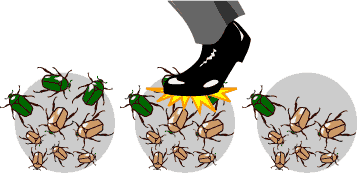
Someone steps on some bugs and randomly removes their alleles from the population. This is an example of

a)

gene flow

b)

genetic drift

c)

speciation

d)

allele frequency

17.

Alleles that improve survival will decrease in frequency in the next generation.

a)

True

b)

False

18.

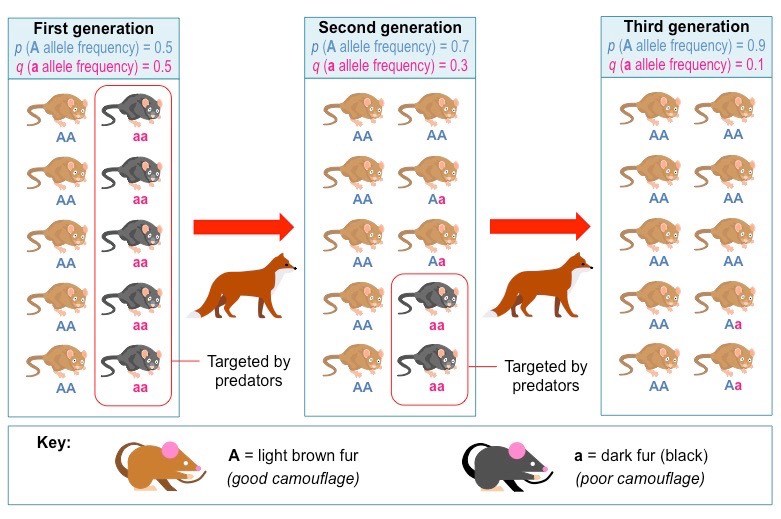
The allele frequencies of the mouse population in the picture are changing over time. Which is true?

a)

The population is evolving.

b)

The population is not evolving.

c)

The population will go extinct.

d)

The population's genetic variation is increasing.

19.

Adaptations are features you are born with that either help you or hurt you in your environment.

a)

True

b)

False