wayground logo

Free Printable Worksheets

Font size

S
M
L
XL
Worksheets

Combining Matter Review

Total questions: 57

Worksheet time: 58mins

Name
Class
Date
1.

Which of the following is NOT matter?

a)

a chair

b)

air

c)

light

d)

water

2.

Which of the following may be heterogeneous?

a)

elements only

b)

compounds only

c)

mixtures only

d)

elements and compounds

3.

Which of the following is pure?

a)

elements only

b)

compounds only

c)

mixtures only

d)

elements and compounds

4.

Which of the following consists of more than one substance?

a)

elements only

b)

compounds only

c)

mixtures only

d)

elements and compounds

5.

Which of the following is a type of mixture?

a)

elements only

b)

compounds only

c)

solutions only

d)

elements and compounds

6.

Which of the following is matter?

a)

love

b)

ideas

c)

rock

d)

heat

7.

Which substance can be decomposed by a chemical change? (1) Ammonia [NH3] (2) Iron [Fe] (3) Argon [Ar] (4) Helium [He]

a)

Ammonia [NH3]

b)

Iron [Fe]

c)

Argon [Ar]

d)

Helium [He]

8.
a)

1

b)

3

c)

2

d)

4

9.

What is a pure substance that cannot be broken down into simpler substances by physical or chemical means?

a)

Compound

b)

Molecule

c)

Element

d)

Atom

10.

What is matter that contains a combination of different elements and/or compounds and can be separated by physical means?

a)

Compound

b)

Mixture

c)

Pure Substance

d)

Molecules

11.

Which option is a homogeneous mixture?

a)
b)
12.

1. Melting crayons is an example of _____________.

a)

physical change

b)

physical property

c)

chemical change

d)

chemical property

13.
A type of substance containing atoms of two or more elements chemically bonded together is a mixture.
a)
Ture
b)
False
14.
Salad is an example of...
a)
a mixutre
b)
an element
c)
a compound
15.
Pure oxygen (O) is an example of...
a)
an element
b)
a mixture
c)
a compound
16.
An example of ...
a)
A mixture
b)
A compound
c)
An element 
17.
If a mixture has components you can see it is a...
a)
solution
b)
compound
c)
homogeneous mixture
d)
heterogeneous mixture
18.
You are about to open an iced coffee, and notice the label says to "shake well", the drink must be a...
a)
solution
b)
colloid
c)
suspension
d)
compound
19.
Which list has the types of mixtures ordered from largest particle size to smallest?
a)
suspension, colloid, and solution
b)
solution, suspension, and colloid
c)
colloid, solution, and suspension
d)
solution, colloid, and suspension
20.
Italian Salad Dressing
a)
heterogeneous mixture
b)
homogeneous mixture
21.
What is Kool-aid?
a)
element
b)
Heterogeneous Mixture
c)
Homogeneous Mixture
d)
Compound
22.
What type of matter is sand?
a)
Element
b)
Compound
c)
Heterogeneous Mixture
d)
Homogeneous Mixture
23.
What type of matter is sugar?
a)
Element
b)
Compound
c)
Heterogeneous Mixture
d)
Homogeneous Mixture
24.
What type of matter is air?
a)
Element
b)
Compound
c)
Heterogeneous Mixture
d)
Homogeneous Mixture
25.
_________ can be separated through physical means.
a)
Compounds
b)
Mixtures
c)
Elements
26.
How does a solution become supersaturated?
a)
dissolve lots of solute in it.
b)
dissolve a little solute in it. 
c)
dissolve more solute than you should be able to. 
d)
dissolve a super amount of solvent in it. 
27.
Solution where more solute can still be dissolved at the given temperature. 
a)
Saturated
b)
Unsaturated
c)
Supersaturated
d)
Homogeneous solution
28.
The ___ is the thing being dissolved.
a)
solute
b)
solvent
c)
mixture
d)
suspension
29.
Which solute does not increase in solubility as temperature rises?
a)
NH3
b)
NaNO3
c)
KNO3
d)
NaCl
30.
How many grams of SOcan dissolve at 50 ⁰C?
a)
5 g
b)
10 g
c)
20 g
d)
39 g
31.
Which salt is LEAST soluble at 0 ºC?
a)
K2Cr2O7
b)
KNO3
c)
 KClO3
d)
Ce2(SO4)3
32.
An ______ is a compound that breaks apart in water, forming charged particles (ions) that can conduct electricity.
a)
electrolyte
b)
nonelectrolyte
c)
polar molecule
d)
non polar molecule
33.

How many grams of Pb(NO3)2 are soluble in 100 g of water at 65 ºC?

a)

80 grams

b)

100 grams

c)

40 grams

d)

90 grams

34.
How many grams of NaNOare soluble in 100 g of water at 10 ºC?
a)
80 grams
b)
100 grams
c)
40 grams
d)
10 grams
35.
How many grams of K2Cr2O7, are soluble in 100 g of water at 95 ºC?
a)
83 grams
b)
75 grams
c)
40 grams
d)
12 grams
36.
When 50 grams of KCl is dissolved in 100 grams of water at 50 ºC, the solution can be correctly described as:
a)
supersaturated
b)
unsaturated
c)
saturated
37.
When 20 grams of KNO3 is dissolved in 100 grams of water at 80 ºC, the solution can be correctly described as:
a)
supersaturated
b)
saturated
c)
unsaturated
38.
When 20 grams of potassium chlorate, KClO3, is dissolved in 100 grams of water at 80 ºC, the solution can be correctly described as:
a)
supersaturated
b)
saturated
c)
unsaturated
39.
Which of the following is a property of bases?
a)
a pH < 7
b)
slippery feel
c)
tart or sour taste
d)
corrosive to metals
40.
Which of the following is a property of an acid?
a)
pH > 7
b)
turns litmus paper blue
c)
tart or sour taste
d)
corrosive to organic materials
41.

Which of the following values would represent the pH of a strong base?

a)

1

b)

8

c)

7

d)

13

42.

Which of the following are the characteristics of a BASE?

a)

Very bitter in taste

b)

Liberate OH- ions when dissolved in water

c)

Have pH of less than 7

d)

Turns blue litmus red

43.

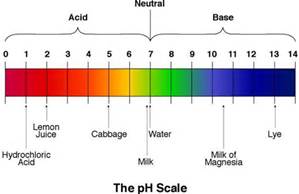
According to the pH range given in the image,which substance is more acidic than lemon juice?

a)

Hydrochloric acid

b)

Cabbage

c)

Milk

d)

Milk Of Magnesia

44.

Which among the following is not a base?

a)

NaOH

b)

KOH

c)

HCl

d)

NH4OH

45.

Which of the following correctly describes an ACID?

a)

feels slippery

b)

contains a hydroxide ion(OH-)

c)

has a bitter taste

d)

forms hydrogen ions when dissolved in water (H+)

46.

What happens when an acid and a base are mixed together?

a)

they explode

b)

nothing will happen

c)

a salt & water are formed

d)

a weaker base & stronger acid are formed

47.

Neutralization is a reaction between a(n)

a)

acid and a base

b)

acid and a metal

c)

base and a salt

d)

salt and water

48.

On the pH scale, which number indicates neutral?

a)

0

b)

1

c)

7

d)

14

49.

Solutions with a pH greater than 7 are called_________.

a)

acids

b)

bases

c)

indicators

d)

neutral

50.

Strong bases contain:

a)

-OH

b)

Hydrogen

c)

Halogens

51.
An indicator will ______________ when it is in contact with an acid or base
a)
Bubble
b)
Form a new substance
c)
Change color
d)
Stay the same color
52.

Which of the following formulas is an ACID?

a)

Ca(OH)2

b)

KOH

c)

NH4OH

d)

HCl

53.

Lemon juice has a pH of 2. What is it best classified as?

a)

acid

b)

base

c)

neutral

54.

The lower the pH, the greater the concentration of :

a)

OH-

b)

H3O+

55.

What type of reaction is this?


H2SO4 + NaOH → Na2SO4 + H2O

a)

Neutralization

b)

Synthesis

c)

Single Replacement

d)

Combustion

56.
Kool-Aid - Powder, sugar, and water
Identify the solvent 
a)
water
b)
powder
c)
sugar
d)
powder and sugar
57.
Another name for a homogeneous mixture is 
a)
an element.
b)
a solution.
c)
a compound.