Wayground logo

Free Printable Worksheets

Font size

S
M
L
XL
Worksheets

Unit 7 natural selection and evolution

Total questions: 67

Worksheet time: 1hrs 15mins

Name
Class
Date
1.
A table of arachnid and insect characteristics is shown. Which characteristic could be used to distinguish between
arachnids and insects?
a)
Jointed legs
b)
Body segments
c)
Presence of eyes
d)
Presence of antennae
2.
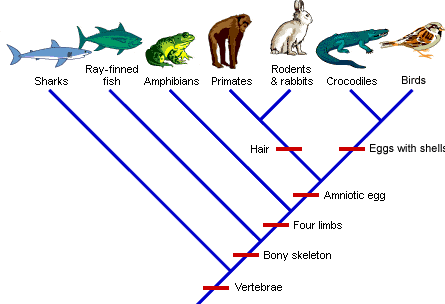
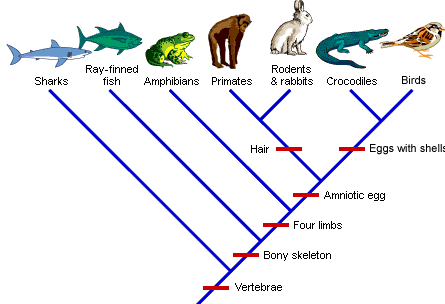
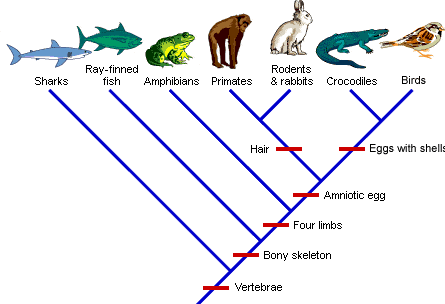
According to this cladogram, sharks are MOST closely related to which organism? 
a)
Amphibians
b)
Ray finned fish
c)
Crocodiles
d)
Birds
3.
Which two orgainsms have hair? 
a)
Sharks & Ray Finned Fish
b)
Primates & Rodents
c)
Birds & Crocodiles
d)
Rabbits & Birds
4.
According to this cladogram, birds are LEAST related to: 
a)
Amphibians
b)
Sharks
c)
Ray Finned Fish
d)
Crocodiles
5.
You look at two species and see very similar DNA. What does this likely tell you?
a)
These are the same animal.
b)
These animals have a common ancestor.
c)
These animals are not likely related.
d)
These animals are likely becoming one species.
6.
You look at two species and see very similar amino acid sequences. What does this likely tell you?
a)
These are the same animal.
b)
These animals have a common ancestor.
c)
These animals are not likely related.
d)
These animals are likely becoming one species.
7.
a)
Homologous
b)
Vestigial
c)
Analogous
8.
a)
Homologous
b)
Vesitigial
c)
Analogous
9.
A common ancestor for both A and E could be at position __.
a)
1
b)
2
c)
3
d)
4
10.
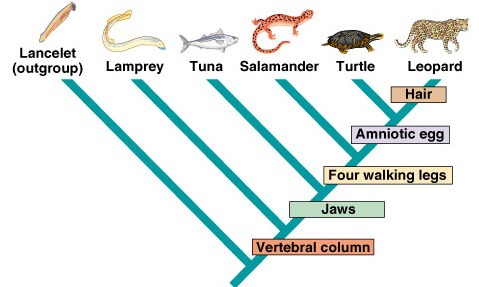
Which is the newest trait?
a)
Amniotic egg
b)
Walking legs
c)
Jaws
d)
Hair
11.
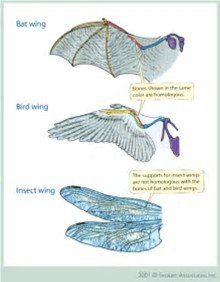
How would you describe this picture? butterly vs. bat wing
a)
Homologous structure
b)
Analogous structure
c)
Structural adaption
d)
Functional adaption
12.
If an organism has a vestigial structure, that structure likely once had a function in a(n)...
a)
close relative
b)
early ancestor
c)
unrelated organism
d)
embryological stage
13.
Two organisms that are closely related would have...
a)
very similar DNA sequence
b)
exactly the same DNA sequences
c)
no proteins in common
d)
completely different DNA sequence
14.
Based on the phylogenic tree, which of these shows a correct ancestral lineage?
a)
E is an ancestor to F and G
b)
C is an ancestor to D and E
c)
B is an ancestor to A
d)
E is an ancestor to H and I
15.

What number is the common ancestor of C and D

a)

1

b)

2

c)

3

d)

4

16.

What is the common ancestor of Letters A, B, C, D, E?

a)

1

b)

2

c)

3

d)

4

17.

Which group of animals on this tree are most closely related to birds?

a)

Saurischian dinosaurs

b)

Ornithischian dinosaurs

c)

Crocodiles

d)

None of these are related to birds

18.
Which of the following statements is correct based on the information shown in this cladogram?
a)
the turtle and the frog are more similar to each other than the turtle and the bass
b)
frogs have existed for a longer time that bass
c)
the frog is more closely related to the bass than to the leopard
d)
the bass is exinct
19.

Who is most closely related to Taxidea taxus?

a)

Lutra lutra

b)

Panthera pardus

c)

Canis latrans

d)

Canis lupus

20.

According to this image, when did the ancestors of Indohyus and Pakicetus diverge?

a)

52 million years ago

b)

56 million years ago

c)

25 million years ago

d)

47 million years ago

21.

Which species is the least closely related to humans based on the comparisons of amino acids in cytochrome c?

a)

rhesus monkey

b)

chimpanzee

c)

yeast

d)

fruit fly

22.
Which layer is the oldest
a)
B
b)
A
c)
E
d)
C
23.

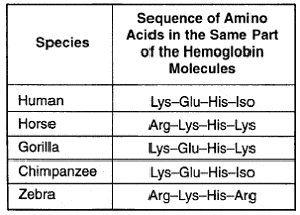
How many differences exist in the sequence of amino acids that codes for hemoglobin proteins in horses and zebras?

a)

1

b)

2

c)

3

d)

4

24.

According to the information presented, which two species are the most closely related based on comparisons of amino acid sequences for the protein hemoglobin?

a)

horse and zebra

b)

human and chimpanzee

c)

horse and gorilla

d)

human and gorilla

25.
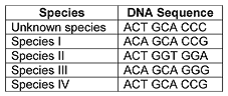
According to this data, the unknown bacterial species is most closely related to: 
a)
Species I
b)
Species II
c)
Species III
d)
Species IV
26.

The table summarizes the presence or absence of the traits listed for five different animal species. List the derived traits in order of their emergence over time from oldest to newest.

a)

Fur, large brain, warm blooded, backbone

b)

Warm blooded, backbone, fur, large brain

c)

Backbone, warm blooded, fur, large brain

d)

Large brain, fur, backbone, warm-blooded

27.

The table summarizes the presence or absence of certain traits for five different animal species. Which two species are most closely related?

a)

A and B

b)

B and D

c)

C and E

d)

A and D

28.

The same gene was sequenced for five closely related species and a sixth species selected as an outgroup. Genetic sequences for a region of this gene are summarized in the table. In a phylogenetic tree using these data, what is the branching order of species, from oldest to newest?

a)

3, 4, 2, 5, 1

b)

4, 1, 3, 2, 5

c)

2, 5, 1, 4, 3

d)

1, 4, 3, 2, 5

29.

DNA sequences for the same gene were compared in four different organisms. Based on these data, which two organisms in this set are most distantly related?

a)

Y and X

b)

X and Z

c)

Q and Y

d)

Q and X

30.

Which Hardy-Weinberg factor represents the frequency of heterozygous individuals in a population?

a)

p2

b)

2pq

c)

q2

d)

p2 + 2pq

31.
A few deer wander out of their native woods into a completely new park where no deer had ever been before. They go on to create an entirely new population.
a)
Genetic Drift
b)
Natural Selection
c)
Non-random mating
d)
Mutation
32.
In the Hardy-Weinberg Equation, q2 is the frequency of what?
a)
The recessive allele 
b)
the dominant allele
c)
the recessive genotype
d)
the dominant genotype
33.
A population of 150 individuals has an allele frequency of 0.3 for the dominant allele (B) and a frequency of 0.7 for the recessive allele (b). Use the Hardy-Weinberg equation to determine the frequency of the genotype (bb).
a)
0.09
b)
0.42
c)
0.49
d)
0.21
34.

The allele frequency of p=.20 What is the percentage of recessive genotype?

a)

.80

b)

.04

c)

.32

d)

.64

35.
Which of the following statements is supported by the graph below?
a)
The population is in Hardy-Weinberg equilibrium, as the sum of the frequency of the dominant allele and the recessive allele is always equal to 1
b)
The percentage of individuals homozygous recessive for this particular trait is increasing over time
c)
Selection has caused frequencies to change over time because individuals with a dominant allele survive at higher rates than individuals with recessive alleles
d)
Individuals who are homozygous recessive for this particular trait have migrated into the population, causing the frequency to approach 1
36.
Which Hardy-Weinberg equation represents the genotype frequencies in a population?
a)
p + q = 1
b)
p2 + 2pq + q2 = 1
c)
p2 + pq2 + q2 = 1
d)
p + 2pq + q3 = 1
37.

Which of these is a condition that must be met for Hardy-Weinberg equilibrium?

a)

extremely small population size

b)

no natural selection

c)

gene flow

d)

nonrandom mating

38.
Which evidence of common ancestry is being studied in this visual?
a)
biogeography
b)
fossil record
c)
anatomical homology
d)
molecular homology
39.
Scientists compare the limbs of organisms to look for evidence of common ancestry. These limbs provide evidence of common ancestry because they -
a)
perform the same function
b)
are the same size
c)
have the same basic structure
d)
are parts of the same animal
40.

The three species pictured do not share a common ancestor, yet have evolved to have a similar anatomy and life style. This is an example of ?

a)

Homologous Structures

b)

Divergent Evolution

c)

Vestigial Organs

d)

Convergent Evolution

41.

The three species pictured share a common ancestor and have adapted so that each lives in a different environment. This is an example of

a)

Law of Superposition

b)

Evolutionary Arms Race

c)

Divergent Evolution

d)

Convergent Evolution

42.
A biological ____________ is a group of interbreeding populations that is reproductively isolated from other groups.
a)
species
b)
family
c)
phylogeny
d)
hybrid
43.

Cheetah's all have 99% identical DNA. Which is/are true?

a)

They are more likely to evolve into a new species than other cats due to gene flow.

b)

They are likely to go extinct because they have so little variation.

c)

They likely underwent a bottleneck in their history.

d)

The founder's effect made it so they have several different subspecies.

e)

Cheetahs never prosper and winners never cheat.

44.

What type of structures are shown?

a)

Homologous

b)

Analogous

c)

Vestigial

d)

Heterologous

45.

Male birds of paradise have extremely long, showy tail feathers. Which of the following statements best

describes a selective advantage for having this trait?

a)

The bird attracts more females and therefore mates more frequently.

b)

The bird is easier for predators to spot.

46.

Elimination of a species.

a)

Extinction

b)

Gradualism

c)

Coevolution

d)

Adaptive radiation

47.

Occurs when a catastrophic event changes the environment suddenly.

a)

Gradual extinction

b)

Mass extinction

48.

Bursts of change followed by periods of stability.

a)

Punctuated equilibrium

b)

Gradualism

c)

Extinction

d)

Speciation

49.

When unrelated species evolve similar characteristics because they live in similar environments.

a)

Convergent Evolution

b)

Coevolution

c)

Adaptive Radiation

d)

Divergent Evolution

50.

The dolphin and the shark are similar because they have

Both adapted to a marine (ocean) environment and they both have a similar body shape but they do not share a recent common ancestor. This is known as ___________.

a)

coevolution

b)

ancestral breeding

c)

artificial selection

d)

convergent evolution

51.

Which rock layer is probably the oldest?

a)

A

b)

B

c)

C

52.

A fish fossil was found in layer A. What does this tell us about the possible history of this area?

a)

Fish used to live on land there

b)

This area has always been land

c)

That area used to be underwater

d)

Layer A is currently covered in water

53.
The diagram shows fossils in different rock layers. Which of these statements about the age of these fossils is most likely correct?
a)
Fossil A and C are the same age
b)
Fossil B is older than fossil C
c)
Fossils A is older than fossil B
d)
Fossil D is older than fossil C
54.
The apparatus in the experiment was used to mimic what?
a)
proteins
b)
Earth's present conditions
c)
early Earth's conditions
d)
they didn't mean to mimic anything in particular
55.
The gas in the apparatus mimicked? 
a)
space
b)
time
c)
stars
d)
atmosphere
56.
The electrical sparks mimicked?
a)
heat waves
b)
lightening
c)
volcano
d)
hurricane
57.
The water used in the apparatus was used to mimic what part of early Earth?
a)
sea
b)
swimming pool
c)
ocean
d)
rain
58.
What was the result of the Miller-Urey Experiment?
a)
amino acids
b)
nucleotides
c)
lipids
d)
glucose
59.
Miller/Urey and other scientists have shown that:
a)
 Life on early Earth required material from space
b)
Cells survived in the primitive atmosphere
c)
Amino acids could be produced from inorganic molecules 
d)
Simple cells can be produced in a laboratory
60.
Which type of cell came first?
a)
Eukaryotic
b)
Prokaryotic
c)
Plant
d)
Both Eukaryotic and Prokaryotic cells evolved around the same time
61.
Based upon the conditions of the early Earth, which forms of live most likely appeared first?
a)
Prokaryotic and aerobic
b)
Prokaryotic and anaerobic 
c)
Eukaryotic and aerobic
d)
Eukaryotic and anaerobic
62.
RNA World Theory states that ...
a)
Life came from RNA
b)
Life came from life
c)
Life came from non living things
d)
Life came from outer space
63.
Which of the following was probably not present in the atmosphere of the primitive Earth? 
a)
Methane
b)
Oxygen
c)
Water
d)
Carbon dioxide
64.
Earth formed 4.5 billion years ago, but life did not show until around...
a)
3.5 billion years ago
b)
1 million years ago
c)
200,000 years ago
d)
4.2 billion years ago
65.

Which of the following WERE abundant on early earth? YOU MAY SELECT MORE THAN 1

a)

Oxygen

b)

Carbon Dioxide

c)

Water

d)

Sunlight

66.

What is one benefit of having an amniotic egg?

a)

Their egg does not require oxygen

b)

their can have external fertilization

c)

their eggs are protected by jacobson's organs

d)

they do not have to return to the water to reproduce

67.

According to most scientists, what is the ultimate cause of most mass extinctions?

a)

overhunting

b)

evolution of new species to replace old ones

c)

major change in environment due to extreme natural events

d)

asteroid impact