
 Worksheets
Evolution
Total questions: 63
Worksheet time: 3570secs

Organs or skeletal elements that have a similar structure, but not function
analogous structures
homologous structures
vestigial structures
none of the above


Individuals that are well adapted to their environment will survive and produce _________
better traits
stronger genes
more offspring
fewer mutations


Darwin observed many finch species on the Galapagos Islands. To explain these observations, he
proposed that each species evolved from the same common ancestor, which was a finch species
that migrated to the islands from the mainland. What additional evidence did Darwin use to support
his explanation?
The finch populations were very numerous, and different species often bred with one another.
The finch species lived in different habitats on different islands, which isolated them from one another.
The finch species were distributed evenly among all of the islands, but did not interbreed.
The beaks of the finches were identical, allowing them to eat the same foods on any of the islands.
A population of rabbits grows rapidly from one year to the next. Then one year, a disease strikes approximately one fourth of the adult rabbits. The disease remains with the population in the years that follow.
As explained by Darwin’s theory, which of these conditions allows the rabbit population to evolve by natural selection?
The disease affects adult and juvenile rabbits equally.
The disease reduces the ability of the rabbits to reproduce.
Some rabbits are resistant to the disease, and they pass the resistance to their offspring.
No rabbits are resistant to the disease, and all die when the disease strikes them.

The graphs below show the changes in crab color at one beach.
Which of the following is most likely to have caused the change in the distribution?
A new predator arrived that preferred dark-tan crabs.
A new predator arrived that preferred light-tan crabs.
A change in beach color made medium-tan crabs the least visible to predators.
A change in beach color made medium-tan crabs the most visible to predators.
Grass plants in a population range in height from 6 cm to 25 cm. The short plants receive little sunlight, and the tall plants are eaten by grazing animals. Which statement best describes the effect of natural selection on the grasses?
Because average height grass plants are favored, stabilizing natural selection is occurring.
Because average height grass plants are favored, disruptive natural selection is occurring.
Because tall grass plants are favored by the animals that eat grass, directional selection is occurring.
Because short and tall grass plants are favored, normal natural selection is occurring.

Which of the following statements best describes what will most likely occur to the moth populations in the image above?
The light moths will be captured by predators more easily than the dark moths, and the population of dark moths will rise.
The light moths will be captured by predators more easily than the dark moths, and the population of light moths will rise.
The dark moths will be captured by predators more easily than the light moths, and the dark moths will probably go extinct.
The light moths will change their wing color to match that of the dark moths.

Robins typically lay fours eggs. If more then four eggs are produced then the baby chicks are malnourished while smaller egg numbers result in no viable (able to live) baby chicks. This is an example of
stabilizing
disruptive
direction
none of the above


What type of natural selection is this?
Disruptive Selection
Directional Selection
Stabilizing Selection

Natural selection occurs during the lifetime of a single organism.
True
False

What is most likely to happen to moth populations in the picture shown?
Light moths--hunted easily, dark moths--population increase
Dark moths--hunted easily, dark moths--population increase
Light moths--hunted easily, light moths--population increase
Lights moths will change their color to match dark moths.
How do you "win" at natural selection?
survive
go extinct
survive & reproduce

Due to pollution, a pond becomes darker over time. Which trait variation became more common?
light fish
dark fish
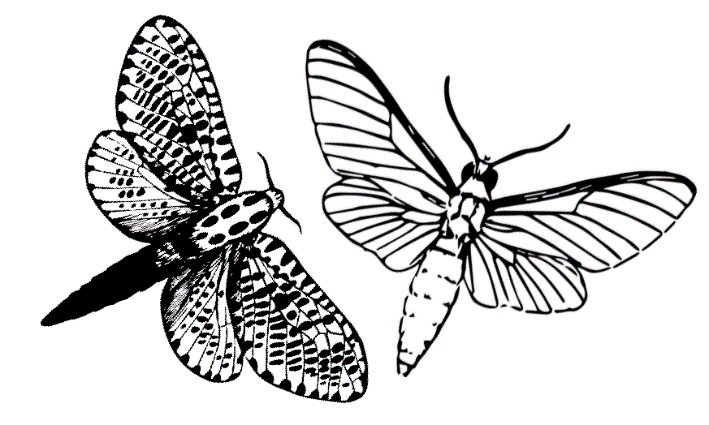
According to natural selection, light colored tree trunks would favor
light colored moths
dark colored moths
red colored moths
red and light colored moths
Natural Selection is driven by a change in the environment and survival of the
Earth
Fastest
Fittest
Biggest
Change in a population over time that descend from a common ancestor.
Natural Selection
Selective Breeding
Homeostasis
Evolution
Why are advantageous traits more likely to be passed onto offspring?
Because they are more likely to survive and reproduce.
Because they come from dominant alleles.
Because they come from recessive alleles.
Because the organism knew it needed that trait, survives, and passes it on.
Mutations are a change in what?
DNA
tRNA
protein
rRNA
Where do adaptations come from?
The individual organism decides to adapt
Mutations that give an organism an advantage in its environment
Genetic recombination during meiosis
Both mutations and genetic recombination are sources of adaptation
Which best describes the role of mutations in natural selection?
Mutations help an organism to better survive in their environment
An organism may acquire a helpful mutation by interacting with the environment
A mutation may result in a beneficial trait that makes an organism more likely to survive and reproduce
Organisms with certain traits are more likely to win competitions for mutations

All rabbits of the same species living in a particular area would be an example of a(n)
population
species
community
ecosystem

Darwin observed several different types of finches. Why are there so many different types?
Finches live in different places, but eat the same food.
Finches live in the same place, but eat different types of food.
Finches live in different habitats and eat different types of food.
Finches are found all over the world.

Based on the fossil layers shown, what can you infer about the past environment at this location?
The environment at this location has never changed
The organisms at this environment became simpler over time
The environment began as a dry land environment, then evolved into an ocean or water environment.
The environment began as an ocean or water environment, then evolved into a dry land environment.
People are making antibiotic resistance worse by:
Taking antibiotics only when they need them
Not finishing the full course of prescribed antibiotics
Not sharing antibiotics with others
Taking antibiotics for when they have a virus
To prevent antibioitc resitance from developing you must...
Only use antibiotics when needed
Only take half of the course of antibiotics
Only take antibioitcs for viruses
Complete the full course of antibiotics
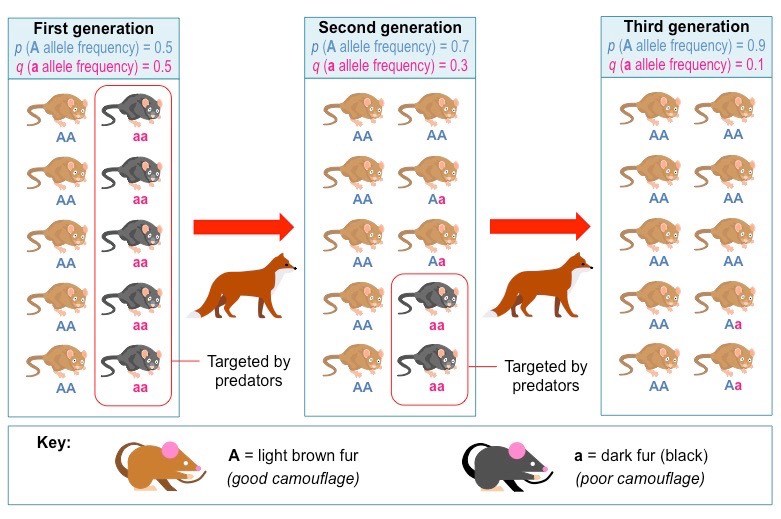
The allele frequencies of the mouse population in the picture are changing over time. Which is true?
The population is evolving.
The population is not evolving.
The population will go extinct.
The population's genetic variation is increasing.
This is the combinations of all of the genes present in a given population.
genome
allele frequency
microevolution
gene pool
Then a tiger and a lion mate, they create a liger. The tiger and lion are not the same species because:
The liger is not able to adapt to its environment
The liger does not live long after it is born
The liger is not a real animal
The liger is not able to reproduce
Convergent evolution is when
Species share traits due to a common ancestor
Species have similar traits because of similar environment
Species have same traits due to different environments
The Tasmanian devil is a marsupial that resembles the North America wolf, which is a mammal. These do not have a common ancestor but have taken on similar forms. WHat type of evolution does this show?
adaptive radiation
divergent evolution
founder effect
convergent evolution
What is an adaptation?
A temporary change in an organism's behavior
A genetic trait that improves an organism's ability to survive and reproduce
The process by which a species splits into two or more species
A random change in the DNA of an organism
How does antibiotic resistance in bacteria demonstrate natural selection?
Bacteria develop resistance by choosing to mutate their DNA.
Antibiotics cause mutations in bacterial DNA, leading to resistance.
Bacteria that are naturally resistant to antibiotics survive and reproduce, passing on the resistance genes.
All bacteria eventually become resistant to antibiotics through use.
Which of the following best explains why the fossil record is considered evidence for evolution?
It shows that Earth is less than 10,000 years old.
It demonstrates that species have remained unchanged over millions of years.
It provides sequential snapshots of how species have changed over time.
It proves that all living organisms originated from a single species.
Explain how the concept of punctuated equilibrium in evolutionary theory differs from gradualism.
Punctuated equilibrium suggests that species evolve rapidly in short bursts, followed by long periods of stasis, while gradualism proposes that evolution occurs at a constant, slow pace.
Punctuated equilibrium states that evolution does not occur, while gradualism supports the idea of continuous evolution.
Punctuated equilibrium is a theory that applies only to plants, while gradualism applies to all living organisms.
Punctuated equilibrium and gradualism are essentially the same theory but use different terminology.
How do homologous structures provide evidence for common ancestry among species?
By showing that unrelated species can develop similar structures through convergent evolution.
By demonstrating that species with similar environments develop identical structures.
By revealing that different species have structures with different appearances and functions but similar underlying anatomy.
By proving that all species have identical genetic material.

