wayground logo

Free Printable Worksheets

NEW

Font size

S
M
L
XL
Worksheets

Chemical Reactions Quiz Review

Total questions: 36

Worksheet time: 44mins

Name
Class
Date
1.
What does the Law of Conservation of Mass state?
a)
Matter cannot be gained or lost in a chemical reaction.
b)
Matter can only be lost in a chemical reaction.
c)
Matter can only be gained in a chemical reaction.
d)
Matter can be gained and lost in a chemical reaction. 
2.
What is the left part of a chemical equation called?
2H2 + O2 --> 2H2O
a)
Reactants
b)
Products 
c)
Yields 
d)
Chemical Equation 
3.
What is the right part of a chemical equation called...
2H2 + O2 --> 2H2O
a)
Reactants
b)
Products 
c)
Yields 
d)
Chemical Equation 
4.
How many atoms of carbon (C) are in C6H12O6?
a)
3
b)
6
c)
12
d)
24
5.
How many elements are in C6H12O6?
a)
1
b)
2
c)
3
d)
4
6.
How many Sodium (Na) are in 6NaCl?
a)
1
b)
12
c)
6
7.
How many Aluminum are in Al2O3?
a)
3
b)
2
c)
5
8.
How many Hydrogen are in 4H2O?
a)
6
b)
8
c)
2
d)
4
9.
Is the following equation balanced?...
Al + O2 --> 2Al2O3
a)
Yes!
b)
No!
10.
Which of the following reactions is balanced?
a)
2CH4 + O2 -> CO2 + H2O
b)
CH4 + 2O2 -> CO2 + H2O
c)
CH4 + 2O2 -> CO2 + 2H2O
d)
None of the chemical equations are balanced.
11.
Balance this equation...
HgO --> Hg + O2
a)
It is balanced 
b)
2HgO --> Hg + O2
c)
2HgO --> 2Hg + O2
d)
I don't know...Oh well!
12.
How many HCl molecules do you need to balance this equation? 
Mg +  __HCl --->  MgCl2 + H2
a)
1
b)
2
c)
3
d)
4
13.
Balance this equation.
_CF+ _Br-- _CBr+ _F2
a)
2,1,2,1
b)
1,2,2,1
c)
1,2,1,2
d)
2,2,2,2
14.
Which is the name of the kind of solid substance formed in this figure?  
a)
aqueous 
b)
precipitate
c)
acid
d)
synthesis 
15.
Describes the number of molecules in a compound and is used to balance a chemical reaction. 
a)
coefficient 
b)
subscript
c)
superscript
d)
SI unit
16.
Describes the number of atoms in a compound of each element. 
a)
coefficient 
b)
superscript 
c)
subscript 
d)
SI unit 
17.
In an endothermic reaction, heat is ...
a)
taken in or absorbed
b)
given out or released 
18.
Exothermic reactions...
a)
Absorb energy
b)
Release energy
c)
Release Color
d)
Absorb Color
19.
Which of the following shows the correct way to balance the chemical equation?
Fe + O2 -> Fe2O3
a)
4Fe + 3O2 -> 2Fe2O3
b)
2 Fe + 3O2 -> Fe2O6
c)
4 Fe + O6 -> 2Fe2O3
d)
None of the options are correctly balanced.
20.
What happens in ALL chemical changes?
a)
Change in state of matter
b)
A new substance is formed
c)
Bubbles are produced
d)
An explosion
21.
Is the following equation balanced or unbalanced?
Fe + S --> FeS
a)
balanced
b)
unbalanced
22.

In reactions, products must be equal to..

a)

Products

b)

Reactants

c)

Starters

d)

Enders

23.
Which of the following describes a precipitate?
a)
a liquid forms when a block of metal is heated
b)
a solid forms when one liquid is poured into another
c)
a gas forms when a solid is placed in a liquid
d)
bubbles form when an acid is poured on a rock
24.
an atom or molecule which has gained or lost one or more of its valence electrons
a)
Covalent Bond
b)
Chemical Formula
c)
Ion
d)
Compound
25.
a substance formed when two or more elements are chemically bonded together
a)
Element Soup
b)
Pure Element
c)
Ion
d)
Compound
26.
a chemical reaction that releases energy by light or heat
a)
Endothermic Reaction
b)
Exothermic Reaction
c)
Diffusion
d)
Fission
27.
Which of the following examples shows that a chemical reaction has occurred? 
a)
A rock breaks into smaller pieces when it is struck with a hammer.
b)
Rust forms on a hammer that has been left outside to long. 
c)
A cup of water turns pink when a few drops of red food coloring are added. 
d)
A solid is formed when heat is removed from a sample of water. 
28.
Hydrogen peroxide breaks down to form water and oxygen gas. Which observation is evidence that a chemical reaction has occurred?
a)
The mass of the solution remains the same.
b)
 Phase changes are observed.
c)
 The color of the solution remains clear.
d)
The temperature of the solution increases. 
29.
If reaction starts with 20g of reactants it should produce 
a)
a total of 40g of products
b)
a total of 10g of products
c)
a total of 80 g of products
d)
a total of 20g of products
30.
One of the signs of a chemical reaction taking place is:
a)
Bubbles are produced 
b)
Reactants are not combining
c)
Products are not forming
d)
Color is not changing
31.
Which is NOT an indication of a chemical change?
a)
temperature change
b)
formation of a precipitate
c)
shape change
d)
production of light
32.
You know you a chemical reaction has occurred if 
a)
there is a precipitate.
b)
there is a color change.
c)
there is a temperature change.
d)
All of these answers are evidence.
33.

What does a catalyst do to a chemical reaction?

a)

speeds up the reaction by orienting the molecules correctly so they can interact.

b)

reducing the space to increase the chance of collisions

c)

it adds more particles to the chemical reaction.

34.

Increase in temperature causes the particles to

a)

slow down

b)

move faster

c)

stay apart from each other

d)

move in the correct order

35.

Why does a higher concentration increase the rate of reaction?

a)

it increases the amount of reactants

b)

it lowers the activation energy

c)

it increases the energy of reactant particles

d)

it increases the frequency of collision
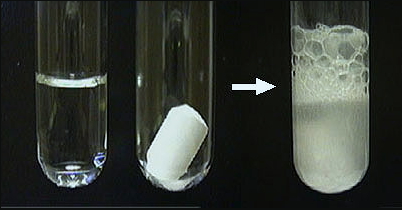
36.

How could we make this reaction happen more quickly?

a)

Decrease the concentration of the acid

b)

crush the chalk to increase the surface area

c)

Put the test tube in an ice bath