Wayground logo

Free Printable Worksheets

Font size

S
M
L
XL
Worksheets

Chapter 12: Work and Energy (PS)

Total questions: 50

Worksheet time: 50mins

Name
Class
Date
1.
Which one is a unit of mass?
a)
meter (m)
b)
gram (g)
c)
Joule (J)
d)
Newton (N)
2.
Which one is a unit of distance?
a)
meter (m)
b)
gram (g)
c)
liter (L)
d)
Joule (J)
3.
Force is a _____ or _______
a)
simple    complex
b)
push     pull
c)
up      down
d)
in      out
4.
 Work done = Force x _________
a)
a. distance
b)
b. acceleration
c)
c. velocity
d)
d. speed
5.
The unit used to measure work is the 
a)
Watt
b)
Newton
c)
Joule
d)
meter
6.
Which situation is work not done?
a)
lifting a 20 pound box off the floor
b)
holding a 20 pound box above the floor
c)
sliding a 20 pound box across the floor
d)
sliding a 20 pound box up an inclined plane
7.
What is work?
a)
A push or pull.
b)
When the object moves in the same direction in which the force is exerted.
c)
A change in energy.
d)
The rate at which energy is transferred.
8.
Which is doing work?
a)
pushing a wall
b)
holding a box
c)
picking up a pencil
d)
sitting in a chair
9.
You do work only when you exert a force on an object and move it.
a)
True
b)
False
10.
If you push a cart with a force of 60 N for 2 m, how much work have you done?
a)
120 J
b)
30 J
c)
120 N 
d)
30 N
11.
Both work and energy are measured in 
a)
joules
b)
newtons
c)
meters
d)
seconds
12.
A girl pushes a box across the floor. Did she do work?
a)
No.
b)
Yes.
13.
Fred kicks a ball with a force of 20N to George, who is 5M away. How much work was done to the ball?
a)
25J
b)
100J
c)
4J
d)
75J
14.
Gravitational potential energy depends on the ________ and ________ of the object. 
a)
Height and mass
b)
Friction and movement
c)
Mass and Movement
d)
Height and Friction 
15.
When you stretch a rubber band, you are storing __________ energy. 
a)
kinetic 
b)
potential
c)
none of the above
d)
all of the above 
16.
Energy due to motion is ____________ energy. 
a)
Potential 
b)
Energy
c)
Kinetic
d)
Friction
17.
The faster an object moves, the ________ kinetic energy it has. 
a)
more
b)
less
c)
none of the above
d)
all of the above 
18.
Energy can not be created or destroyed, only converted from one form to another.
a)
true
b)
false
19.
At which point is kinetic energy greatest? 
a)
W
b)
X
c)
Y
d)
Z
20.
Which of these is a measurement of power?
a)
100 joules
b)
100 watts
c)
100 meters per second
d)
100 hertz
21.
What is the equation for calculating power?
a)
distance / time
b)
work x time
c)
work / time
d)
force x distance
22.

What is needed calculate power?

a)

work

b)

time

c)

mass

d)

distance

23.

Two workers use 100 N of force to move a sofa 2 meters in 2 seconds. How much power is required?

a)

100 watts

b)

400 watts

c)

104 watts

d)

50 watts

24.
If 68 W of power is produced in 18 seconds, how much work is done?
a)
1,224 J
b)
0.264 J
c)
3.77 J
d)
12.24 J
25.
How much time is needed to produce 720 Joules of work if 90 watts of power is used? 
a)
0.125 s
b)
8 s
c)
64800 s
d)
80 s
26.

Kinetic and potential energy are the two types of energy that relate to:

a)

Change

b)

Friction

c)

Density

d)

Motion

27.

Which of these has the most potential energy?

a)
b)
c)
d)
28.

What is potential energy?

a)

The stored energy of an object due to its position or condition.

b)

The energy that an object has due to its motion.

c)

The energy an object has due to its speed.

d)

The energy an object has due to its volume.

29.

What is kinetic energy?

a)

The stored energy of an object due to its position or condition.

b)

The energy that an object has due to its motion.

c)

The energy an object has due to its speed.

d)

The energy an object has due to its volume.

30.

Which of the following has the most kinetic energy?

a)

A car traveling at 80 mph

b)

A tractor-trailer traveling at 80 mph

c)

A cheetah running at 80 mph

d)

a motorcycle traveling at 80 mph

31.

When does an object have no kinetic energy?

a)

When it is at rest

b)

When it is moving very slowly

c)

When the only force acting on it is gravity

d)

When it has no electrical charge

32.

When is potential energy transformed into kinetic energy?

a)

When an object at rest is lifted to a higher elevation.

b)

When an object at rest remains at rest.

c)

When an object at rest is put into motion.

d)

When an object in motion is stopped and put at rest.

33.

An object that is at rest on top of a bookshelf has

a)

chemical energy

b)

chemical energy

c)

potential energy

d)

kinetic energy

e)

elastic energy

34.

If you are rolling down a big hill you are (a)   the kinetic energy.

35.

If you are rolling down a big hill you are (a)   the potential energy.

36.

Which letter shows the ball when it has THE MOST potential energy?

a)

A

b)

B

c)

C

d)

F

e)

G

37.

Which letter shows the ball when it has NO potential energy?

a)

B

b)

C

c)

D

d)

E

e)

F

38.

Which letter shows the ball when it has THE MOST kinetic energy?

a)

B

b)

C

c)

D

d)

E

e)

F

39.

Which letter shows the ball when it has THE LEAST kinetic energy?

a)

A

b)

B

c)

C

d)

F

e)

G

40.

Which letter shows the ball when it is moving the fastest?

a)

B

b)

C

c)

D

d)

E

e)

F

41.
Identify this simple machine
a)
Lever
b)
Wheel & Axle
c)
Inclined Plane
d)
Screw
42.
Which of the following does a simple machine do?
a)
allows the users to apply less force over a longer distance
b)
reduce the amount of force needed to do work
c)
change the direction of the applied force
d)
all of the above
43.
Which is an example of someone using a simple machine to do work?
a)
a boy runs across a football field
b)
a banker counts money
c)
a mother pushes a stroller up a ramp
d)
a girl eats a sandwich
44.
The device used to raise a flag up a flag pole is an example of a 
a)
wheel and axle 
b)
lever
c)
inclined plane 
d)
pulley 
45.
An inclined plane wrapped around a rod forms this simple machine 
a)
lever
b)
pulley
c)
screw
d)
wedge 
46.
A seesaw is an example of a  
a)
wedge
b)
lever 
c)
inclined plane 
d)
pulley 
47.
Stairs
a)
wedge
b)
pulley
c)
inclined plane
d)
wheel and axle
48.
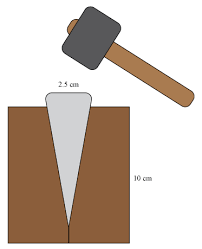
This device
a)
wedge
b)
lever
c)
incline plane
d)
wheel and axle
49.
The fixed point on the lever is called 
a)
load
b)
resistance
c)
bar
d)
fulcrum
50.
A motor will make electrical energy change into 
a)
motion energy
b)
chemical energy
c)
mechanical energy
d)
nothing