
Font size
 Worksheets
Cellular Respiration Review
Total questions: 30
Worksheet time: 15mins
Which is a product of glycolysis?
2 molecules of pyruvic acid
1 molecule of glucose
NAD+
oxygen
Where does the pyruvic acid produced by glycolysis go next?
the Calvin Cycle
the electron transport chain
the Krebs Cycle
the link reaction
Glycolysis has a net gain of how many ATP molecules?
2
4
6
How many ATP molecules are required to start glycolysis?
Four
Three
Two
One
Mitochondrial Matrix
InterMembrane Space of the Mitochondria
The waste product produced during the Krebs cycle is...
Oxygen
Water
Carbon Dioxide
ATP
What is the final product of the oxidative phosphorylation (ETC & chemiosmosis) ?
ATP
NADH
FADH2
ADP
Which of the following gets pumped into the intermembrane space?
FADH2
O2
H+
NAD+
As electrons travel down the electron transport chain, they release
ADP
Energy
ATP
Hydrogen ion
The final electron acceptor in electron transport chain is
NAD+
FAD
Oxygen
Water
Where does oxidative phosphorylation take place?
Cytosol
Matrix of mitochondria
Innermembrane of mitochondria
Intermembrane space of mitochondria
What are the two parts of oxidative phosphorylation?
glycolysis
Krebs cycle
electron transport chain
chemiosmosis
ATP synthesis by ATP synthase is driven by
H+ movement
electron movement
NADH movement
FADH2 movement

Please indicate the correct equation(s) for Cellular Respiration. (2 answers)
Glucose + Oxygen --> Carbon Dioxide + Water + Energy
C6H12O6 + O2 --> CO2 + H2O + ATP
Carbon Dioxide + Water + Energy --> Glucose + Oxygen
C6H12O6 + 6 O2 --> 6 CO2 + 6 H2O + ATP
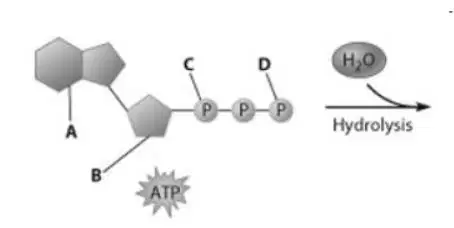
Which portion of the ATP molecule breaks off and releases energy?
A
B
C
D
______________ reactions take in energy; _______________ release energy.
Exergonic; energetic
Exergonic, endergonic
Endergonic; exergonic
endergonic; energetic
___________ is losing electrons; ____________ is gaining electrons.
Oxidation; reduction
Reduction; oxidation
Anions; cations
Oxidation; ionization
Which molecule is the starting substrate for the Krebs cycle?
Pyruvate
Acetyl-CoA
ATP
NADH
A decrease in the amount of oxygen available will....
not have an effect on the amount of energy produced during cellular respiration
decrease the amount of glucose produced during cellular respiration
cause the amount of water produced during cellular respiration to increase
decrease the amount of energy produced during cellular respiration
What is the correct order of processes in Aerobic Respiration?
Glycolysis, Chemiosmosis, Kreb's Cycle, Electron Transport Chain
Glycolysis, Chemiosmosis, Electron Transport Chain, Kreb's Cycle
Chemiosmosis, Electron Transport Chain, Kreb's Cycle, Glycolysis
Glycolysis, Kreb's Cycle, Electron Transport Chain, Chemiosmosis
How many times does the Kreb's Cycle "turn" per glucose?
1
2
3
6
How many times does the Kreb's Cycle "turn" per glucose?
1
2
3
6

