wayground logo

Free Printable Worksheets

Font size

S
M
L
XL
Worksheets

Harding-FDR Quizizz

Total questions: 147

Worksheet time: 2hrs 43mins

Name
Class
Date
1.

Which amendment resulted in speakeasies being established?

a)

Twenty-first

b)

Twentieth

c)

Nineteenth

d)

Eighteenth

2.

What was the cause of speakeasies and bootleggers?

a)

Prohibition

b)

Progressive Movement

c)

Suffrage

d)

Industrial Revolution

3.

The growth of organized crime during the 1920s is most closely related to the --

a)

laws against making alcohol

b)

increase in unemployed workers

c)

collapse of the stock market

d)

rise of labor unions

4.

Which of the following was a result of Prohibition in the 1920s?

a)

Fall of the stock market

b)

More jobs on farms

c)

Less unemployment in cities

d)

Growth of organized crime

5.

The ratification of the 21st Amendment marked the end of --

a)

women's suffrage

b)

segregated society

c)

Progressive Movement

d)

Prohibition Era

6.

What were the illegal secret bars of the Prohibition Era called?

a)

Bootleggers

b)

Saloons

c)

Speakeasies

d)

Pubs

7.

Louis Armstrong, Aaron Copland, George Gershwin, Bessie Smith were all . . .

a)

painters

b)

poets

c)

musicians

d)

writers

8.

In which city did the Harlem Renaissance orginate

a)

Philadelphia

b)

Chicago

c)

New York

d)

New Orleans

9.

Who is known for writing about the Jazz Age of the 1920s?

a)

Langston Hughes

b)

George Gershwin

c)

F. Scott Fitzgerald

d)

John Steinbeck

10.

The period of rebirth of African American art forms is known as the --

a)

Black Eagles

b)

Harlem Revival

c)

Great Migration

d)

Harlem Renaissance

11.

How did Prohibition contribute to the growth of organized crime?

a)

by making it easier for bootleggers to branch into other types of illegal activity

b)

by forcing police to enforce anti liquor laws

c)

by forcing farmers to grow grain for the production of alcohol

d)

by strengthening respect for the law

12.

Presidents Harding and Coolidge favored policies that

a)

supported the growth of business

b)

encouraged activism

c)

brought about social reform

d)

discouraged laissez faire

13.

At its heart, the Scopes Trial was a clash between

a)

religion and science

b)

biology and science

c)

evolution and science

d)

education and science

14.

How was Henry Ford able to reduce the sale price of the Model T?

a)

with the use of the assembly line

b)

changing locations

c)

importing all raw materials

d)

increasing the wages of his workers

15.

Which of these limited immigration during the 1920s?

a)

National Origins Act

b)

KKK

c)

Scientific Management

d)

The Great Migration

16.

The demand for automobiles in the 1920s

a)

stimulated growth in many other industries

b)

led to a nationwide recession

c)

closed down the steel industry

d)

brought about the collapse of the suburbs

17.

The literature of the Harlem Renaissance

a)

explored the pains and joys of being black in America

b)

explored the origins of jazz

c)

was written by Marcus Garvey

d)

argued for the separation of races

18.

Involved transferring oil reserves from the Interior Department to private companies for profit

a)

Teapot Dome Scandal

b)

Scopes Trial

c)

Great Migration

d)

Jazz Age

19.

Which of these best describes the "New Woman" of the 1920s?

a)

They wore shorter skirts, bobbed their hair, and went to speakeasies

b)

They stayed home and cooked and cleaned

c)

They rejected the idea of suffrage

d)

They preferred the same fashions as their parents

20.

Which 1920s president is best known for scandals and corruption?

a)

Harding

b)

Coolidge

c)

Hoover

d)

Trump

21.

Change in the constitution which prohibited the making, selling and transportation of alcohol.

a)

18th Amend.

b)

19th Amend.

c)

21st Amend.

d)

1st Amend.

22.

Change in the constitution which gave women the right to vote.

a)

19th Amend

b)

18th Amed

c)

21st Amend

d)

1st Amed

23.

Italians convicted of murder mainly because they were foreigners.

a)

Sacco & Vanzetti

b)

Scopes & Darrow

c)

Bryan & Darrow

d)

Mario & Luigi

24.

Period in the 1920s when suspected communists and other radicals were arrested due to the fear of the spread of communism.

a)

Red Scare

b)

Teapot Dome Scandal

c)

Scopes Trial

d)

KKK

25.

Disillusioned poets and novelists who wrestled with the meaning of war and life.

a)

Lost Generation

b)

Harlem Renaissance

c)

flappers

d)

The Great Gatsby

26.

What type of economy did the US have in the 1920s?

a)

laissez faire capitalism

b)

socialsim

c)

communism

d)

command economy

27.

The title given to the mass movement of African-Americans in the South to large northern cities.

a)

Harlem Renaissance

b)

The Great Migration

c)

The Great Depression

d)

The Stock Market Crash

28.

Select two (2) famous pilots who became very popular during the 1920's.

a)

Amelia Earhart

b)

Babe Ruth

c)

Louis Armstrong

d)

Charles Lindbergh

29.
What is jazz?
a)
A popular form of music that began among African American musicians in the 1920s.
b)
A popular form of music that began among African American musicians in the 1930s
c)
A popular form of music that began among African American musicians in the 1940s
d)
A popular form of music that began among African American musicians in the 1950s
30.
What were the Charleston, Lindy Hop, and the Jitterbug?
a)
Popular people during the 1920s
b)
Popular places during the 1920s
c)
Popular dances during the 1920s
d)
Popular foods during the 1920s
31.
Where did many African American artists move to during the 1920s?
a)
Harlem, New York
b)
Atlanta, Georgia
c)
Detroit, Michigan 
32.
Which African American writer wrote poems, books, and plays about the lives of African Americans?
a)
Bessie Smith
b)
Louis Armstrong
c)
Langston Hughes
33.
Which painter created several series, or groups, of paintings that showed African American life and history?
a)
Langston Hughes
b)
Jacob Lawrence
c)
Zora Neale Hurston
34.
Who was one of the most famous baseball players during the 1920s?
a)
Babe Ruth
b)
Gertrude Ederle
c)
Amelia Earhart
35.
Who became the first person to fly alone across the Atlantic Ocean in 1927?
a)
Babe Ruth
b)
Charles Lindbergh
c)
Amelia Earhart
36.
Who became the first woman to fly across the Atlantic Ocean in 1928?
a)
Amelia Earhart
b)
Charles Lindbergh
37.

During the Great Depression, some people lived together in communities made of boxes and tents called ______.

a)

Pigsties

b)

Roosevelt Villages

c)

Harlem Condos

d)

Hoovervilles

38.
What year did the stock market crash? 
a)
1929
b)
1933
c)
1938
d)
1925
39.
Which states were affected by the dust bowl. 
a)
Oklahoma 
b)
Texas 
c)
Kansas
d)
All of the above 
40.
What was the nickname given to Oklahomans that moved west during the 1930s.
a)
Old Folks 
b)
Okies 
c)
Pandas 
d)
Fools 
41.
What state did many Oklahomans move too during the dust bowl? 
a)
Texas 
b)
Colorado 
c)
California 
d)
New York 
42.
What was the name given to the dust storms? 
a)
Snow Storms 
b)
Black Blizzards 
c)
White Blizzards 
d)
Dust Clouds 
43.
President during the 1930s who was considered a failure because he couldn't fix the Great Depression.
a)
Franklin D. Roosevelt
b)
Herbert Hoover
c)
Margaret Mitchell
d)
Jessie Owens
44.
Famous African American athlete who won four gold medals at the 1936 Olympics in Berlin
a)
Louis Armstrong
b)
Langston Hughes
c)
Jesse Owens
d)
Duke Ellington
45.
The president who promised the people a "New Deal" during the Great Depression.
a)
Jesse Owens
b)
Herbert Hoover
c)
Franklin D. Roosevelt
d)
George Washington
46.
Why was the success of African American athletes at the 1936 Olympics in Berlin, Germany, such an embarrassment to Adolf Hitler?
a)
Hitler believed the German race of people was better than Africans, Jews, and other races who were successful at the games.
b)
Hitler was not embarrassed because African Americans were not allowed to complete in the Olympics.  
c)
Hitler was embarrassed because he  lost several races that he promised he could win.
d)
Hitler didn't have anything to do with the 1936 Olympics. 
47.
Which technological advance in the 1920s and 1930s caused over farming and the destruction of many farms when a drought hit?
a)
tractors
b)
contour farming
c)
plow
d)
windbreaks
48.

Consumer who borrowed money to buy more stocks were buying on

a)

a whim

b)

guarantees

c)

their feet

d)

margin

49.

In his first inaugural address, FDR famously said "We have nothing to fear but ..."

a)

fear, itself.

b)

death and taxes.

c)

Mr. Hanlon.

d)

Adolph Hitler.

50.

The New Deal promised

a)

Rest and relaxation

b)

Relief, reform and recovery

c)

A chicken in every pot

d)

peace, justice and the American way.

51.
Explain the Stock Market Crash.
a)
People purchased stocks with credit, got scared and sold their stocks. There was no money to pay people their money
b)
People purchased stock
c)
People threw their money away
52.
Define Black Tuesday
a)
Group of government programs created to try and end the Great Depression.
b)
October 29, 1929 when the stock market crashed. It was the official start of the Great Depression
c)
Minimal improvement in economy. FDR urged congress to pass additional programs.
53.
What caused millions to lose their family wealth during The Depression?
a)
Bank closures
b)
Foreclosures on their farms and homes
c)
Stockmarket
d)
All of the above
54.
Which of the following European country faced the greatest economic challenges after WW I? 
a)
Austria
b)
Great Britian
c)
France
d)
Germany
55.
Month and Day that Stock Market Crashed
a)
October 28, 1929
b)
October 29, 1928
c)
October 29, 1929
d)
October 29, 1939
56.
The Great Depression began in
a)
1925
b)
1929
c)
1932
d)
1940
57.
What effect did the Dust Bowl storms have on the Great Depression?
a)
Many farmers were forced to leave the Great Plains.
b)
Unemployment decreased gradually.
c)
Many homes long the Mississippi River were flooded.
d)
Hoover was re-elected as president.
58.
After the Stock Market Crash, many people lost their life savings because _______________.
a)
banks closed
b)
banks gave away their money
c)
they couldn't remember where they put it
d)
someone stole it
59.
Which economic factor contributed most directly to the start of the Great Depression?
a)
low worker productivity
b)
high income taxes
c)
decreasing tariff rates
d)
buying stocks on margin
60.
What natural disaster of the 1930s added insult to injury?
a)
Flooding along the Mississippi River
b)
The Dust Bowl
c)
Tornadoes called the Helen Hunt Twisters
d)
Hurricanes along the Gulf Coast
61.
What tool - passed during the Hoover Administration -  designed to protect American manufacturers actually ended up creating a worldwide depression?
a)
Reconstruction Finance Committee
b)
Hawley-Smoot Tariff
c)
New Deal
d)
Second New Deal
62.
What is another name for the Stock Market Crash?
a)
Black Friday
b)
Taco Tuesday
c)
Black Tuesday
d)
Throwback Thursday
63.

Veterans of this conflict were owed bonus pay for their service.

a)

World War I

b)

World War II

c)

Gulf War

d)

Civil War

64.

What was President Herbert Hoover's response to the Great Depression?

a)

He believed "rugged individualism" would solve the economy

b)

He created mass welfare

c)

He increased infrastructure to create jobs

d)

He violated his policy of laissez-faire

65.

Money loaned to banks, insurance companies & businesses to jumpstart the economy by Hoover

a)

Reconstruction Finance Corporation (RFC)

b)

Civilian Conservation Corps (CCC)

c)

Works Progress Administration (WPA)

d)

Securities & Exchange Commission (SEC)

66.
Farmers contributed to the problems that led to the Dust Bowl by
a)
putting down new layers of topsoil.
b)
moving off of the plains to find new farmland.
c)
damming western rivers and using irrigation techniques.
d)
using intensive farming practices that removed protective grasses.
67.

Choose the picture that best fits with the Dust Bowl

a)
b)
c)
d)
68.

Choose the picture that best fits with bank issues in the Depression

a)
b)
c)
d)
69.

Income inequality is _______________________

a)

When most people have equal amounts of money

b)

When you bring in lots of income

c)

When you bring in a little amount of income

d)

When much of the wealth is owned by the richest few

70.

In 1930 lawmakers passed the _____________________ that put taxes on imports.

a)

Boot- Crawley Tariff

b)

New Deal

c)

Banking Act

d)

Smoot-Hawley tariff

71.
A time when business activity is very slow and people are out of work is known as a _____________.
a)
crash
b)
depression
c)
party
d)
low time
72.
This program hired young men ages 18-26 who were unemployed and paid them to work mostly on outdoor projects such as national parks and planting trees (helped to prevent erosion which was prevalent because of over farming).
a)
CCC
b)
TVA
c)
WPA
73.
This program provided jobs for millions of Americans, who were given the task of building roads, bridges, parks, airports and a plethora of other public facilities.
a)
CCC
b)
WPA
c)
TVA
74.
One difference between the administrations of President Roosevelt and President Hoover was that Roosevelt was-
a)
more willing to use government intervention to solve economic problems
b)
unwilling to allow government agencies to establish jobs
c)
able to ignore economic issues for most of his first term in office
d)
opposed to any type of government regulation of financial institutions
75.
What problem were both the Civilian Conservation Corps and the Works Progress Administration developed to address?
a)
Excessive stock market speculation
b)
High unemployment
c)
Increased use of credit
d)
Overproduction of goods
76.
During the New Deal, how did the government attempt to improve conditions for farmers?
a)
By ending the practice of sharecropping
b)
By encouraging farmers to grow more to increase profits
c)
By paying farmers to grow fewer crops
d)
By training farmers for jobs in a new field
77.
What was a major result of FDR’s New Deal programs?
a)
The national deficit declined for most U.S. citizens
b)
The suffrage rights for women changed
c)
The power of the federal government was expanded
d)
The federal government lowered taxes for most Americans
78.
What institution opposed parts of the New Deal because it believed it gave the federal government an unconstitutional amount of power over the states and economy?
a)
Congress
b)
Supreme Court
c)
Stock Market
d)
Executive Branch
79.
The largest New Deal program which worked on public projects such as roads, bridges, public buildings, etc.
a)
Works Progress Administration
b)
World Peace Association
c)
Working Period Administration
d)
Tennessee Valley Authority
80.
Which program built roads, schools, buildings, libraries, etc?
a)
Social Security
b)
FDIC
c)
CCC
d)
WPA
81.
Which program insures banks and keeps your money safe?
a)
Social Security
b)
TVA
c)
CCC
d)
FDIC
82.
Which program builds wildlife perserves and plants trees?
a)
CCC
b)
TVA
c)
WPA
d)
FDIC
83.
Which program sets up a tax to help benefit retired people?
a)
FDIC
b)
Social Security
c)
TVA
d)
WPA
84.
Which New Deal program was chiefly designed to correct abuses in the stock market?
a)
Civilian Conservation Corps
b)
Federal Deposit Insurance Corporation
c)
Securities and Exchange Commission
d)
National Recovery Administration
85.
When President Roosevelt talked to the American people directly over the radio, they called it ____ ____.
a)
Fireside Chats
b)
the President talking
c)
Chats with me
d)
Campfire chats
86.
Which was a guiding principle of New Deal economic policies?
a)
“Rugged individualism” will end social inequality
b)
Government must assume greater responsibility for helping the unfortunate
c)
Antitrust legislation could destroy the free enterprise system
d)
State governments should have more power over the economy than the national government
87.
What was FDR’s plan to add justices to the Supreme Court called?
a)
The Yes Man Trials
b)
Court Packing Scheme
c)
Operation Puppet
d)
Court Repatriation
88.
Franklin Roosevelt's "court-packing plan" was a serious mistake because-
a)
Many Americans opposed the idea of forced retirement
b)
The angry judges reacted by striking down much of the New Deal legislation
c)
It appeared to interfere with the Constitution's separation of powers
89.
What was the Mexican Repatriation Act?
a)
Mexicans were encouraged to enter the country
b)
To send Mexican Americans back to Mexico
c)
Given many high paying jobs
d)
Given a quick process to citizenship 
90.
Why did Franklin Roosevelt close banks when he became president?
a)
to prevent "runs" on the banks
b)
to consolidate the assets fo several banks
c)
to reduce the number of banks in operation
d)
to allow the banks to receive money from the federal government
91.
Which New Deal law restricted crop production to reduce crop surplus and was ruled unconstitutional by the Supreme Court?
a)
The Agricultural Adjustment Act
b)
The Glass-Steagall Act
c)
The Pure Food and Drug Act
d)
The Truth-in-Labelling Act
92.
Who was elected president of the US on 1932?
a)
George Washington
b)
Herbert Hoover
c)
Franklin D. Roosevelt
d)
Barack Obama
93.

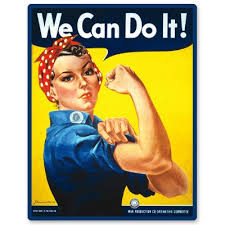
Who is this a image of and what did she a symbol of .....

a)

June the Fighter symbol of women's suffrage

b)

Susan the solider symbol of women working on airplanes

c)

Rosie the Riveter symbol of women working in factories during the war.

94.

What did the U.S get in return for sending destroyers of Britain?

a)

cash money $$

b)

U.S bases on British held-territory

c)

an I.O U to pay after the war

d)

soldiers to work in U.S factories

95.

When Roosevelt signed the Lend-lease Act, he said that the U.S must become the "arsenal of democracy in order to ?

a)

end the Great Depression

b)

help the Axis powers

c)

help Britain

d)

stay out of the war

96.

What battle is the pacific theater was vital to gain in order the bomb Japan

a)

Okinawa

b)

Iwo Jima

c)

Normandy

d)

Midway

97.

The American program to build an atomic bomb was known as the

a)

Manhattan Project

b)

Operation overlord

c)

New York Project

d)

Operation A-bomb

98.

A key to the American success at Midway was.....

a)

the use of new sonar and radar technology.

b)

the use of long-range B-25 bombers launched from aircraft carriers

c)

breaking the Japanese Navy’s secret code.

d)

American submarines.

99.

The strategy of capturing some islands and going around others. That United States used in order to invade Japan.

a)

Double V

b)

Naplam

c)

Lend-Lease

d)

Island hopping

100.

What is another name for the Invasion of Normandy?

a)

Battle of France

b)

Battle of the Bulge

c)

D-Day

d)

V-E Day

101.

What was President Roosevelt referring to in this speech?

a)

The victory at Normandy and liberation of France.

b)

the Japanese bombing of Pearl Harbor.

c)

The Battle of Britain.

102.

What are reparations?

a)

When a country sends workers to repair damage from the war.

b)

When a defeated country pays for war damage.

c)

The amount of money it will take to repair a country after war.

d)

When you "repair" something physical.

103.

Which country rejected the Treaty of Versailles?

a)

France

b)

Great Britain

c)

USA

d)

Japan

104.
Why was Germany's economy struggling after WWI?
a)
The Treaty of Versailles punished Germany for WWI
b)
Other countries were using imperialism to take over the economies of other governments, including Germany's
c)
Hitler was keeping his own people in a state of poverty in order to control them
d)
America was punishing Germany for playing such a major role in WWI
105.
After WWI, the ____________________________ of the 1930s brought chaos and unemployment to Europe, which led to the rise of authoritarian dictators.
a)
Imperialism
b)
Treaty of Versailles 
c)
Great Depression
d)
Invasion of Nanking 
106.
In 1939, France and Great Britain declared war on Germany as a direct result of the German...
a)
invasion of Poland
b)
seizure of the Sudetenland
c)
occupation of the Rhineland
d)
annexation of Austria
107.
Which of the following events during WWII brought the United States into the war?
a)
Germany's invasion of Poland
b)
D-Day invasion of Normandy
c)
Nazi Germany's treatment of the Jewish people
d)
Japan's bombing of Pearl Harbor
108.
Allied Powers during WWII included:
a)
Great Britain, France, the Soviet Union, and the United States
b)
Great Britain, Japan, the Soviet Union, and the United States
c)
Germany, France, the Soviet Union, and the United States
d)
Germany, Japan, Italy, and the United States
109.
Axis Powers during WWII included:
a)
Great Britain, Germany, and the Soviet Union
b)
Germany, Italy, and Japan
c)
Great Britain, France, and Japan
d)
Germany, Japan, and the Soviet Union
110.
America did not want to get involved in other country's conflicts. This was known as __________________________
a)
Imperialism
b)
Axis
c)
Isolationism
d)
Dictatorship
111.

Describe the causes of WWII:

a)

Treaty of Versailles, economic depression & totalitarian dictators

b)

WWI Peace Treaty Problems, New Military Technology

c)

Rise of dictators, Poor U.S. President

d)

Russia attacked Germany & took over Italy

112.
What did allied forces do on D-Day, June 6, 1944?
a)
They sent thousands of troops to Berlin.
b)
They stormed the beaches of Normandy, France.
c)
The fought the Nazi troops in Russia.
d)
They took control of many Japanese islands.
113.
The United States essentially ended World War II by:
a)
bombing Tokyo
b)
launching the D-Day invasion
c)
capturing Hitler
d)
dropping atomic bombs on Japanese cities
114.
Communication aimed at convincing others of a particular idea or position
a)
Propaganda
b)
Bias
c)
slogan
d)
Name-calling
115.

Who transmitted code messages for the allies during WWII?

a)

women

b)

Navajo

c)

African Americans

116.

The Munich Pact incorporated this policy

a)

Isolationism

b)

Neurality

c)

Appeasement

117.

This document laid the foundation for the United Nations

a)

Atlantic Charter

b)

Cash and carry

c)

Lend-Lease Act

118.

What is Genocide?

a)

prejudice, racism, hatred against Jews

b)

systematic attempt to eliminate an entire race

c)

organized attack on Jewish homes and businesses

119.

What stated that the US would not sell war materials or give loans to nations at war?

a)

Neutrality Acts

b)

Lend-Lease Act

c)

Atlantic Charter

120.

This was a major reason for dropping the atomic bomb on Japan

a)

promote US Isolationism

b)

destroy Japan's industrial centers and save American lives

c)

Scare Hitler

121.

What was the purpose of rationing?

a)

increase supply of natural resources

b)

cause a shortage of crops

c)

provide supplies to the troops

122.

The day that Japan officially surrendered is called?

a)

Victory Day

b)

V-E Day

c)

D Day

d)

V-J Day

123.
The Nazi program of exterminating Jews under Hitler
a)
Holocaust
b)
Fascism
c)
Rationing
d)
Nazism
124.
Japanese and Japanese Americans from the West Coast of the USA during WWII who were sent to camps called "War Relocation Centers" in remote portions of the nation's interior
a)
Cornelia Fort
b)
Japanese Internment
c)
Allied Powers
d)
Axis Powers
125.
A political system based on extreme national loyalty where the government controls the economy, culture, and all parts of people's lives. Usually the government is controlled by a dictator.
a)
Nazism
b)
Fascism
c)
Rationing
d)
Holocaust
126.

Who was the leader of Great Britain during WW II?

a)

Chruchhill

b)

Hitler

c)

Stalin

d)

Roosevelt

127.

At first, European leaders gave into Hitler's demands using what type of policy?

a)

aggression

b)

advancement

c)

internment

d)

appeasement

128.

Who was the dictator of the Soviet Union during WWII?

a)

Adolf Hitler

b)

Winston Churchill

c)

Josef Stalin

d)

Franklin Roosevelt

129.

What event led to the start of WWII?

a)

Germany invaded Poland

b)

Germany invaded Austria

c)

Germany formed an alliance with Italy

d)

Germany formed an alliance with Japan

130.
Who was the dictator of Germany that rose to power with the Nazi Party?
a)
Joseph Stalin
b)
Winston Churchill
c)
Adolf Hitler
d)
Franklin D. Roosevelt
131.
Victory in Europe (V-E Day) was a result of ________________.
a)
Japan surrendering
b)
The atomic bombings
c)
Germany surrendering
d)
the signing of the Treaty of Versailles
132.
Which WWII leader became President after FDR passed, wanted  to save American lives in the Pacific, and decided to drop the  atomic bombs?
a)
Franklin D. Roosevelt
b)
Winston Churchill
c)
Harry S. Truman
d)
Joseph Stalin
133.
What role did women  take during WWII?
a)
house wives that took care of the house and  children
b)
drove tanks and fought in the war
c)
created black out curtains for everyone 
d)
filled many traditionally male jobs
134.

Which plan aided European countries after World War II?

a)

Marshall Plan

b)

Freedom Plan

c)

Truman Plan

d)

European Plan

135.

Which two cities were attacked with atomic bombs by the United States?

a)

Nagasaki & Hiroshima

b)

Tokyo & Kyoto

c)

Tokyo & Yokohama

d)

Osaka & Kyoto

136.

Who is this a image of and what did she a symbol of .....

a)

June the Fighter symbol of women's suffrage

b)

Susan the solider symbol of women working on airplanes

c)

Rosie the Riveter symbol of women working in factories during the war.

137.

Germany's approach to defeat enemies early in World War II was called _________, which means "lightening war".

a)

Lebensraum

b)

Anschluss

c)

Kristallnacht

d)

Blitzkrieg

138.

Hitler justified his expansion of territory by saying that Germany needed more living space to help produce food to feed Germans. This policy is known as _______.

a)

Anschluss

b)

Kristallnacht

c)

Lebensraum

d)

Blitzkrieg

139.

Britain and France both gave into Hitler's request to occupy the Rhineland and Sudetenland in order to avoid an outbreak of war. This policy is known as _________.

a)

Appeasement

b)

Non-aggression

c)

Blitzkrieg

d)

Luftwaffe

140.

What years did WWII take place?

a)

1939-1945

b)

1914-1918

c)

1945-1991

d)

1929-1939

141.

What event led to the surrender of Japan in 1945 and ended WWII?

a)

Atomic bombing of Hiroshima & Nagasaki

b)

Hitler committed suicide

c)

Battle of Midway

d)

Battle of Normandy

142.

The creation of these for Japanese Americana violated their civil liberties.

a)

Concentration Camps

b)

Internment Camps

c)

Summer Camps

d)

Winter Camps

143.

What is the name of the African-American fighter pilots whose success helped convince Truman to desegregate the armed forces?

a)

NAACP

b)

WAC

c)

Flying Tigers

d)

Tuskegee Airmen

144.

What did the government encourage people to do to increase the food supply and reduce the demand for commercially grown food?

a)

War Bonds

b)

Ration Books

c)

Plant Victory Gardens

d)

Speculation

145.

What did the government introduce to ensure the fair distribution of goods when consumer goods are scarce during war?

a)

War Bonds

b)

Ration Books

c)

Victory Gardens

d)

War Powers Act

146.

Why did the Supreme Court rule Japanese internment camps constitutional even though they violated the 4th &14th amendments?

a)

Job competition

b)

They were racist

c)

Civil liberties can be limited during wartime.

d)

Nativism

147.

What did the government encourage people to buy to help finance the war?

a)

Speculation

b)

Ration Books

c)

Victory Gardens

d)

War Bonds